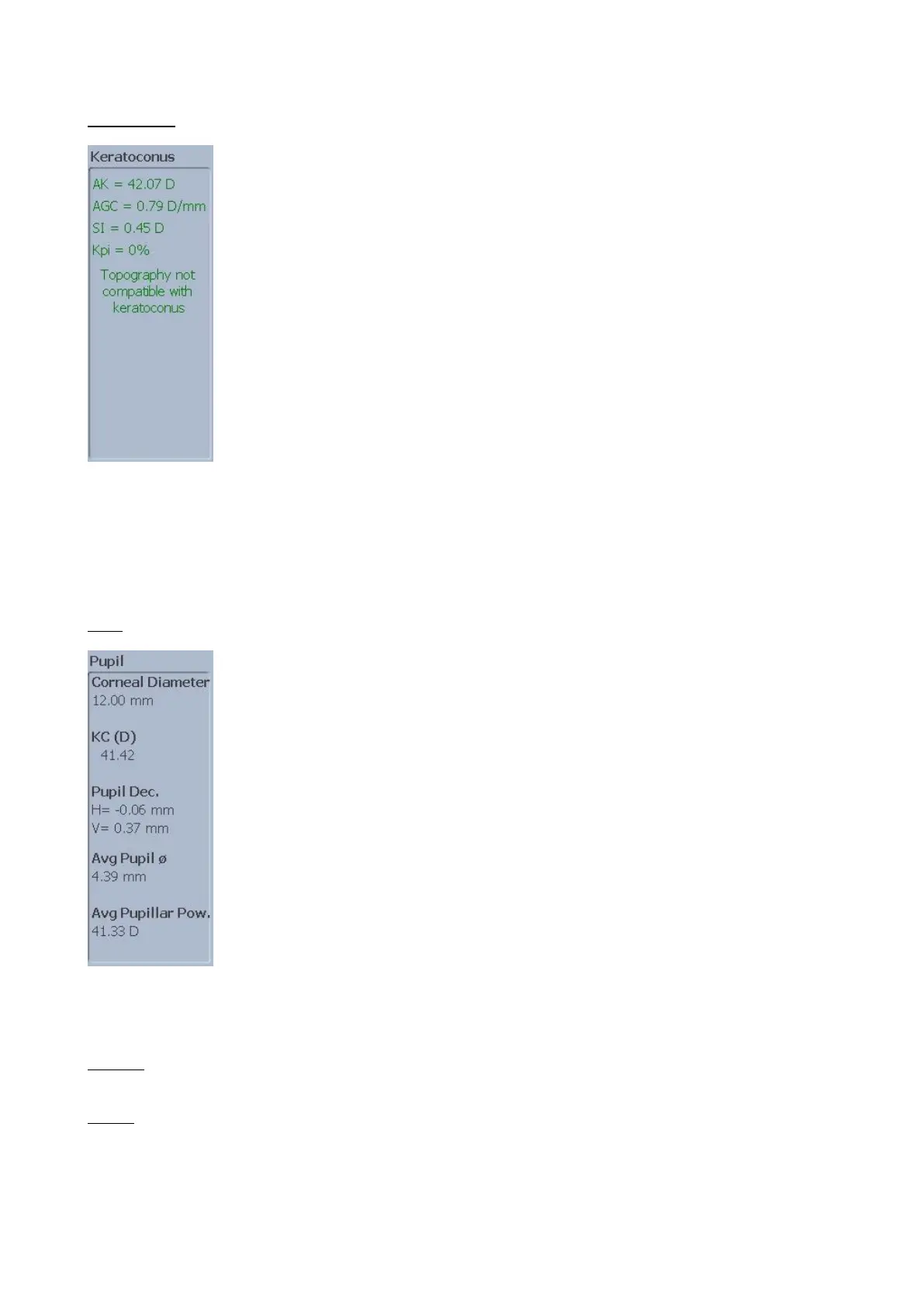
Tap on the “KC” button to open keratoconus screening with the following information
(fig. 1-29):
AK: Apical curvature. Represents the cornea power at its apex
AGC: apical curvature gradient. Represents the mean variation by unit of length of the
cornea power taking the apical power as reference
SI: difference between the average power of two circular areas centered on the vertical
axis of the rulers and positioned in the lower and upper hemisphere of the cornea,
respectively
Kpi: Keratoconus diagnosis probability index
Based on the combined assessment of the first three indices with the probability index,
there are three different possibilities: topography not compatible with keratoconus
(green); suspected keratoconus (yellow); topography compatible with keratoconus
(red).
If the topography is compatible with keratoconus or indicates suspected keratoconus,
the numerical values of the geometrical cone parameters are shown at the bottom of
the panel, which are:
A: keratoconus area (mm²)
D: Average keratoconus diameter (mm)
r, ø: polar coordinates (mm, °) of the keratoconus barycenter with respect to the center
of the map
RND: keratoconus circularity factor
Tap on the “P” button to open the pupil indices (fig. 1-30):
Corneal diameter
KC represents the central keratometry in diopters
Pupil decentralization from the optical axis
Average pupil diameter
Average pupillar power for a 4.5 mm pupil


 To Next Page