14 D01-060en202008 Manual nanoFlu
Use Calibration
Malfunction &
Maintenance
Introduction
General
Information
FAQTechnical Data Warranty
Customer
Service
Contact
Keyword
Index
Accessories
Commis-
sioning
Commissioning // nanoFlu
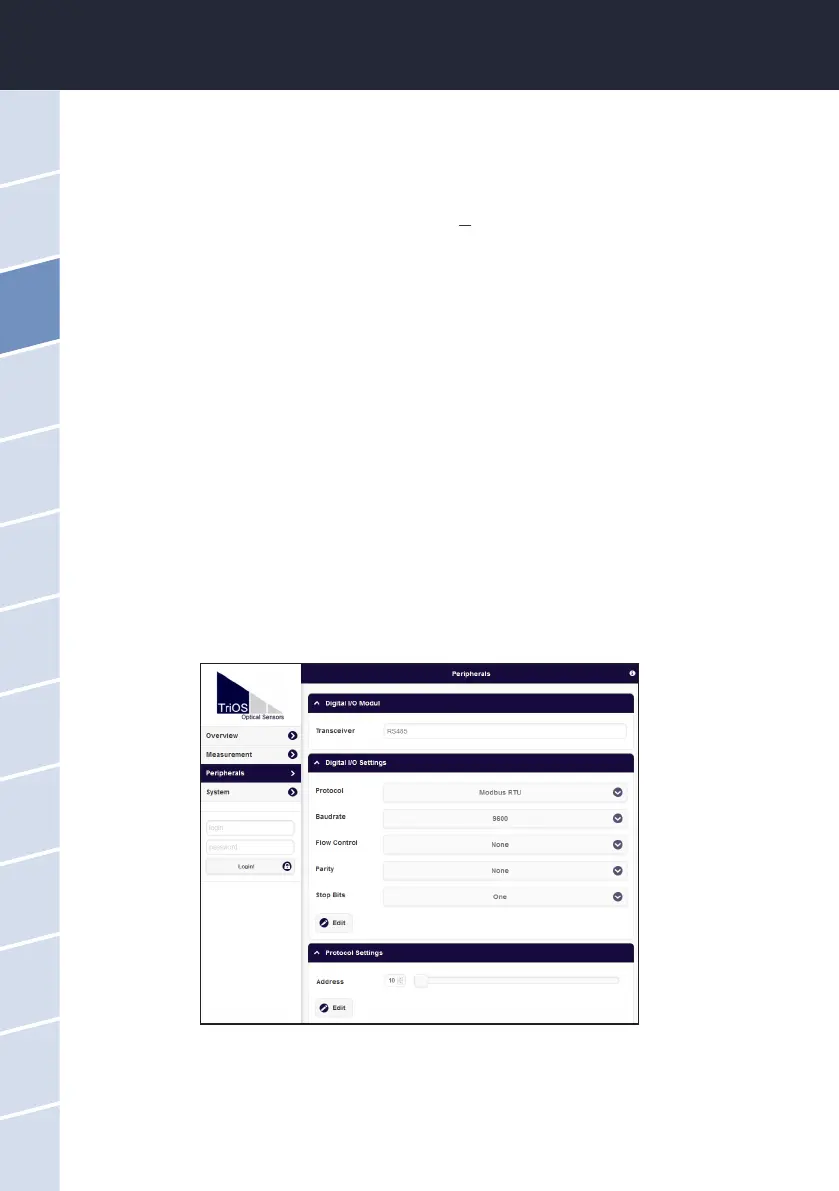
• Protocol: Species the data protocol to be used. Supported:
• Modbus RTU
• ASCII Output
3.2 Interfaces
3.2.1 Serial Interface
The nanoFlu provides two lines for digital, serial communication with a control device. It is equipped with a
congurable digital serial interface as RS-232 (also EIA 232) or RS-485 (also EIA 485). The interface cannot be
switched and is already dened when delivered.
For the RS-232, voltages of –15 V to +15 V with respect to the ground are possible. For the RS-485, voltages
of –5 V to +5 V with respect to the ground are possible.
nanoFlu is delivered as RS-485 in the standard version. Upon delivery, the nanoFlu is congured for RS-485
with the following settings:
• Baud rate: 9600 bps
• Data bits: 8
• Stop bits: 1
• Parity: none
Detailed description of the Modbus protocol commands can be found in the annex.
For the RS-232, data transmission takes place on one line per direction, with the RX cable being used for
the communication from the control device to the sensor and the TX cable being used from the sensor to the
control device.
RS-485 uses a dierential signal with the sign-negative potential of the A line is put on the B line. The A-B dier-
ence is decisive, where the transmission is most resistant to interactive interference signals.
For the nanoFlu, the “Peripherals” page of the web interface allows conguration of the digital interface. The
following setting options are available:


 To Next Page