
 Need help?
Do you have a question about the Triumph Thunderbird Commander and is the answer not in the manual?
Explains how warnings, cautions, and notes are presented in the handbook.
Details warning labels and mentions maintenance requirements.
Describes immobilizer, tire pressure monitoring, and noise control system regulations.
Explains handbook purpose, recommended training, language availability, and customer feedback.
Safety warnings regarding motorcycle use, design limitations, load capacity, and fumes.
Importance of wearing proper safety gear, including helmets and protective clothing.
Advice on safe riding practices, handling stability, controls, and hazard awareness.
Safety guidelines for parking and warnings about approved parts and maintenance.
Details the locations of warning labels on the Thunderbird LT motorcycle.
Details the locations of warning labels on the Thunderbird Commander motorcycle.
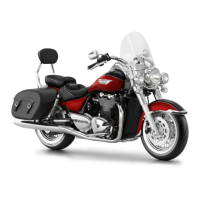
Identifies various parts of the Thunderbird LT motorcycle with numbered diagrams.
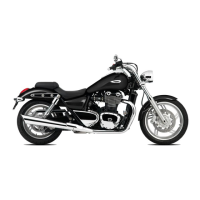
Identifies various parts of the Thunderbird Commander motorcycle with numbered diagrams.
Illustrates and labels components of the Thunderbird LT's controls and dashboard.
Explains where to find the Vehicle Identification Number (VIN) on the motorcycle.
Describes the location and identification of the engine serial number.
Illustrates and explains the instrument panel, gauges, and warning lights.
Explains how to navigate and reset the odometer, trip meter, clock, and range display.
Details ignition, security systems, and handlebar control operations.
Guidance on fuel requirements, grade, types, tank cap operation, and filling procedures.
Information on side stands, panels, seats, windshields, and panniers, including removal.
Covers motorcycle breaking-in procedures and essential daily safety checks.
Instructions for stopping the engine, starting the engine, and moving off safely.
Procedures for shifting gears and applying brakes correctly during riding.
Details ABS operation, safe parking, and safety considerations for high-speed riding.
Pre-ride checks for various motorcycle systems and components.
Guide to potential hazards of adding accessories and carrying passengers or loads.
Outlines the importance and schedules for performing maintenance tasks on the motorcycle.
Procedures for engine oil checks, changes, and cooling system maintenance.
Information on brake system inspection, fluid levels, wear, and light switch checks.
Procedures for inspecting bearings and adjusting suspension systems.
Procedures for checking and adjusting the drive belt and maintaining tires.
Guidance on battery maintenance, charging, electrical checks, and bulb replacements.
Comprehensive guide to cleaning and maintaining various parts of the motorcycle.
Key physical dimensions, weight, and engine specifications for both motorcycle models.
Details performance metrics, fuel, ignition, and transmission system specifications.
Tire specifications, electrical components, frame geometry, torque values, and fluid recommendations.
 General
| Displacement | 1699 cc |
|---|---|
| Bore x Stroke | 107.1 mm x 94.3 mm |
| Compression Ratio | 9.7:1 |
| Max Torque | 151 Nm @ 3550 rpm |
| Clutch | Wet, multi-plate |
| Gearbox | 6-speed |
| Rear Brakes | Single 310mm disc, 2-piston caliper |
| Seat Height | 700 mm |
| Fuel Tank Capacity | 22 litres |
| Engine Type | Liquid-cooled, DOHC, parallel-twin |
| Fuel System | Electronic fuel injection |
| Exhaust | Chrome 2-into-1-into-2 system |
| Final Drive | Belt |
| Front Suspension | Telescopic forks |
| Rear Suspension | Twin shocks, adjustable preload |
| Front Brakes | Twin 310mm discs, 4-piston calipers |
| Weight | 308 kg |
| Power | 93 bhp |


 To Next Page
