structure above is secure and safe.
Make the opening below the lintel by removing the masonry and clearing debris. If
the cavity has loose fill (e.g. granular) insulation material, pack the edges of the
opening with Rockwool as you proceed to hold back the insulating material.
8.2.2 Preparing a wall cavity.
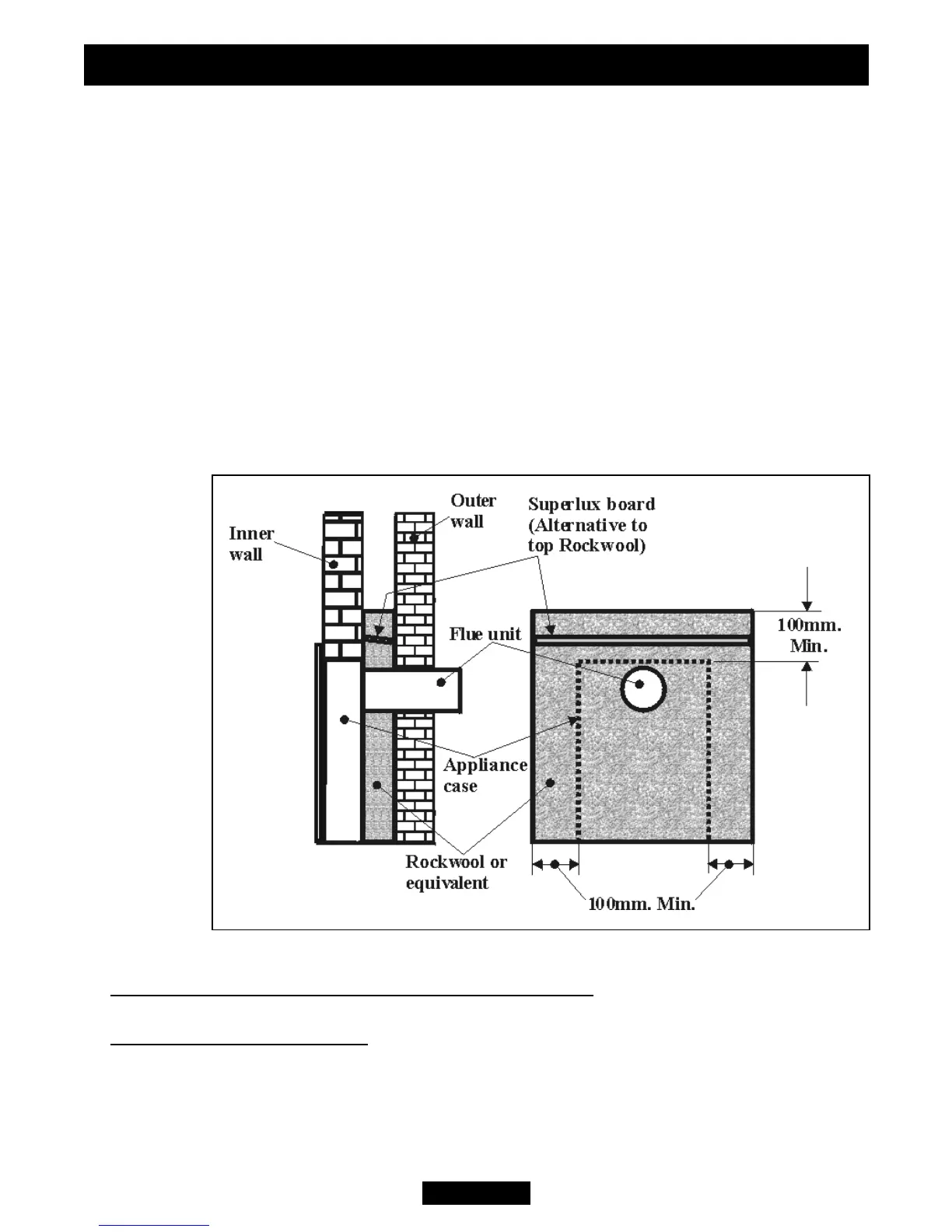
The wall cavity must not be bridged other than by the flue unit. The appliance case
must not project into the cavity between the inner and outer walls by more than
10mm.
The cavity should be sealed where the opening has been cut. We recommend
filling fully across the cavity with Rockwool or equivalent to at least 100mm above and
each side of the recess opening (See figure 11).
An alternative to rockwool above the opening is to seal across the top of the cavity
with Superlux board or equivalent. The board should slope downward to the back so
that any moisture will be channeled to the outside (See figure 11).
8.3 Combustible wall materials.
For brick or other non-combustible wall constructions, be sure to remove any
combustible wall cladding material from the area shown in figure 3.
For Timber frame buildings, the back surface of the appliance case must be
separated from the timber frame by 25mm of non-combustible material. This can
consist of the usual 12.5mm thick plasterboard plus a 12.5mm thick sheet of non-
combustible insulating material (e.g. fibre cement board). The insulating sheet can be
used to seal the annular gap between the flue unit and the inner leaf sleeve (See
INSTALLER GUIDE
Page 22
© Baxi Heating U.K. Limited 2010.
Figure 11.


 To Next Page