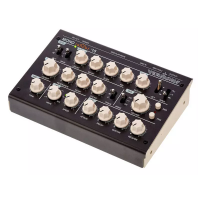
To access edit-parameters follow these steps:
1. Enter the edit menu by pressing E.
2. Select a parameter by setting the rotary encoder to the desired value 1…10.
3. Change a parameter’s value by using the buttons A, B, C and D. On some parameters you can use more than
one option.
4. Leave the edit menu by pressing E again.
Configuring the control voltage inputs
MeloDICER offers two inputs for controlling various parameters by an external control voltage. Both CV inputs
work with positive voltages between 0 and 5 volts, negative voltages have no effect.
☞
Voltages up to +12 volts won’t damage meloDICER. But above +5 volts there
won’t be any changes to the selected parameter(s).
CV IN 1 – pitch control
Control voltage input CV IN 1 can be routed to control four destinations dedicated to pitch.
ADD SEQ (1-A) vs. TRANS SEQ (1-B)
Options ADD SEQ (1-A) and TRANS SEQ (1-B) are exclusive, meaning, that only one of them or none can be
selected. They are very similar as both of them affects the sequence’s pitch.
ADD SEQ (1-A) adds the incoming voltage to the 1V/OCT output without quantization whereas TRANS SEQ (1-
B) adds the incoming voltage with quantization to semitones.
In practice that means, that you can add a modulation, i.e. from an LFO with option 1-A. With option 1-B you can
transpose the pattern.
18 User Guide meloDICER & MEX3


 To Next Page