iPM 200 generator module
® Vetaphone March 2021 3401201GB
14.2.2 The electrical process
ALTERING THE SURFACE ENERGY
This can be done in several ways. VETAPHONE uses electrical Corona-plus discharge,
which is the most suitable treatment method for plastic films, cables and tubes. It is
easy to control, requires little maintenance and the system is inexpensive to run.
Plastic is a man-made synthetic material, which contains long homogeneous molecular
chains that form a strong and uniform product. The chains of molecules are normally
joined end to end forming even longer chains, leaving only a few open chain ends, thus
providing only a small amount of bonding points at the surface.
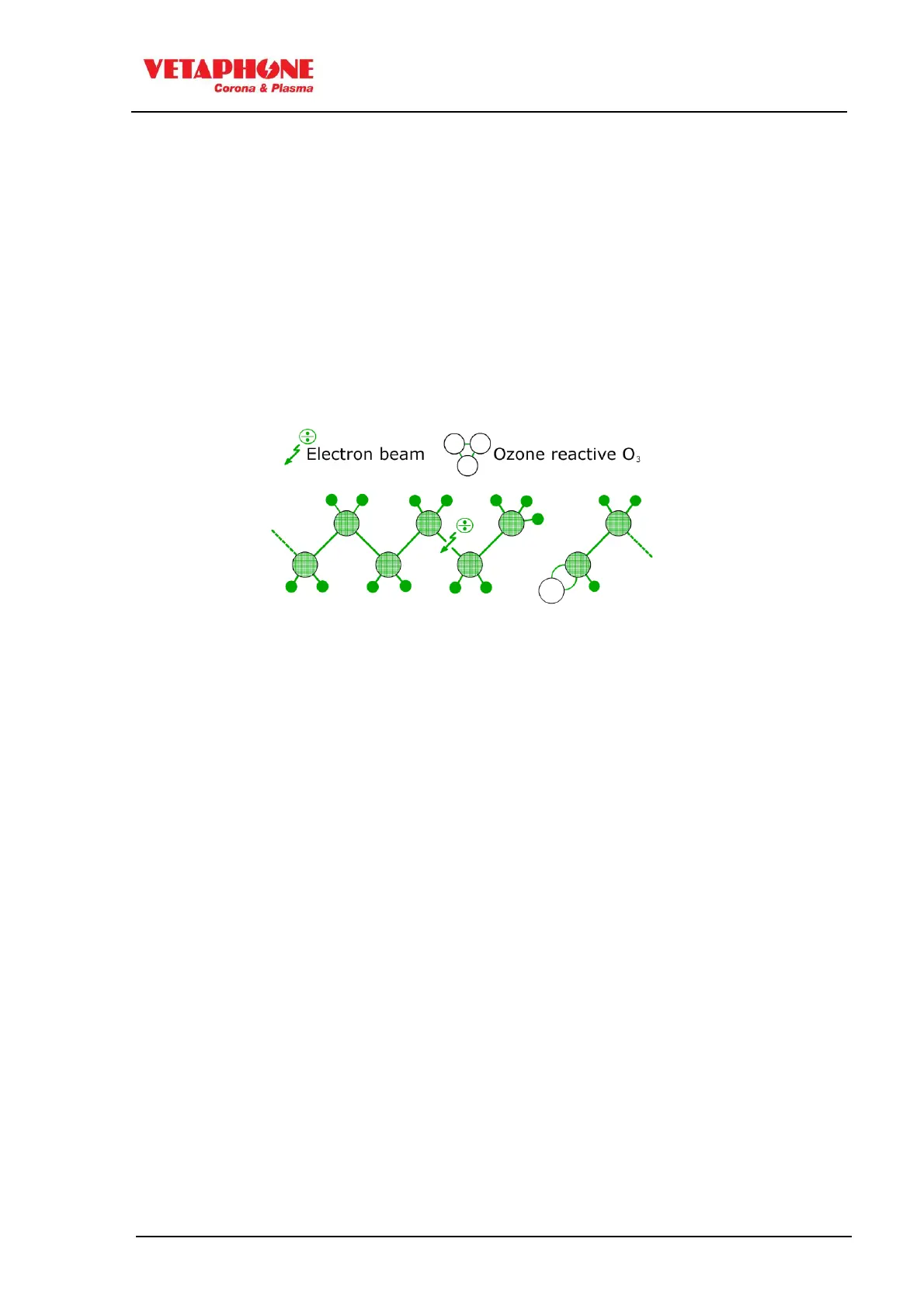
During corona discharge treatment, electrons are accelerated into the surface of the
plastic causing the long chains to rupture, producing a multiplicity of open ends and
free valences are formed. The free valences are then able to form carbonyl groups with
the atoms from the ozone created by the electric discharge, which gives the improved
adhesion.
PE molecular chain ruptured by corona discharge
The adhesion is further enhanced by the cleaning effect that the ozone causes, by
oxidation on the surface of the material.
In spite of the fact, that accelerated electrons cause rupturing of the surface, the
strength of the material is not affected, as the reactive force of the upper molecular
layers dramatically reduces the acceleration. Thus, the essential properties of the
material are maintained, and less than 0,1 of the material is penetrated.
POWER CALCULATION
The generator power required to treat the plastic sufficiently on various types of
materials and various treatment areas, can be calculated by using the following
formula:
Power = T S W M
P = Total Power (Watt) required
T = Number of sides to Treat (single/double sided)
S = Line Speed (in meters per minute)
W = Film Width (in meters)
M = Material factor (required Watt per m² per minute)
The material factor is the number of watts needed to raise the surface energy of a film
to a sufficient level. The factor typically varies between 10 and 50 Wattm²/min for most
materials, depending on type of material, age, additive content, etc. The exact value is
best determined by testing a sample of the actual film that is used for a specific
application.



 To Next Page