DURABILITY OF THE TREATMENT
The increase in surface energy (dynes/cm), that is induced into a film begins to decay immediately
following treatment, and again this depends upon the same factors mentioned above, with the
additional considerations of storage conditions and temperatures. Generally speaking, the more
difficult a material is to treat the quicker it is likely to decay with time. It has been established. that film
with very high slip additives (over 1200 ppm) can be totally resistant to printing just 24 hours after
treatment, and it may be necessary to process the film immediately following treatment, or boost the
treatment in line with the printer. Ageing of such films can render them impossible to treat if they are
not treated during production.
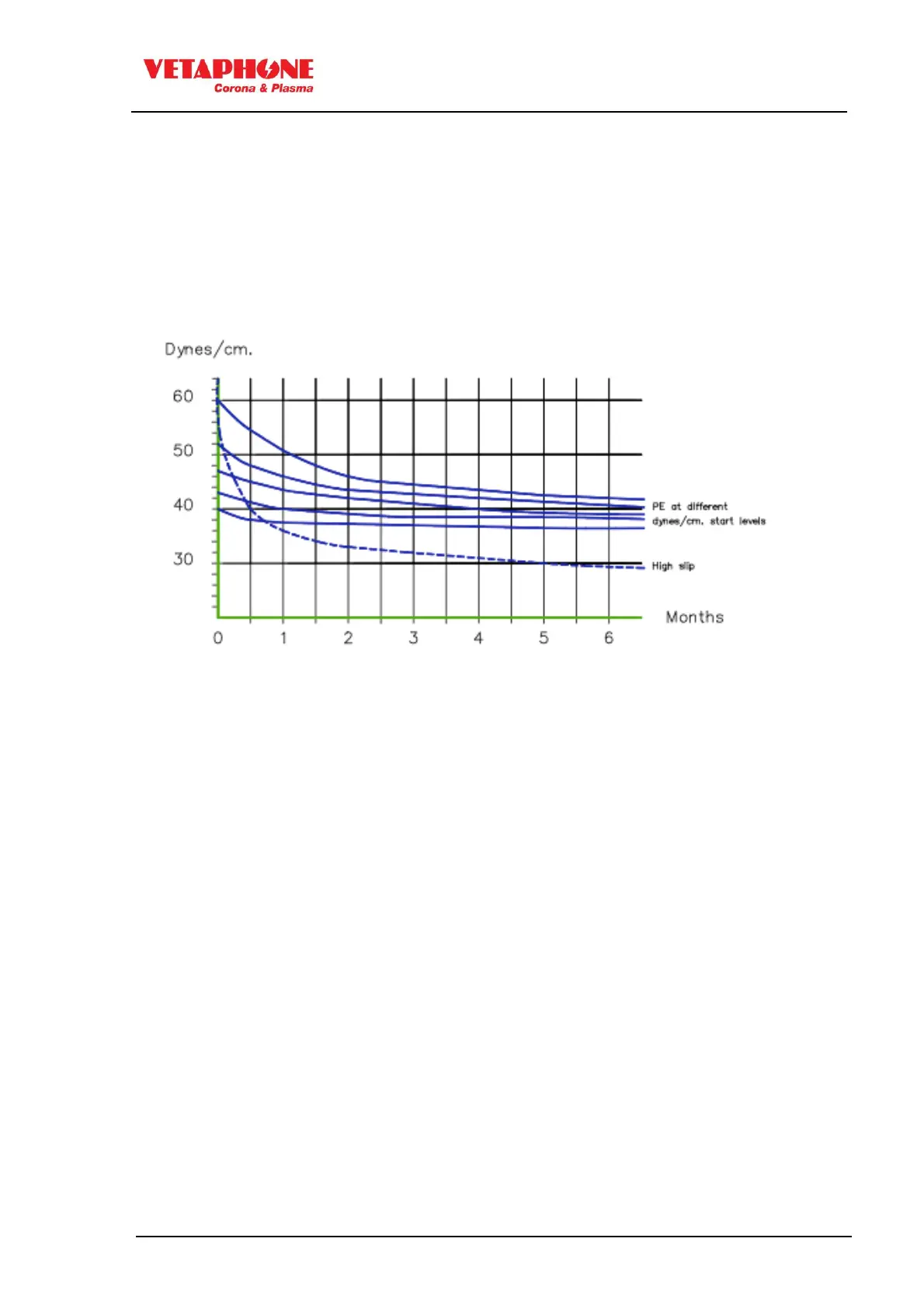
Typical decay in surface energy on PE-materials over a 6-month period
As can be seen from the graph, the level of treatment decays more quickly immediately following
treatment, and less rapidly as the time passes, depending on different dynes/cm start levels.
MEASURING THE SURFACE ENERGY
Using the test method described by DIN 53364 and ASTM D2578-67, which is a liquid test, carries out
the measurement of surface energy of a film. Vetaphone supply test liquid. The liquid is applied as a
broad line in a thin layer with either a brush or a pen.
The surface tension is then determined visually by estimating how the liquid reacts within the first two
seconds following application. The test liquid can shrink and/or form itself into globules (individual
droplets) or it can remain unchanged.
When a test liquid shrinks or forms into droplets it indicates that the film has a lower surface energy
than the liquid applied. The test should be repeated as many time as necessary with a liquid of a lower
surface tension until it remains unchanged for a period of two seconds or more. Once that has been
achieved, the film can be said to have that level or surface energy at least equal to that of the liquid
applied. Further applications should be made until shrinkage or droplets occur within two seconds. This
last measurement should be taken as failure, and the surface energy of the liquid used for the previous
measurement should be taken to be the surface energy of the film.


 To Previous Page
 Loading...