Group 25 Intake and Exhaust System Design and Function
Compression Brake
The exhaust brake is always engaged in conjunction
with the compression brake. In the compression brake
induction phase, the exhaust brake creates an overpres-
sure in the exhaust manifold, making the compression
brake more efficient.
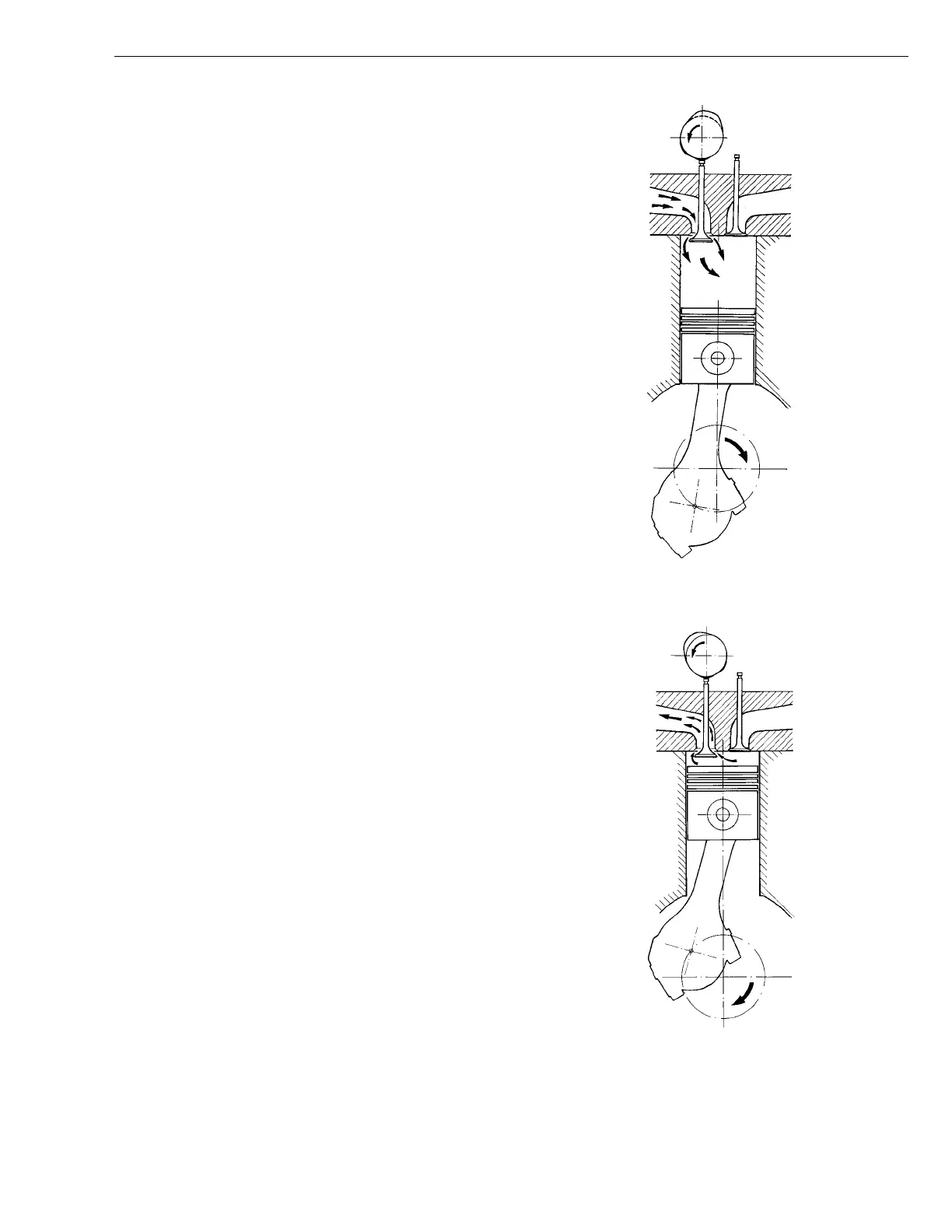
Induction phase
The induction phase begins at the end of the intake
stroke and continues slightly into the compression stroke.
The piston travels towards its bottom dead center posi-
tion and the camshaft induction lobe opens the exhaust
valves for the time required to fill the cylinder with the
overpressure created by the exhaust brake in the ex-
haust manifold.
When the induction lobe closes the exhaust valves, the
cylinder has an overpressure at the start of the compres-
sion stroke.
This overpressure considerably increases the compres-
sion during the compression stroke, which in turn
creates a powerful braking effect during the upward
movement of the piston.
T2006830
Fig. 12: Charging phase
Decompression phase
At the end of the compression stroke, when the piston is
nearing its top dead center position, the camshaft
decompression lobe opens the exhaust valves and re-
leases the pressure out of the cylinder.
Shortly before the bottom dead center position, the ex-
haust valves are opened by the ordinary exhaust lobe.
During the exhaust stroke, the counterpressure is cre-
ated in the exhaust manifold which, in turn, has a
braking effect because the exhaust pressure governor
shutter is still restricting the flow of exhaust gases out of
the turbocharger.
T2006831
Fig. 13: Decompression phase
17


 To Next Page