Group 25 Intake and Exhaust System System Check
System Check
2559-06-02-02
Boost Pressure, Checking
Note: This operation number covers only the installation
and removal of test equipment.
Special tools: 9996065, 9996666
1
T2006943
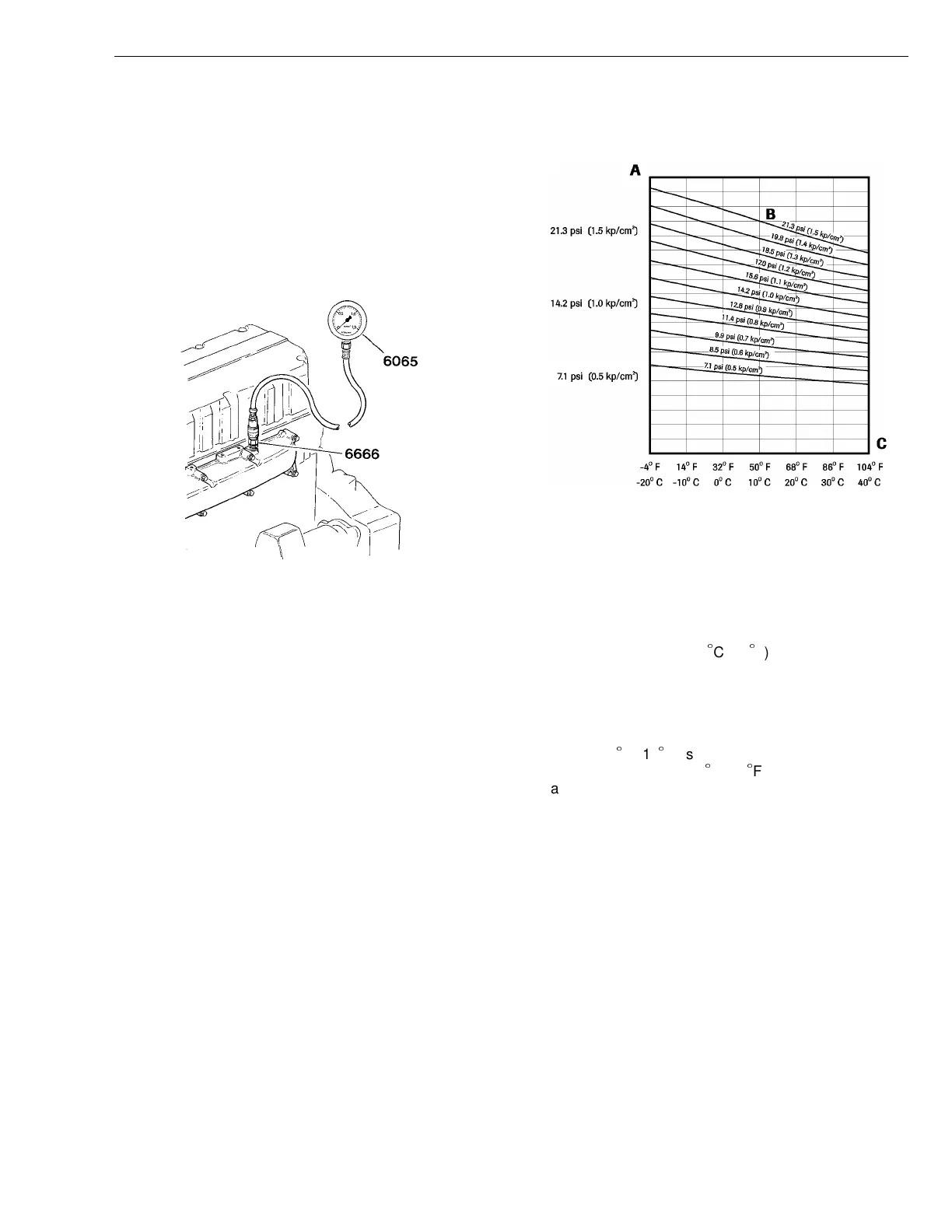
Boost pressure gauge installation
Clean around the plug for the boost
pressure gauge on the intake mani-
fold. Remove the plug and install
union 9996666. Connect pressure
gauge 9996065 to the 9996666 union.
Make sure the pressure gauge hose is
long enough to reach the driver’s seat
in the cab.
Note: Secure the hose so that it does
not contact any moving parts.
2
The measurement should be carried
out:
•
with a fully loaded vehicle
•
driving up an incline at full accel-
eration (full load)
•
while engine revs (rpm), slowly
pass the speed specified for boost
pressure.
Note: For a reliable result, engine load
must be maintained long enough for
the pressure to stabilize. Boost pres-
sure specifications at 28.3 r/s (1700
rpm):
•
VE D12–370 125–170 kPa (18–24.7 psi)
•
VE D12–415 145–175 kPa ( 21–25.4 psi)
3
W2000737
Boost pressure at various temperatures
A measured boost pressure
B correction curves
C intake air temperature
The specifications state engine speed
and boost pressure at +20
C (68
F). If
reading at any other temperature, use
the chart above to correct the resulting
boost pressure.
Example:
A pressure of 80 kPa (12 psi) mea-
sured at –10
C (14
F) is equivalent to
about 70 kPa (10 psi) +20
C (68
F).
That is, pressure drops as tempera-
ture rises.
If boost pressure does not reach spec-
ified levels, check the following:
•
properly tightened bolts on intake
and exhaust manifolds
•
exhaust brake
•
backpressure in exhaust system
•
air cleaner element
•
fuel pressure
41


 To Next Page