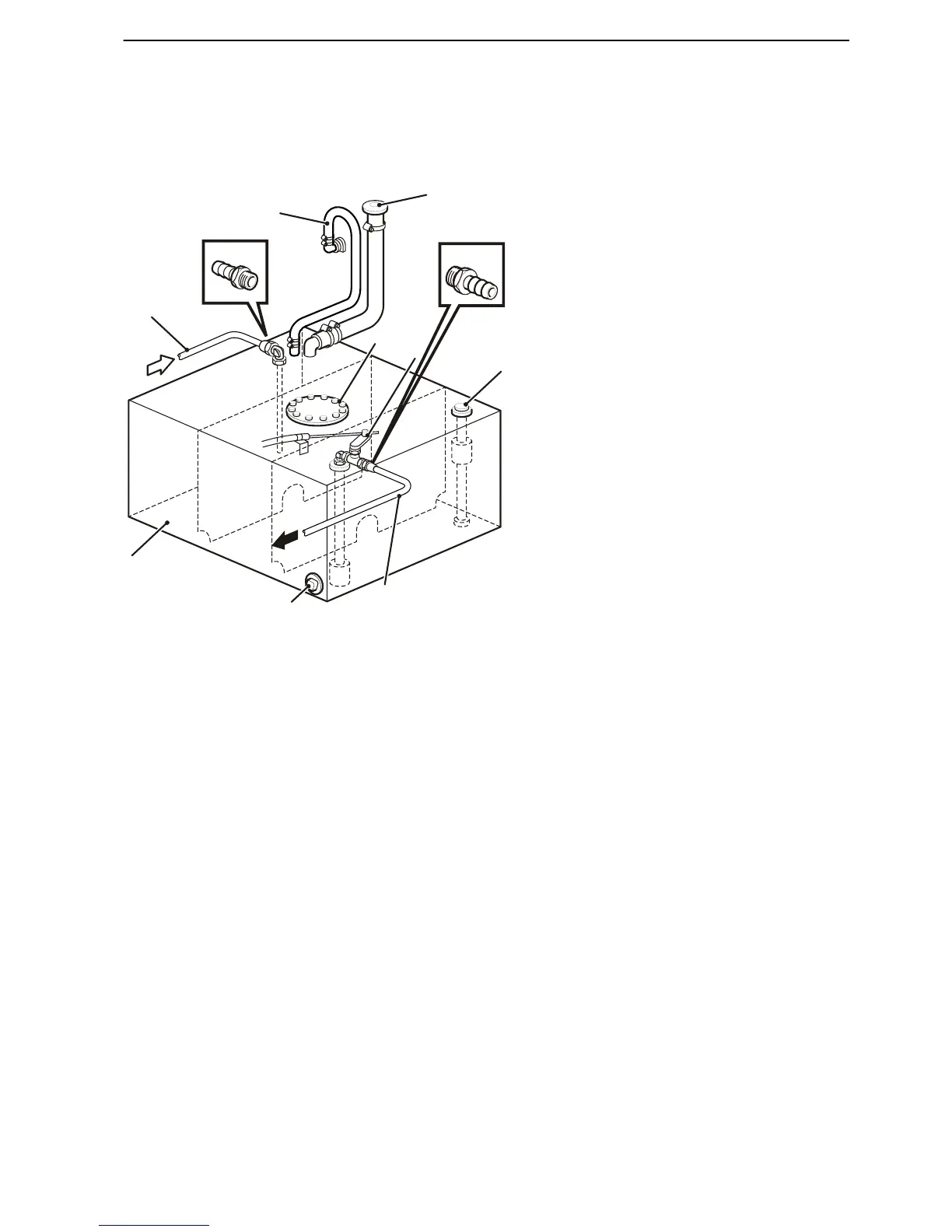
1 Fuel tank
2
Filler cap
3 Vent line
4 Suction line
5 Inspection cover
6 Remotely operated fuel shut-off valve
7 Fuel level sensor
8 Return line
9 Bottom plug
A Nipple in installations with a rubber
hose
The installation of fuel system components such as fuel tank,
taps, fuel pipes and auxiliary fuel filters etc., must be carried
out
very carefully in order to ensure sufficient fuel to the engine
and that the requirements for perfect sealing and fire safety
are met.
Plan the locations of the tanks carefully before starting work.
Use quality taps to avoid leakage. A leaking fuel system
always entails great risk of functional faults and fire.
Use first-class quality components.
Ideally, the taps must be installed on the outside of the engine
compartment, or be remotely operable.
Fuel may be divided up between several tanks in order to keep
the center of gravity low and also to allow adjustment of the
fore-and-aft CoG.
If the tanks are to be built in, the surrounding space must have
good ventilation.
NOTICE! There may be local legislation that
always sets aside engine manufacturer liter-
ature and recommendations.
In Europe, materials and installation of fixed
fuel systems must fulfill the requirements of
ISO 10088. In the USA the installation must
fulfill the requirements of the ABYC and
USCG.
When working on the fuel system, it is impor-
tant to keep it clean and free from dirt.
Installation, Fuel System
47704162 10-2014 © AB VOLVO PENTA 111


 To Next Page