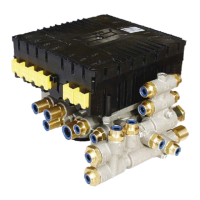
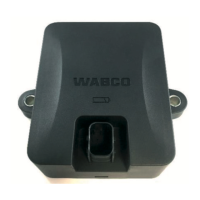
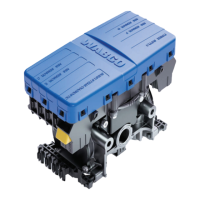
TEBS E
5
braking system
47
5.9.6 Roll Stability Support (RSS)
Trailers of class O4 with up to 3 axles with air suspension, which are certified as of
July 2010, must be equipped with a stabilisation function according to European
legal requirements. RSS is mandatory as of July 2011 when certifying a vehicle for
the first time. With WABCO RSS, all legal requirements concerning safety and traf-
fic are met.
Vehicle type
All trailer vehicles
Purpose
Roll Stability Support is a function integrated into the EBS, which introduces the
brake application as a preventative measure when there is a danger of tipping, to
stabilise the vehicle.
Function
The RSS function uses the input values of the Trailer EBS E, such as wheel
speeds, loading information, and target deceleration, as well as a lateral accelera-
tion sensor that is integrated into the TEBS E Modulator.
For this purpose, test pressure activations are performed for restricted periods at
low pressure if the calculated lateral acceleration critical for tilting is exceeded in
the trailer. The duration and magnitude of the pressure depend on the lateral ac-
celeration sequence.
The risk of overturning is detected on the basis of the wheel reaction of the wheels
braked during a test. If a danger of tilting is detected, brake application at high
pressure is initiated in the trailer vehicle at least on the individually controlled (IR)
outside wheels in order to reduce the vehicle speed, lateral acceleration, and
therefore the danger of tilting or to prevent overturning. The braking pressure for
the wheels on the inside of the curve is largely unchanged. As soon as there is no
danger of tipping, the RSS brake application is ended.
On an axle with a modified axle control (MAR), depending on the system it may not
be possible to control the braking pressure differently for ‘right/left’. In this case,
Select-High control is actuated when a danger of tipping is detected.
RSS control is started in unbraked or partially braked driving mode. The RSS con-
trol is deactivated if the driver brakes heavily enough (deceleration above the level
of RSS deceleration).
If the driver defines a pneumatic or electrical nominal braking value for the trailer
while an RSS control is taking place, and this is higher than the RSS control, the
RSS control is interrupted and the respective nominal value is used for the braking
procedure.
The type of pressure control for the wheels on axle e-f depends on the vehicle type
and the ABS system configuration.



 To Next Page