COOLING
SYSTEM
[FRESH
WATER
COOLED
MODELS]
FRESH
WATER
COOLING
CIRCUIT
Fresh water coolant is pumped through the engine by a
circulating pump, absorbing heat from the engine. The
coolant then passes through the thermostat into the manifold,
to the heat exchanger where it
is
cooled and returned to the
engine block via the suction side
of
the circulating pump.
When the engine is started cold, external coolant flow
is
prevented by the closed thermostat (although some coolant
flow
is
bypassed around the thermostat to provide coolant
circulation in the engine block). As the engine warms up, the
thermostat gradually opens, allowing full flow
of
the engine's
coolant to flow unrestricted to the external portion
of
the
cooling system.
ENGINE
COOLANT
WESTERBEKE recommends a mixture
of
50% antifreeze
and
50% distilled water. Distilled water is free from the
chemicals that can corrode internal engine surfaces.
The antifreeze perfonns a double duty.
It
allows the engine to
run at proper temperatures by transfening heat away from
the engine to the coolant and lubricates and protects the
cooling circuit from rust and corrosion. Look for a good
quality antifreeze that contains Supplemental Cooling
Additives
(SCA' S) that keep the antifreeze chemically
balanced, crucial to long term protection.
NOTE:
Look
for
the new environmentally friendly long lasting
antifreeze that
is
now available.
The recommended
50/50 mixture will protect the engine
against the most extreme temperature. The antifreeze mixture
will also retard rust within the engine and add to the life
of
the circulating pump impeller and seals.
A proper
50/50 mixture as recommended will protect the
engine coolant to temperatures
of
-
40°F.
Coolant
Recovery
Tank
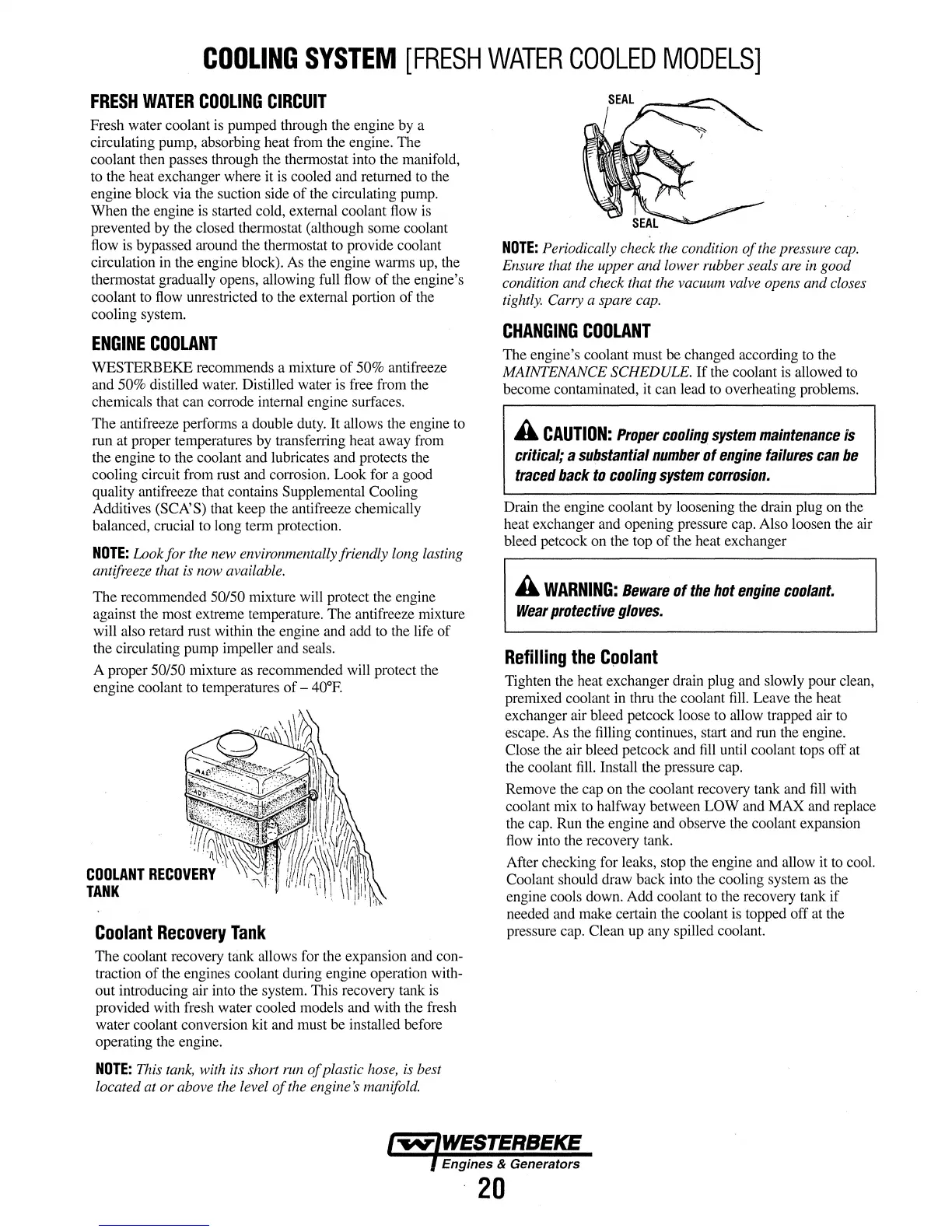
The coolant recovery tank allows for the expansion and con-
traction
of
the engines coolant during engine operation with-
out introducing air into the system. This recovery tank
is
provided with fresh water cooled models and with the fresh
water coolant conversion kit and must be installed before
operating the engine.
NOTE:
This tank, with its short run
of
plastic hose,
is
best
located at
or
above the level
of
the engine's manifold.
NOTE:
Periodically check the condition
of
the pressure cap.
Ensure that the upper and lower rubber seals are
in
good
condition and check that the vacuum valve opens and closes
tightly. Carry a spare cap.
CHANGING
COOLANT
The engine's coolant must be changed according to the
MAINTENANCE
SCHEDULE.
If
the coolant is allowed to
become contaminated, it can lead to overheating problems.
A
CAUTION:
Proper
cooling
system
maintenance
is
critical;
a
substantial
number
of
engine
failures
can
be
traced
back
to
cooling
system
corrosion.
Drain the engine coolant by loosening the drain plug on the
heat exchanger and opening pressure cap. Also loosen the air
bleed petcock on the top
of
the heat exchanger
A
WARNING:
Beware
of
the
hot
engine
coolant.
Wear
protective
gloves.
Refilling
the
Coolant
Tighten the heat exchanger drain plug and slowly pour clean,
premixed coolant in thru the coolant
fill.
Leave the heat
exchanger air bleed petcock loose to allow trapped air to
escape. As the filling continues, start and run the engine.
Close the air bleed petcock and fill until coolant tops off at
the coolant
fill.
Install the pressure cap.
Remove the cap on the coolant recovery tank and
fill
with
coolant mix to halfway between LOW and MAX and replace
the cap. Run the engine and observe the coolant expansion
flow into the recovery tank.
After checking for leaks, stop the engine and allow it to cool.
Coolant should draw back into the cooling system as the
engine cools down. Add coolant to the recovery tank
if
needed and make certain the coolant is topped off at the
pressure cap. Clean up any spilled coolant.
lw/WESTERBEKE
/ Engines & Generators
20


 To Next Page