GENERATOR
INFORMATION
USE
OF
ELECTRIC
MOTORS
The power required
to
start
an
electric motor
is
considerably
more than is required
to
keep it running after it is started.
Some motors require much more current
to
strut them
than
others. Split-phase
(AC)
motors require more
cmTent
to
start,
under similar circumstances, than other
types.
They are
com-
monly used
on
easy-starting loads,
such
as
washing
machines, or where
loads
are applied after
the
motor is
started,
.such
as
small power tools. Because they require 5
to
7 times
as
much
current
to
start
as
to
run,
their
use
should be
avoided, whenever possible, if
the
electric motor
is
to
be
driven
by
a
small
generator.
Capacitor
and
repulsion-
induction motors require
from
2
to
4
times
as
much current
to
start
as
to
run.
The current required
to
start
any
motor
varies
with
the
load connected
to-it.
An
electric motor
con-
nected
to
an
air compressor, for example, will require
more
current
than
a motor
to
which
no
load
is
connected.
In
general,
the
current
required
to
start
115-Volt
motors
connected
to
medium
starting
loads
will
be
approximately
as
follows:
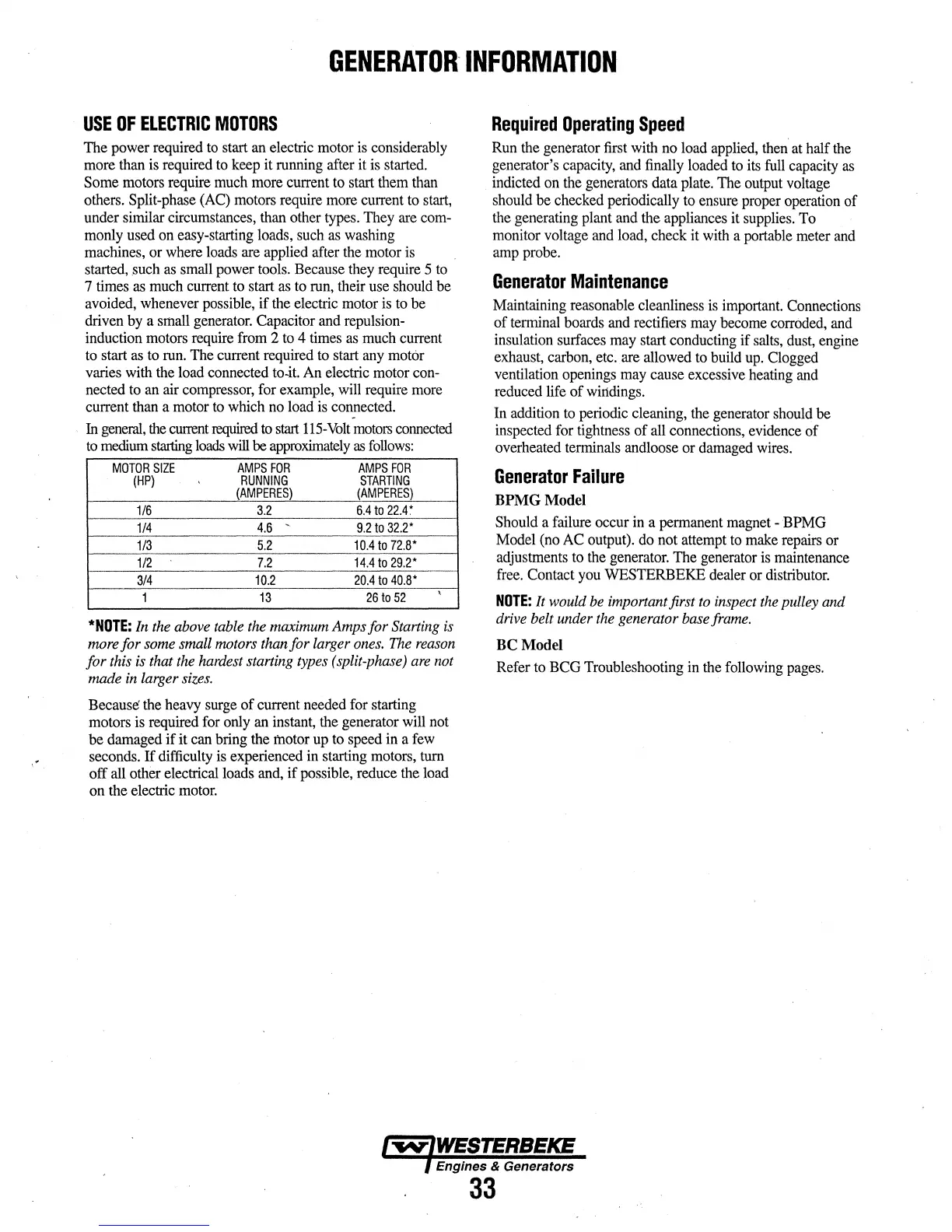
MOTOR
SIZE
AMPS
FOR
AMPS
FOR
(HP)
RUNNING
STARTING
(AMPERES)
(AMPERES)
1/6
3.2
6.4
to
22.4~
-
1/4
4.6
'
9.2
to
32.2*
1/3
5.2
10.4
to
72.8
*
1/2
7.2
14.4
to
29.2*
3/4
10.2
20.4
to
40.8*
1
13
26
to
52
'
*NOTE:
In
the
above table the maximum Amps for Starting
is
more for some small motors than for larger
ones.
The
reason
for this
is
that
the
hardest starting types (split-phase)
are
not
made
in
larger
sizes.
Because the heavy
surge
of current needed
for
starting
motors
is
required
for
only
an
instant,
the
generator
will
not
be damaged if it can bring
the
motor
up
to
speed
in
a
few
seconds.
If
difficulty
is
experienced
in
starting motors, turn
off all other electrical loads
and,
if possible, reduce
the
load
on the electric
motor.
Required
Operating
Speed
Run
the
generator
first
with
no
load
applied,
then at
half
the
generator's capacity,
and
finally loaded
to
its
full
capacity
as
indicted
on
the
generators data plate. The output voltage
should be checked periodically
to
ensure proper operation of
the
generating plant
and
the appliances it
supplies.
To
monitor voltage
and
load, check it
with
a portable meter
and
amp
probe.
Generator
Maintenance
Maintaining reasonable cleanliness
is
important.
Connections
of terminal boards
and
rectifiers may become corroded,
and
insulation surfaces
may
start conducting if
salts,
dust,
engine
exhaust, carbon,
etc.
are allowed
to
build
up.
Clogged
ventilation openings
may
cause excessive heating
and
reduced life of windings.
In addition
to
periodic cleaning,
the
generator should be
inspected for tightness of
all
connections, evidence of
overheated terminals andloose or damaged
wires.
Generator
Failure
BPMGModel
Should a failure occur
in
a permanent magnet - BPMG
Model
(no
AC
output).
do
not attempt
to
make
repairs or
adjustments
to
the
generator. The generator
is
maintenance
free.
Contact
you
WESTERBEKE dealer or
distributor.
NOTE:
It
would
be
important first
to
inspect
the
pulley and
drive belt under the generator base frame.
BC Model
Refer
to
BCG Troubleshooting
in
the
following
pages.
Engines & Generators
33



 To Next Page