EasyManua.ls Logo

Westerbeke 4.5 BCG - Raw Water Intake Strainer; Raw Water Pump

Westerbeke 4.5 BCG
54 pages
Print Icon
To Next Page IconTo Next Page
To Previous Page IconTo Previous Page
Loading...
COOLING
SYSTEM
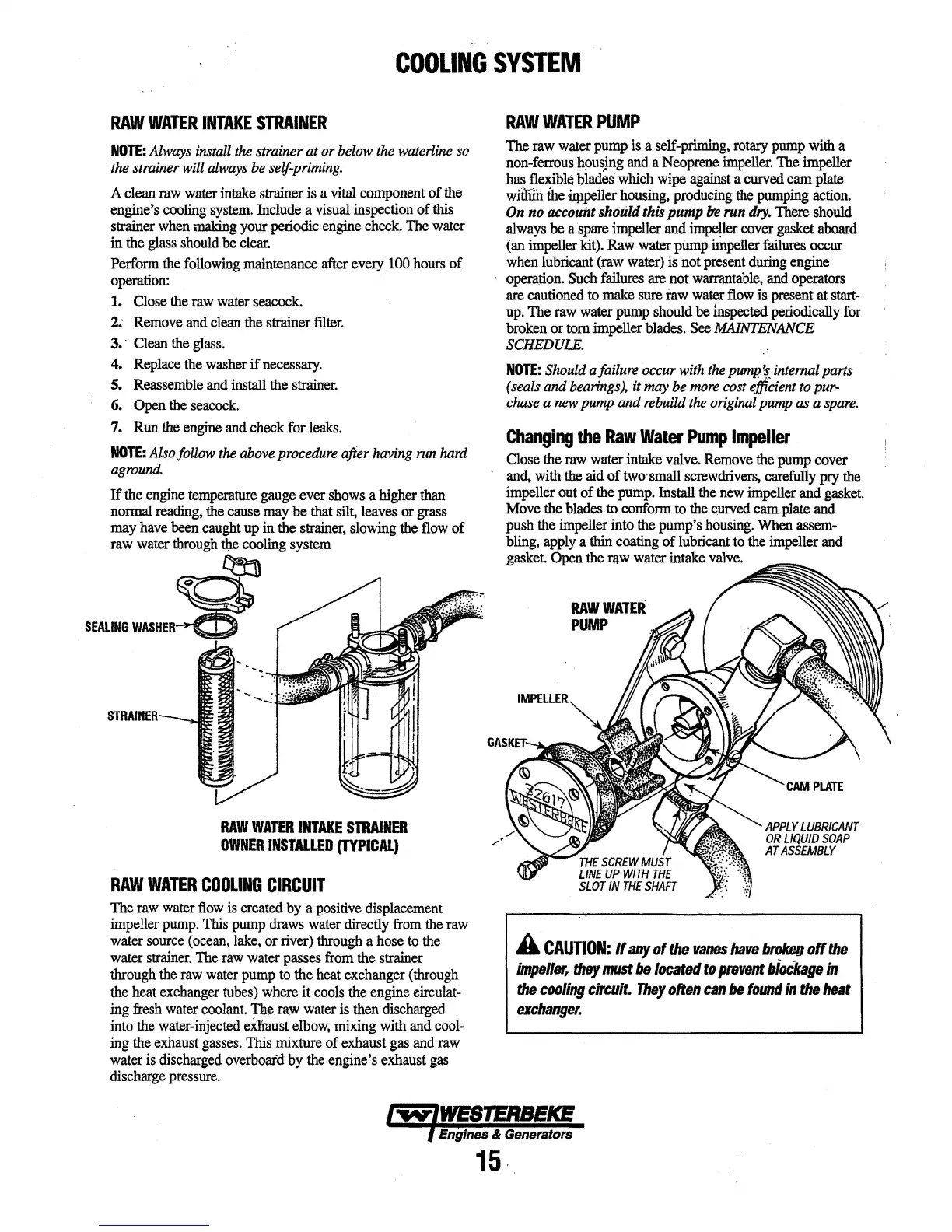
RAW
WATER
INTAKE
STRAINER
NOTE:
Always
install
the
strainer
at
or
below
the
waterline
so
the strainer will
always
be
self-priming.
A
clean
raw
water
intake
strainer is a
vital
component
of
the
engine's cooling
system.
Include a
visual
inspection
of this
strainer
when
making
your periodic
engine
check.
The
water
in the
glass
should
be
clear.
Perfonn
the
following
maintenance
after
every
100
hours
of
operation:
1. Close the
raw
water
seacock.
2;
Remove
and
clean
the
strainer
filter.
3.
·
Clean
the
glass.
4. Replace
the
washer
if
necessary.
5.
Reassemble
and
install
the
strainer.
6.
Open
the
seacock.
7.
Run
the
engine
and
check
for
leaks.
NOTE:
Also follow the
above
procedure
after
having
nm
hard
aground.
If
the
engine
temperature
gauge
ever
shows
a higher
than
normal
reading,
1he
cause
may
be
that
silt,
leaves or
grass
may
have
been
caught
up
in
the
strainer,
slowing
the
flow
of
raw
water
through
tl;te
cooling
system
~
SEAUllGWAS~
STRAINER
RAW
WATER
INTAKE
STRAINER
OWNER
INSTALLED
(TYPICAL)
RAW
WATER
COOLING
CIRCUIT
The
raw
water
flow
is
created
by a positive
displacement
impeller
pump.
This
pump
draws
water
directly
from
the
raw
water
source
(ocean,
lake,
or river)
through
a
hose
to
the
water
strainer.
The
raw
water
passes
from
the
strainer
through
the
raw
water
pump
to the
heat
exchanger
(through
the
heat
exchanger
tubes)
where
it
cools
the engine
circulat-
ing
fresh
water
coolant.
Th~.
raw
water
is
then
discharged
into
the
water-injected
e:itfumst
elbow,
mixing
with
and
cool-
ing
the
exhaust
gasses.
This
mixture of exhaust
gas
and
raw
water
is
discharged
overboard
by
the
engine's exhaust
gas
discharge
pressure.
RAW
WATER
PUMP
The
raw
water
pump
is a
self-priming,
rotary
pump
with a
non-ferrous,~9usjng
and
a
Neoprene
impeller.
The
impeller
has_
flexible
b,lade8
which
wipe
against a
curved
cam
plate
wiililit
ihe@peller
housing,
producing
the
pumping
action.
On
no
a.ccount
should
this
pump
ITe
run
dry.
There
should
always
be a
spare
impeller and
impeµer
cover
gasket
aboard
(an impeller kit).
Raw
water
p\Jmp
impeller
failures
occur
when
lubricant
(raw
water)
is not
present
during
engine
·
operation.
Such
failures
are
not
warrantable,
and
operators
are
cautioned
to
make
sure
raw
water
flow
is
present at
start-
up.
The
raw
water
pump
should be
inspected
periodically
for
broken
or
tom
impeller
blades.
See
MAINTENANCE
SCHEDULE.
NOTE:
Should
a
failure
occur
with
the
purnP,
~
internal
parts
(seals
and
bearings),
it
may be
more
cost
efficient to pur-
chase
a
new
pump
and
rebuild
the
original
pump
as
a
spare.
Changing
the
Raw
Water
Pump
Impeller
Close
the
raw
water
intake
valve.
Remove
the
pump
cover
and,
with
the
aid
of
two·
small
screwdrivers.
carefully pry
the
impeller out of the
pump.
Install
the
new
impeller and gasket.
Move
the
blades
to
conform
to
the
curved
cam
plate
and
push
the
impeller
into the pump's
housing.
When
assem-
bling,
apply
a thin
coating
of
lubricant
to the impeller
and
gasket.
Open
the nt,W water intake
valve.
IMPELLER
RAW
WATER
PUMP
APPLY
LUBRICANT
OR
LIQUID
SOAP
AT
ASSEMBLY
A
CAUTION:
ff
any
of the
vanes
have
broken
off
the
impeller,
they
must
be
located
to
prevent
biacicage
in
the
cooling
circuit.
They
often
can
be
found
in
the
heat
exchanger.
lwlWESTERBEKS
)
Engines
& Generators
15·.

Related product manuals