EasyManua.ls Logo

Westerbeke 4.5 BCG - BC Generator Single Phase Voltage Adjustment; Single Exciter No-Load Voltage Adjustment

Westerbeke 4.5 BCG
54 pages
Print Icon
To Next Page IconTo Next Page
To Previous Page IconTo Previous Page
Loading...
BC.GENERATOR
SINGLE
PHASE
NOTE:
lvEsTERBEKE
~ommends
thatw
following
generator
tests
and
adjus~
be
performed
by
a
qtliJlt/ifid
techriicirin..
SINGLE
EXCITER
HO-LOAD
VOLTAGE
ADJUSTMENT
__________
;.....__
____
_
i.
Remove
tl_le
louvered
metal
plate,
at
the
back
of
the
generator,
covering
the
AC
terminal
conD.eetions
and
the
capacitor(s).
· ·
1.
Start
the
generator
an4
aU()W
it
«J
run
for
apprpximately
five
minutes
so
the
engine
can
warm
up.Make
sure
the
·
generatOr
is
opetating
without
any
equipment
dra\\fing
~
current
from
the
generator
(that
is,
shut
off
an
electrical
appliances).
Make
srire
the
engine'~
speed
(Hertz)
is
correct
Adjust
the
fuel
tbrottle/speecMinkag~aS
needed
to
obtain
the
correct
engine
speed
before
prOOeeding.
·
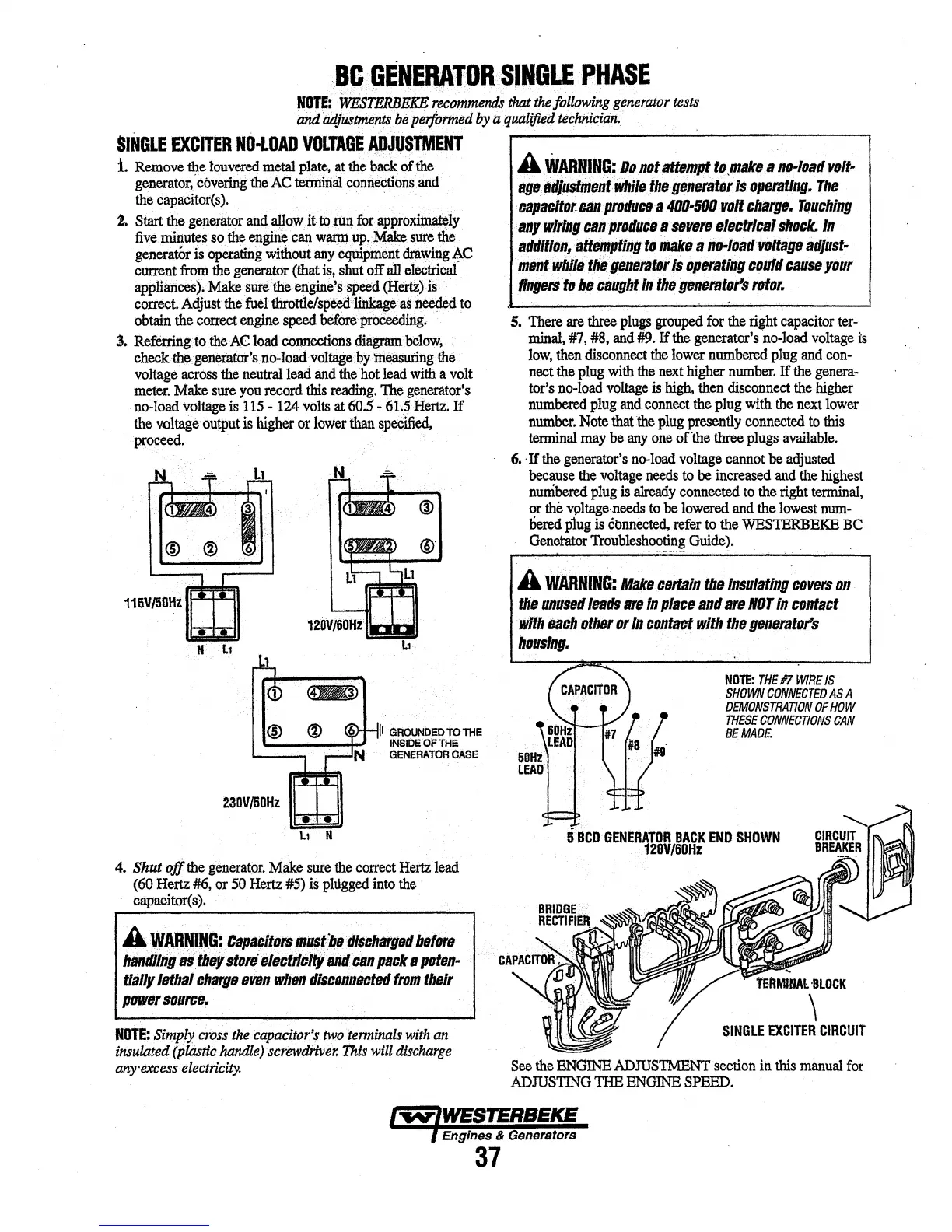
3.
Referring
to
the
AC
loa4
connections
diagram
below,
checkthegenetator'sno-Ioad
\loltage
by
measuring
the
wltage
across
the
neutral
lead
and
the
hot
lead
with
a
volt
meter.
Make
sure
you
record
this
reading.
The
generator's
no-load
\IOltllge
is
115
-
124
volts
at
60.5
-
6LS
Hertz.
If
the
voltage
output
is
higher
or
lower
than
specified,
proceed.
® @
23DV/50Hz
fr
GRoUNDED
TO
THE
INSIDEOl"THE
GENERATOR
CASE
4.
Shut off
the
generator.
Make
sure
the
correct
Hertz
lead
(60
Hertz
#6,
or
50
Hertz
#S)
is
pttlgged
into
the
·
capacitor(s).
AWARNINQ:
CapaoHor.t
m-'.1'tl dl#hliflllld
before
handlllig
asthBystare
6/ectr/olty
alid
can
plak a
paten·
tlill/y
lstha/·
charge
even
when
dlsconneated
tram
thtllr
power
sourae~
NOTE:
Simply
cross
the
capacitor's
two
tennint'.lls
with
an
insulated
(plastic
handle)
screwdriver.
This
will
discharge
any·excess
electricity.
A
WARfllNG:
/lo
not
attsmpt
to,maks
a
no-load
volt-
age
ild/:uililentWblle
the
genetatar
Is
operating.
The
capao/tou:an
pnlituae
a
480-500
volt
charge.
Jquahlng
any
wiring
can
produn
a
severe
elecfl/cal
shack.
In
addition,
attempting
to
lllake
a
no-load
voltage
ad/ust·
at
While
the/Jeneratar
Is
O/llfStlng
could
cause
your
fingers
ta
be
caught
In
the
generator's
rotor.
5.
There
are
three
plugs
grouped
for
the
right
capacitor
ter-
minal,
#!7,
#8,
and#9.
If
the
generator's
no-load
voltage
is
low,
then
disconnect
the
lower
numbered
plug
and
con-
nect
the
plug
with
the
next
higher
number.
If
the
genera-
tor's
no-load
voltage
is
high,
then
disconnect
the
higher
numbered
plug
and
connect
the
plug
with
the
next
lower
number.
Note
that
the
plug
presently
connected
to
this
terminal
may
be
any_
one
of"tbe
three
plugs
available.
6.
·If
the
generator's
no-load
voltage
cannot
be adjusted
because
the
voltage
needs
to
be
increased
and
the
highest
numbered
plug
is
already
connected
to
the
right
terminal,
or
the
vpltage-needs
to
be
lowered
and
the
lowest
num-
bered
p1ug
is
cbnnected,
refer
to
the
WES1ERBEKE
BC
Oenetator
Troublesh_o?!iit~
Guide).
A
WARNING:
Maire
certain
the
lnsalatlng.covers
an.
ths
unasell
leads
are
In
plaae
and
are
NOT
In
contact
With
nab
other
or
In
contact
with
the
generator's
housing.
NOTE:
THE
#1
WIRE
JS
SHOWN
CONNECTED
AS
A
DEMONSTRATION
OF
HOW
THESt
CONNECTIONS
CAN
BE
MADE.
5
BCD
GENEM.
.
il'OR
BACK
END
SHOWN
.
120V/60Hz
...
t'ERWNAL
·BLOCK
\
SINGLE
EXCITER
CIRCUIT
See
the
BNCHNE
ADJUSTMENT
section
in
this
manual
for
ADJUSTING
THE
ENGJNE
SPEED.
Engines & Generators
37

Related product manuals