EasyManua.ls Logo

Westerbeke 4.5 BCG - Zinc Anode Service

Westerbeke 4.5 BCG
54 pages
Print Icon
To Next Page IconTo Next Page
To Previous Page IconTo Previous Page
Loading...
COOLING
SYSTEM
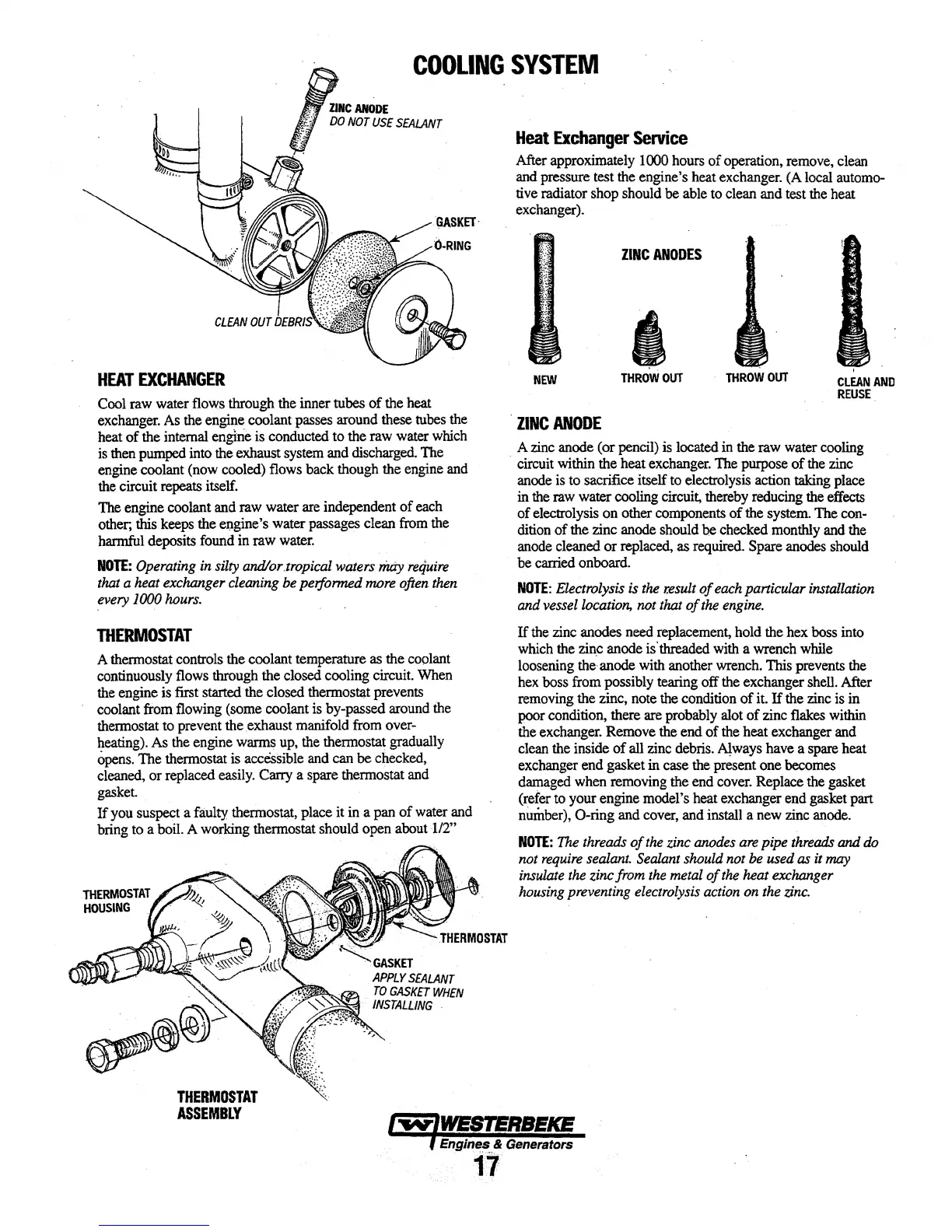
HEAT
EXCHANGER
Cool
raw
water
flows
through
the
inner tubes of
the
heat
exchanger.
As the
en~e
coolant
passes
around these tubes
!he
heat
of
the internal
engrne
is
conducted
to the
raw
water
which
is
then
pumped
into
the
exhaust
system
and
discharged.
The
engine
coolant
(now
cooled)
flows
back
though
the
engine
and
the
circuit
repeats
itself.
The
engine coolant and
raw
water are independent of
each
other;
this
keeps
the engine's water
passages
clean
from
the
harmful
deposits
found
in
raw
water.
NOTE:
Operating
in
silty
and/or.tropical waters
may
require
that a heat exchanger
cleaning
be
peiformed
more
often
then
every
1000
hours.
THERMOSTAT
A thermostat controls the coolant temperature
as
the
coolant
continuously
flows
through
the
closed
cooling circuit.
When
the
engine is first started
the
closed
thermostat
prevents
.
coolant
from
flowing
(some
coolant
is by-passed
around
the
thermostat
to
prevent
the.exhaust
manifold
from
over-
heating).
As
the engine
warms
up,
the
thennostat
gradually
opens.
The
thermostat
is
accessible
and
can
be
checked,
cleaned,
or
replaced
easily.
Carry a spare thennostat
and
gasket.
If
you
suspect a
faulty
thermostat,
place it
in
a pan
of
water
.~d
bring
to
a
boil.
A
working
thermostat should
open
about
1/2
Heat
Exchanger
Service
After approximately 1000
hours
of operation,
remove,
clean
and
pressure
test
the
engine's
heat
exchanger.
(A
local
automo-
tive
radiator
shop
should be able
to
clean
and test
the
heat
exchanger).
·~
NEW
.
ZINC
ANODE
ZINC
ANODES
a
THROWOUT
THROWOUT
CLEAN
AND
REUSE.
A
zinc
anode
(or
pencil)
is located
in
the
raw
water
cooling
·
circuit
within
the
heat
exchanger.
The
purpose of
the
zinc
anode
is
to
sacrifice itself
to
electrolysis
action
taking
place
in
the
raw
water
cooling
circuit,
thereby
reducing
the
effects
of
electrolysis
on
other
components
of the
system.
The
con-
dition
of the zinc
anode
should
be
checked
monthly
and
the
anode
cleaned
or
replaced,
as
required.
Spare
anodes
should
be
carried
onboard.
NOTE:
Electrolysis
is
the
r.esult
of
each
particular
installation
and
vessel
location, not
that
of
the
engine.
If
the
zinc
anodes
need
replacement,
hold
the
hex
boss
into
which
the
zinc
anode
is·
threaded
with
a
wrench
while
loosening
the:
anode
with
another
wrench.
This
prevents
the
hex
boss
from
possibly
tearing
off
the
exchanger
shell.
After
removing
the zinc,
note
the
condition
of it.
If
the
zinc
is
in
poor
condition, there
are
probably
alot of zinc
flakes
within
the
exchanger.
Remove the end
of
the heat
exchanger
and
clean
the
inside
of
all
zinc
debris.
~ways
have a
spare
heat
exchanger end gasket in case
the present one
becomes
damaged
when
removing
the
end
cover.
Replace the
gasket
(refer
to
your engine model's
heat
exchanger
end
gasket
part
number),
0-ring and
cover,
and
install a
new
zinc
anode.
NOTE:
The
threads
of
the
zinc
anodes
are
pipe
threads.
and
do
not
require
sealant.
Sealant
should not
be
used as
it
may
insulate
the
zinc
from
the
metal
of
the
heat
exchanger
housing
preventing
electrolysis
action
on
the
zinc.
THERMOSTAT
ASSEMBLY
lwlWESTERBEKE
I Engines & Generators
17

Related product manuals