TESTING
THE
ENGINE
COMPRESSION
BY-PASSING
THE
ECU
DESCRIPTION
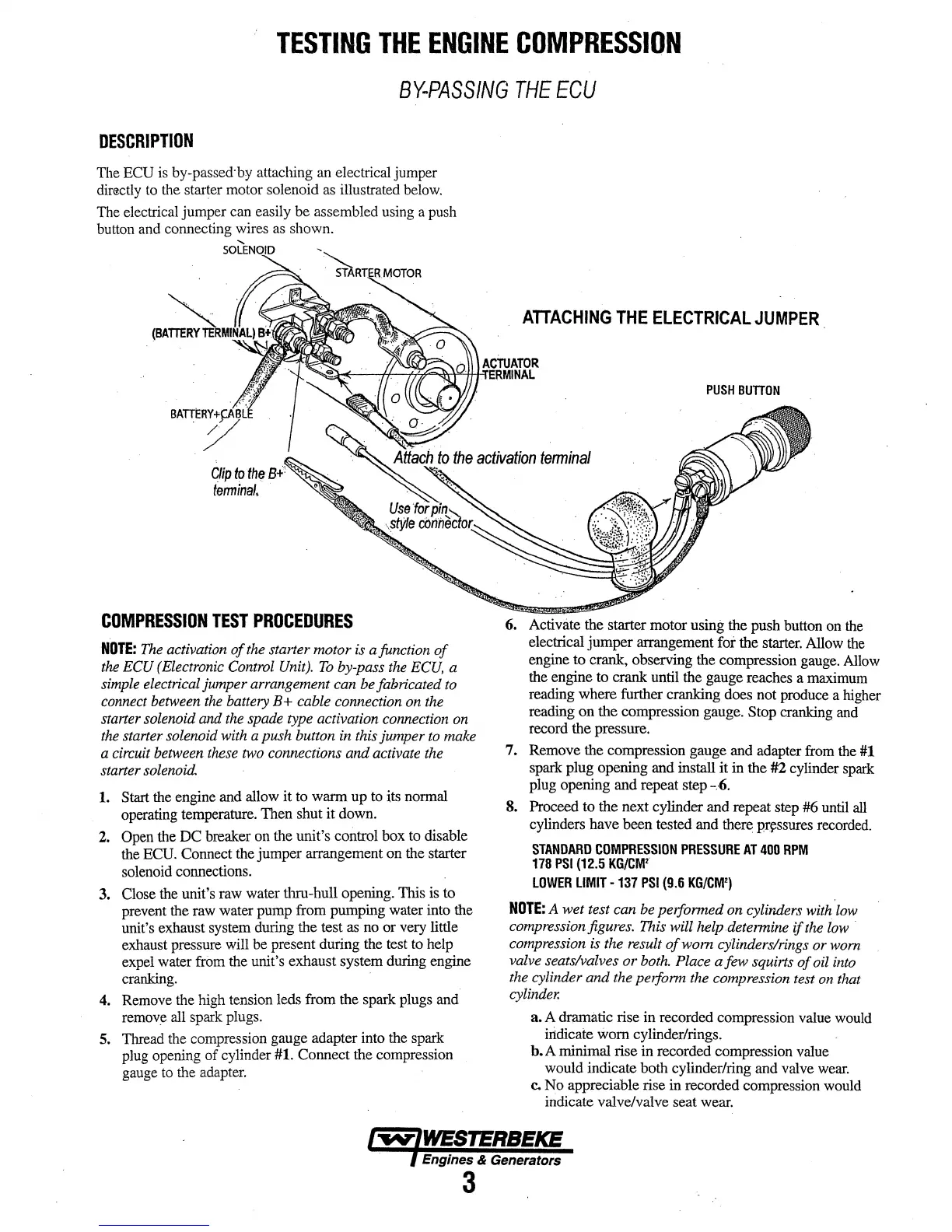
The
ECU
is
by-passed·by attaching
an
electrical jumper
dirnctly
to
the
starter motor solenoid
as
illustrated
below.
The
electrical jumper can easily
be
assembled
using
a
push
button
and
connecting
wires
as
shown.
COMPRESSION
TEST
PROCEDURES
NOTE:
The
activation
of
the
starter motor
is
a function
of
the
ECU
(Electronic
Control
Unit).
To
by-pass
the
ECU,
a
simple
electrical jumper arrangement
can
be fabricated
to
connect
between
the
battery
B+
cable connection
on
the
starter solenoid and
the
spade type activation connection
on
the
starter solenoid
with
a push button
in
this jumper
to
make
a
circuit
between
these
two
connections and activate
the
starter
solenoid.
1.
Start
the
engine
and
allow
it
to
warm up
to
its
normal
operating temperature. Then shut
it down.
2.
Open
the
DC
breaker
on
the unit's control box
to
disable
the
ECU.
Connect
the
jumper arrangement on the starter
solenoid connections.
3. Close
the
unit's raw water thru-hull opening. This is to
prevent
the
raw
water pump from pumping water into
the
unit's exhaust system during the test
as
no
or
very
little
exhaust pressure will
be
present during
the
test
to
help
expel water
from
the
unit's exhaust system during engine
cranking.
4.
Remove
the
high tension leds from the spark plugs and
remove
all
spark plugs.
5.
Thread
the compression gauge adapter into
the
spark
plug
opening of cylinder #1. Connect the compression
gauge
to
the
adapter.
ATTACHING
THE
ELECTRICAL
JUMPER
6. Activate
the
starter motor using the push button
on
the
electrical jumper arrangement for the
starter.
Allow
the
engine to crank, observing
the
compression
gauge.
Allow
the
engine to crank until the gauge reaches a
maximum
reading where further cranking does not produce a higher
reading on the compression gauge.
Stop cranking
and
record the pressure.
7. Remove the compression gauge and adapter
from
the
#1
spark plug opening and install it
in
the #2 cylinder
spark
plug opening and repeat step
-.·6.
8. Proceed
to
the next cylinder and repeat step #6
until
all
cylinders have been tested and there
p~sures
recorded.
STANDARD
COMPRESSION
PRESSURE
AT
400
RPM
178
PSI
(12.5
KG/CM'
LOWER
LIMIT·
137
PSI
(9.6
KG/CM')
NOTE:
A wet test can
be
pelformed on cylinders
with
"zow
compression
figures.
This
will help determine
if
the
iow
·
compression
is
the
result
of
worn cylinders/rings or
worn
valve seats/valves
or
both.
Place a few squirts
of
oil
into
the
cylinder and
the
peiform
the
compression test
on
that
cylinder.
a.
A dramatic rise
in
recorded compression value
would
iridicate worn cylinder/rings.
b. A minimal rise in recorded compression
value
would indicate both cylinder/ring and valve
wear.
c.
No
appreciable rise in recorded compression
would
indicate valve/valve seat
wear.
Engines
&
Generators
3




 To Next Page