EasyManua.ls Logo

White 970 - Faggoting; Stretch Stitches; Adjusting Stretch Stitch Balance; Triple Straight Stitch

Default Icon
44 pages
Print Icon
To Next Page IconTo Next Page
To Previous Page IconTo Previous Page
Loading...
AGGOTNG
X
his
is
a
popular
decorative
stitch
(used
in
sleeves
or
fronts
blouses
and
dresses).
To
attach
two
separate
pieces
of
tbric
together,
leave
a
little
space
in
between.
To
prepare
e
fabric:
old
under
the
seam
allowances
on
the
cut
edges,
and
ress.
Baste
folded
edges
to
stabilizer
with
about
lI8
(0.3
m)
space
between.
Stitch
over
the
1/8”
(0.3
cm)
allowance,
ist
catching
the
fabric
fold
on
both
sides
with
needle.
lemove
bastings
and
stabilizer;
press.
STRETCH
STTCHES
3tretch
stitches
are
mainly
for
use
on
knit,
or
stretchable
abrics,
but
can
also
be
used
on
ordinary
materials.
DJUSflNG
STRETCH
STITCH
BALANCE
Stitch
length/super
(stretch)
stitch
control
should
be
at
‘4
mark
for
most
materials.
Depending
upon
the
type
of
fabric
used,
you
may
need
to
adjust
this
Control
to
match
forward
stitches
of
stretch
sewing
with
reverse
motion
stitches.
If
the
stitches
are
too
open,
turn
the
Control
to
S
position;
if
the
stitches
overlap,
turn
the
Control
to
L
position.
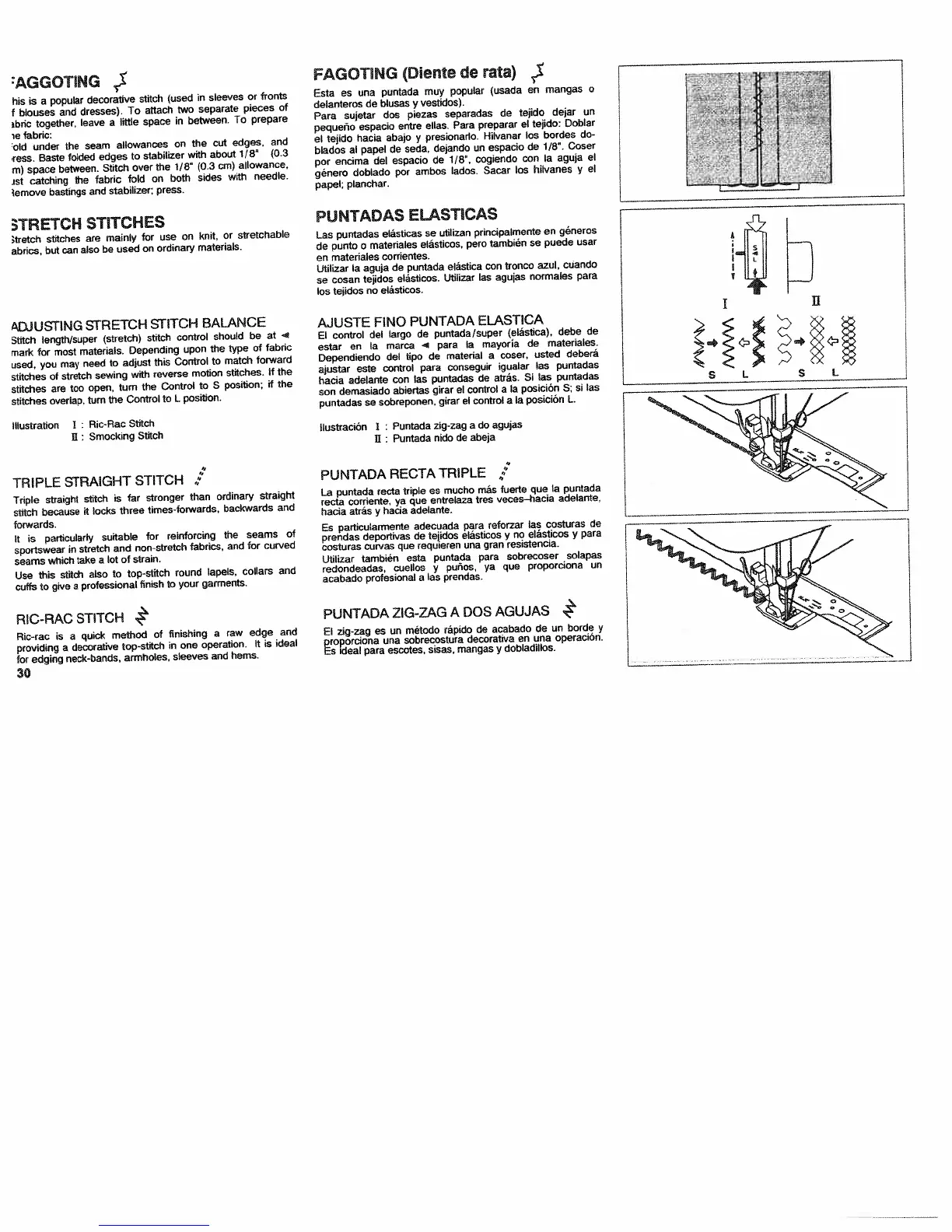
Illustration
I:
Ric-Rac
Stitch
B:
Smocking
Stitch
TRIPLE
STRAIGHT
STITCH
,9
Triple
straight
stitch
is
far
stronger
than
ordinary
straight
stitch
because
it
locks
three
times-forwards,
backwards
and
forwards.
It
is
particularly
suitable
for
reinforcing
the
seams
of
sportswear
in
stretch
and
non-stretch
fabrics,
and
for
curved
seams
which
take
a
lot
of
strain.
Use
this
stitch
also
to
top-stitch
round
lapels,
collars
and
cuffs
to
give
a
professional
finish
to
your
garments.
RIC-RAC
STITCH
*
Ric-rac
is
a
quiclc
method
of
finishing
a
raw
edge
and
providing
a
decorative
top-stitch
in
one
operation,
It
is
ideal
for
edging
neck-bands,
armholes,
sleeves
and
hems.
30
FAGOTNG
(Dente
de
rata)
X
Eats
es
una
puntada
rnuy
popular
(usada
en
mangas
0
delanteros
de
blusas
y
vestidos).
Pars
sujetar
dos
piezas
separadas
tie
teiido
dejar
un
pequeno
espacio
entre
ellas.
Para
preparar
el
tejido:
Doblar
el
tejido
hacia
abalo
y
preaionarlo.
Hilvanar
los
bordes
do
blados
al
papal
tie
soda,
dejando
Un
espacio
de
1/8”.
Coser
por
encima
del
espacio
tie
if
8.
cogiendo
con
Ia
aguja
el
género
doblado
per
ambos
lados.
Sacar
los
hilvanes
y
el
papal;
planchar.
PUNTADAS
ELASTCAS
Las
puntadas
elásticas
se
utilizan
principalmente
en
géneros
tie
punto
0
materiales
elásticos,
pero
también
se
puede
usar
en
materiales
corrientes.
Utilizar
Is
aguja
de
puntada
elastics
con
tronco
azul,
cuando
se
cosan
tejidos
elásticos.
Utilizar
las
agujas
normales
pars
los
tejidos
no
elásticos.
AJUSTE
FINO
PUNTADA
ELASTICA
El
control
del
largo
tie
puntada/super
(elastics),
debe
de
estar
en
Ia
marca
‘4
para
Ia
mayoria
de
materiales.
Dependiendo
del
tipo
de
material
a
coser,
usted
deberé
ajustar
este
control
para
conseguir
igualar
las
puntadas
hacia
adelante
con
as
puntadas
tie
atrás.
Si
las
puntadas
son
demasiado
abiertas
girar
el
control
a
Ia
posición
S;
silas
puntadas
se
sobreponen,
gear
el
control
a
Is
posicién
L.
llustración
I
:
Puntada
zig-zag
a
do
agujas
U:
Puntada
nido
tie
abeia
PUNTADA
RECTA
TRIPLE
,‘
La
puntada
recta
triple
es
mucho
más
fuerte
que
Ia
puntada
recta
corriento,
ya
que
entrelaza
tres
veces—hacia
adelarite,
hacia
atrás
y
hacia
adelante.
Es
particularrnente
atiecuada
para
reforzar
las
costuras
tie
prendas
tieportivas
tie
tejidos
elásticos
y
no
elásticos
y
para
costuras
curvas
que
requreren
una
gran
resistencia.
Utilizar
también
eats
puntada
para
sobrecoser
solapas
redondeadas,
cuellos
y
punos,
ya
que
proporciona
Un
acabado
profesional
a
las
prendas.
PUNTADA
ZIG-ZAG
A
DOS
AGUJAS
*
El
zig-zag
as
un
método
râpido
tie
acabado
tie
un
bortie
y
proporciona
una
sobrecostura
decorativa
en
una
operaciôn.
Es
ideal
pars
escotes,
sisas,
mangas
y
dobladillos.
“-44r--
.--
,,J1
.t•.•
j:
j’.f..•
l”
I
U
:1
:I1

Table of Contents

Related product manuals