Kunststoffschweißtechnik
WIDOS Einsteinstr. 5 Phone ++49 7152 9939 - 0
D-71254 Ditzingen-Heimerdingen Fax ++49 7152 9939 - 40
W. Dommer Söhne GmbH
website: www.widos.de Email: info@widos.de
17.02.14 Working Instructions WIDOS 5500 Page 29 of 48
7. Maintenance and Repair
Goal of the chapter is:
Keeping the nominal state and the operation capacity of the machine.
Increasing the efficiency by avoiding non-planned outage.
Efficient planning of the maintenance works and the maintenance tools.
7.1. Maintenance and Inspection, Repair
All maintenance and repair works have to be basically performed with the
machine in off position.
During this the machine has to be secured against unauthorized switching on.
Prescribed maintenance and inspection works should be performed in time.
The DVS gives the advice of inspection works after 1 year.
For machines with a specially high usage percentage the testing cycle should be
shortened.
The works should be performed at the WIDOS GmbH company or by an
authorized partner.
7.2. Clamping Elements
For a long service life clean and grease regularly the threaded spindles and the joint parts
which are used for clamping the pipes.
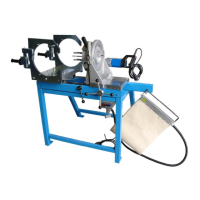
7.3. Planer
Check the stress of the drive chain in the planer and grease it regularly. The cover of the
planer can be screwed off by means of the provided socket spanner.
Do not lay the planer on its blades.
Check the blades of the planer for sharpness, turn them if necessary (grinded on both
sides, max. thickness of the shavings: 0,2 mm!).
7.4. Storage
The cylindrical waves of the basic machine are to be kept free from dirtiness and need to be
covered with a thin oil film if they are not being used.
Store dry.
7.5. Used Hydraulic Oil
Only use HLPD 32.
Features: protection against corrosion, resistance to ageing, abrasion-reducing additives, high
carrying capacity and particulary water retending.
The hydraulic oil has to be disposed of properly.


 To Next Page