Manual Flying in Assisted Mode
Use the remote control for manual flying in Assisted Mode. Read the following section carefully before you switch to Assisted Mode. Use the "Assisted" button (5) on your
RC to switch from Auto or RTH Mode to Assisted Mode. The flight regime will stay as it was before you switched to Assisted Mode, i.e., if you engage Assisted Mode
during cruise flight, you will take over in cruise, and if you engage Assisted Mode during hover flight, you will take over in hover flight. Be aware that there are no extended
safety features (collision avoidance or similar) available for WingtraOne.
Flight Instructions
The main reason to take over (switching to Assisted Mode) should be to hold or adjust the position before landing. Taking over in cruise is a safety feature that can be
used e.g. in case of bird attacks or if RTH can not be performed safely. When flying in Assisted Mode you won't be able to collect images. The easiest point in time to take
over is when WingtraOne is hovering. In this case, WingtraOne is stabilized and it will stay at its current location. If you need to change to Assisted Mode during cruising, it
is therefore advisable to immediately do a back-transition to change to hover. With that procedure you will have time to think before further actions need to be taken.
Caution: WingtraOne can severely harm people if handled inappropriately. Only fly WingtraOne manually if you know what you are doing.
Caution: Depending on GPS quality, WingtraOne can drift for several meters. Be prepared to react.
Hover
Flying WingtraOne in hover works similarly to flying a multicopter. WingtraOne will keep its position if you do not touch the sticks. Likewise, it will move according to your
control stick input.
Cruise
You can fly WingtraOne in cruise mainly with two control inputs: rising/sinking (pitching) and turning. WingtraOne will fly at constant altitude, speed (16m/s), and heading if
you do not touch the sticks and rise/sink/turn according to your control stick input.
Transition
Use the "Transition" button (6) to transition from hover to cruise or vice versa.
Forward-transition (hover->cruise): Make sure you are on a safe altitude before you transition into forward flight (cruise). There is no option to rise or interact in any way
during transition!
Back-transition (cruise->hover): The back-transition needs a lot of space. Engage it 50m before you reach the point at which you want to hover. Always engage back-
transition at a safe distance and altitude away from obstacles and yourself. There is no option to interact in any way during transition!
Landing
If you are flying in Assisted Mode in cruise, transition back to hover by using the "Transition" button (6) at a safe distance and altitude. In case of low wind, change the
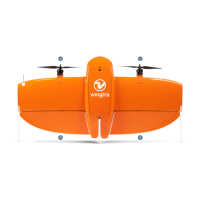
heading after back transition such that the Wingtra logo is facing you to simplify the navigation. Direct WingtraOne to its intended landing position. WingtraOne will use its
distance sensor to detect landing and switch-off the engines at 25cm distance above ground. As a safety feature, WingtraOne only listens to the distance sensor if landing
is commanded, which means that the left stick on the RC is pushed down.
Remote Control


 To Next Page