pg | 100
pH and pH/ORP Sensors
Storage and Rehydration
pH and pH/ORP sensors have two specic storage requirements: they should not be stored in distilled or
deionized water and their reference electrode junction should never dry out. is section will identify storage
as “long-term” or “short-term.” Long-term denotes storage during times of long inactivity (over-wintering,
end of monitoring season, etc.). Short-term denotes storage during times the sonde will be used at a regular
interval (daily, weekly, biweekly, etc.).
1 Short -term storage
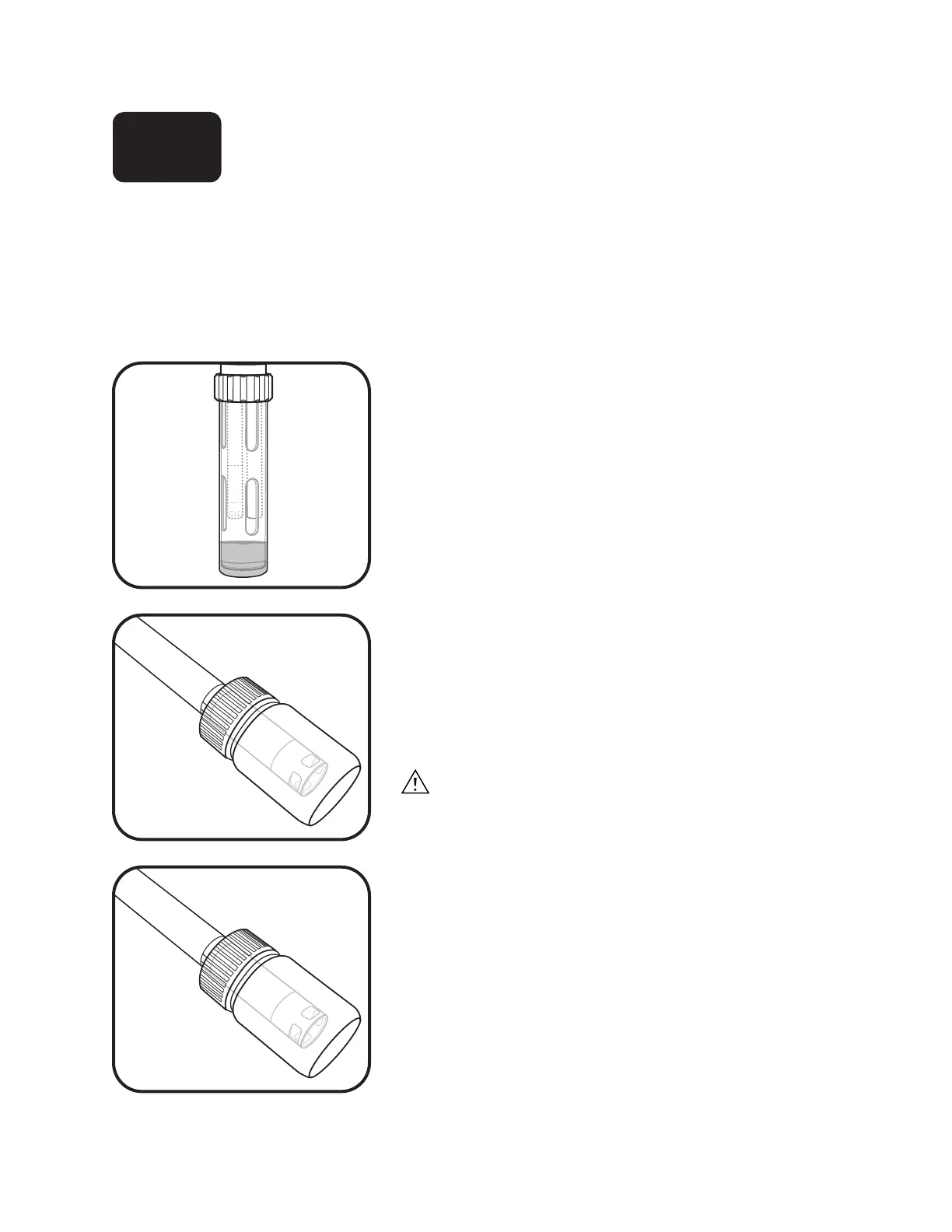
When in regular eld use, the sensor should remain
installed on the sonde in an environment of water-
saturated air. Place approximately 0.5 in (1 cm) of any water
(deionized, distilled, tap, or environmental) in the bottom
of the calibration cup. Insert the sonde and sensor into the
cup and screw it on tightly to prevent evaporation. (More
information in “Short-Term Sonde Storage” section.)
2 Long-term storage
Remove the sensor from the sonde and insert its sensing
end into the bottle that the sensor was shipped in. Install
the bottle’s o-ring and cap then tighten. is bottle contains
a 2 molar solution of pH 4 buer. If this solution is
unavailable, users may store the sensor in tap water.
Do not store the pH/ORP sensor in Zobell solution.
3 Rehydrate reference junction.
If the pH sensor has been allowed to dry, soak the sensor
for several hours (preferably overnight) in a 2 molar (2
M) solution of potassium chloride (KCl). In order to
create a 2 M KCl solution, dissolve 74.6 g of KCl in 500
mL of distilled or deionized water. If KCl is unavailable,
a tap water or pH 4 buer soak may restore function. If
the sensor is irreparably damaged, users must replace the
sensor module.
2 M KCl
6.13


 To Next Page
 Loading...