ELECTRICAL COMPONENTS
8-61
5. Charge:
• Battery
(refer to the appropriate charging method)
EWA19390
Do not quick charge a battery.
ECA24800
• Do not use a high-rate battery charger
since it forces a high-amperage current
into the battery quickly and can cause bat-
tery overheating and battery plate damage.
• If it is impossible to regulate the charging
current on the battery charger, be careful
not to overcharge the battery.
• When charging a battery, be sure to remove
it from the vehicle. (If charging has to be
done with the battery mounted on the vehi-
cle, disconnect the negative battery lead
from the battery terminal.)
• To reduce the chance of sparks, do not
plug in the battery charger until the battery
charger leads are connected to the battery.
• Before removing the battery charger lead
clips from the battery terminals, be sure to
turn off the battery charger.
• Make sure the battery charger lead clips are
in full contact with the battery terminal and
that they are not shorted. A corroded bat-
tery charger lead clip may generate heat in
the contact area and a weak clip spring may
cause sparks.
• If the battery becomes hot to the touch at
any time during the charging process, dis-
connect the battery charger and let the bat-
tery cool before reconnecting it. Hot
batteries can explode!
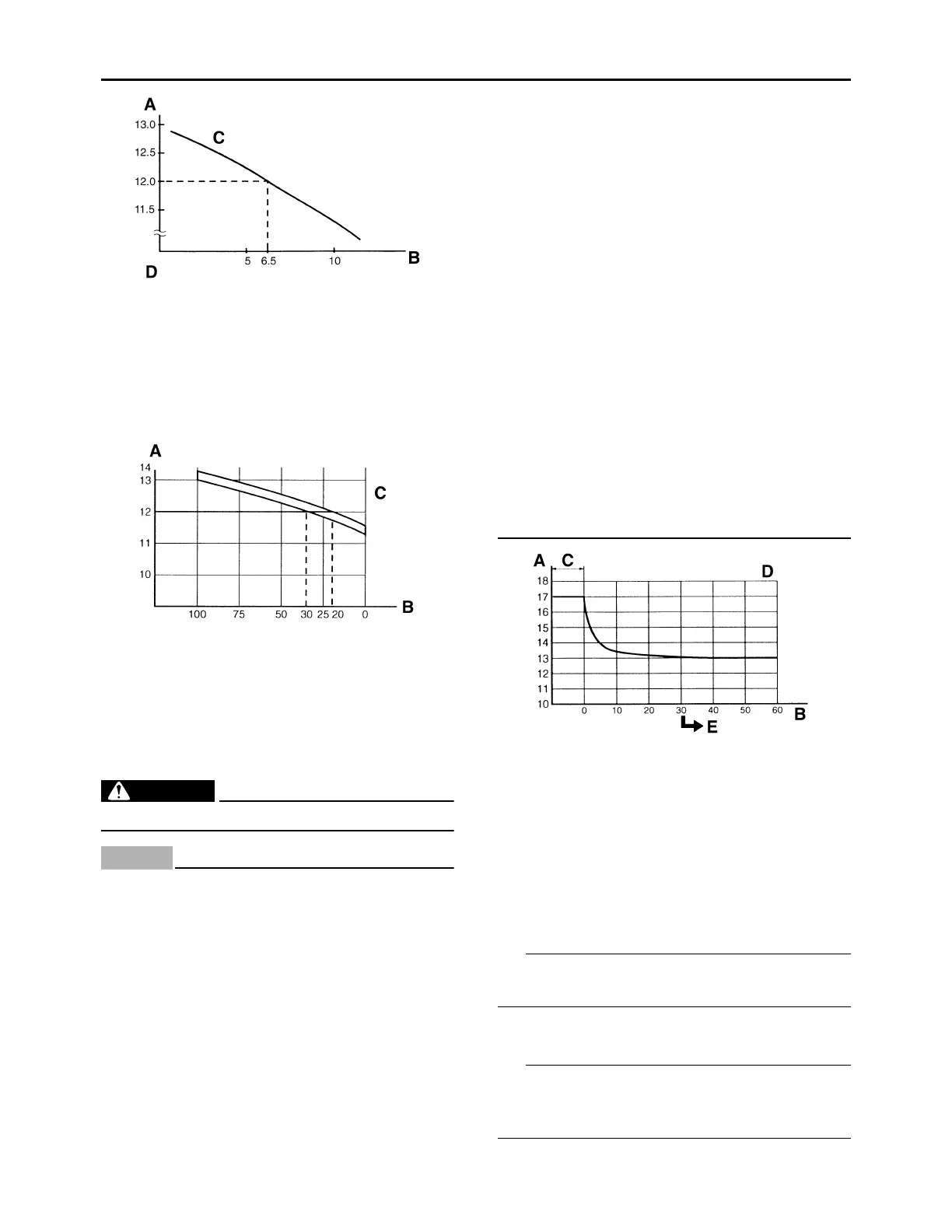
• As shown in the following illustration, the
open-circuit voltage of a VRLA (Valve Reg-
ulated Lead Acid) battery stabilizes about
30 minutes after charging has been com-
pleted. Therefore, wait 30 minutes after
charging is completed before measuring
the open-circuit voltage.
Charging method using a variable-cur-
rent (voltage) charger
a. Measure the open-circuit voltage prior to
charging.
Voltage should be measured 30 minutes after
the engine is stopped.
b. Connect a charger and ammeter to the
battery and start charging.
Set the charging voltage to 16–17 V. If the set-
ting is lower, charging will be insufficient. If too
high, the battery will be over-charged.
c. Make sure that the current is higher than
A. Open-circuit voltage (V)
B. Charging time (hours)
C. Relationship between the open-circuit volt-
age and the charging time at 20 C (68 F)
D. These values vary with the temperature, the
condition of the battery plates, and the elec-
trolyte level.
A. Open-circuit voltage (V)
B. Charging condition of the battery (%)
C. Ambient temperature 20 C (68 F)
A. Open-circuit voltage (V)
B. Time (minutes)
C. Charging
D. Ambient temperature 20 C (68 F)
E. Check the open-circuit voltage.














 To Next Page