Luminosity Limits:
➢ Ballast Physical Minimum [enabled/disabled]: enables or disables the
physical minimum for the ballasts of the group.
• Minimum Luminosity Level [1…10…100] [x 0.1%].
➢ Economical Mode [enabled/disabled]: enables or disables the economic
mode.
• Maximum Luminosity Level [100…1000] [x 0.1%].
Dimming Limits:
➢ Minimum Dimming Value [0…100] [%].
➢ Maximum Dimming Value [0…100] [%].
2.5.4 SWITCH & DIMMING
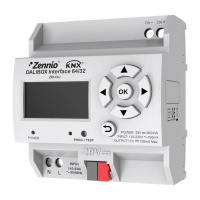
DALIBOX Interface 64/32 lets configuring the general On/Off switch control so that these
actions are performed immediately or through a smooth regulation (according to one
of the three configurable dimming times detailed in section 2.1).
Furthermore, it is possible to specify the luminosity level that the group will adopt when
a general switch-on order is executed: either a fixed value (configurable in parameters)
or the last value prior to the switch-off (i.e., a memory switch-on). In addition, in case of
selecting the latter, it is possible to select whether a second switch-on order should set
the maximum dimming value.
DALIBOX Interface 64/32 provides two general dimming controls besides the general
On/Off control:
Relative Dimming: modifies the dimming level through orders to increment or
decrement it by fixed percentages (“1.6%”, “3.1%”, “6.3%”, “12.5%”, “25%”,
“50%” or “100%”), which will be added to or subtracted from the current
dimming level of the group. A four-bit object is provided for the reception of
the relative dimming orders.
It is possible to select whether it will be possible to switch off a group through
a relative dimming order, in case the target value is lower than the minimum


 To Next Page