Ins p ect i o n | C hec k i ng t h e s us p e ns i o n h o o k o r sa f ety l o a d h ook
33
CHECKING THE SUSPENSION HOOK
OR SAFETY LOAD HOOK
ONLY WITH A SUSPENSION HOOK
OR SAFETY LOAD HOOK
This step only applies if a suspension hook is used
instead of a suspension bracket or if a safety load
hook is used instead of a normal load hook.
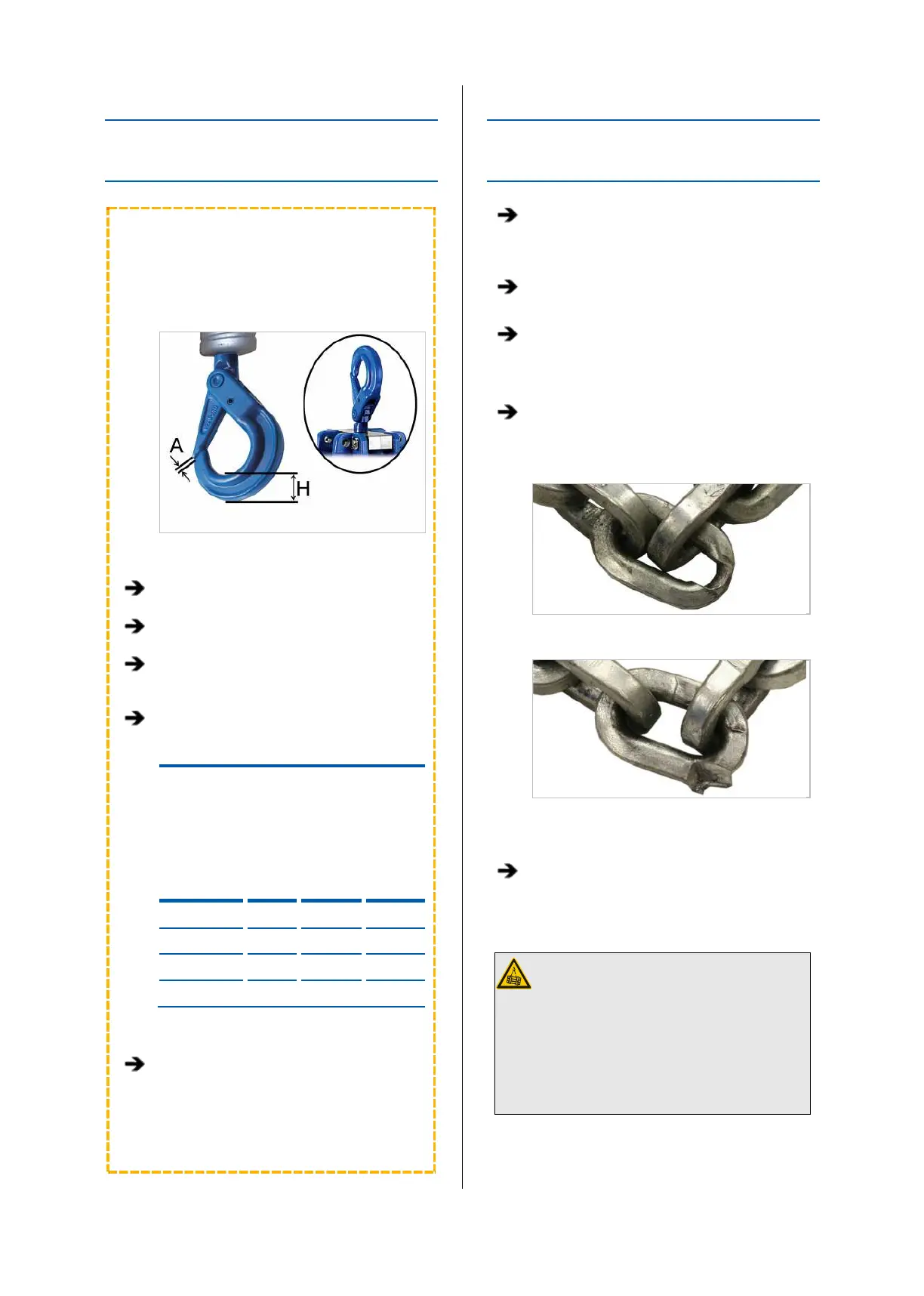
Safety load hooks (left) and suspension
hooks (right) are tested according to the
same procedure.
Measure the base height ‘H’ of the
suspension hook or safety load hook.
Measure the gap ‘A’ between the hook
safety latch and the hook body.
Measure the lateral displacement ‘B’
between the hook safety latch and the hook
body.
The measured values should neither
exceed nor fall short of the values in the
table.
Size of load hook
Maximum gap ‘A’
[mm]
Maximum lateral
displacement ‘B’
[mm]
Minimum base
height ‘H’ [mm]
BKT 6-10 2.2 3.5 17.1
BKT 7-10/8 2.7 4.5 20.7
BKT 10-10 3 6 26.1
BKT 13-10 3.3 7 34.2
If the load hook has been widened to a
greater degree than is allowed or if the base
height is below the permissible limit, replace
the load hook.
CHECKING THE CONDITION OF THE
CHAIN
Check the lubrication of the chain.
─ The chain must be lubricated over its entirety.
─ Pay particular attention to the area of the joints.
Check for chain corrosion.
There must be no visible corrosion.
Check for surface damage on the chain links
and between the joints.
There should be no visible damage such as
undercuts, constrictions or abrasion.
Inspect the entire chain for damage. The
damage shown here or any similar damage
should not be detectable on the chain.
Examples of damage:
The chain link is heavily worn.
The chain link is mechanically damaged.
If there are signs of damage or corrosion on
the chain, replace the chain and chain
sprocket. See “Exchanging the chain and chain
sprocket” page 45.
SUSPENDED LOAD!
Damage and corrosion reduce the
load capacity of the chain and could
lead to the chain breaking.
Replace damaged chains
immediately!



 To Next Page