4
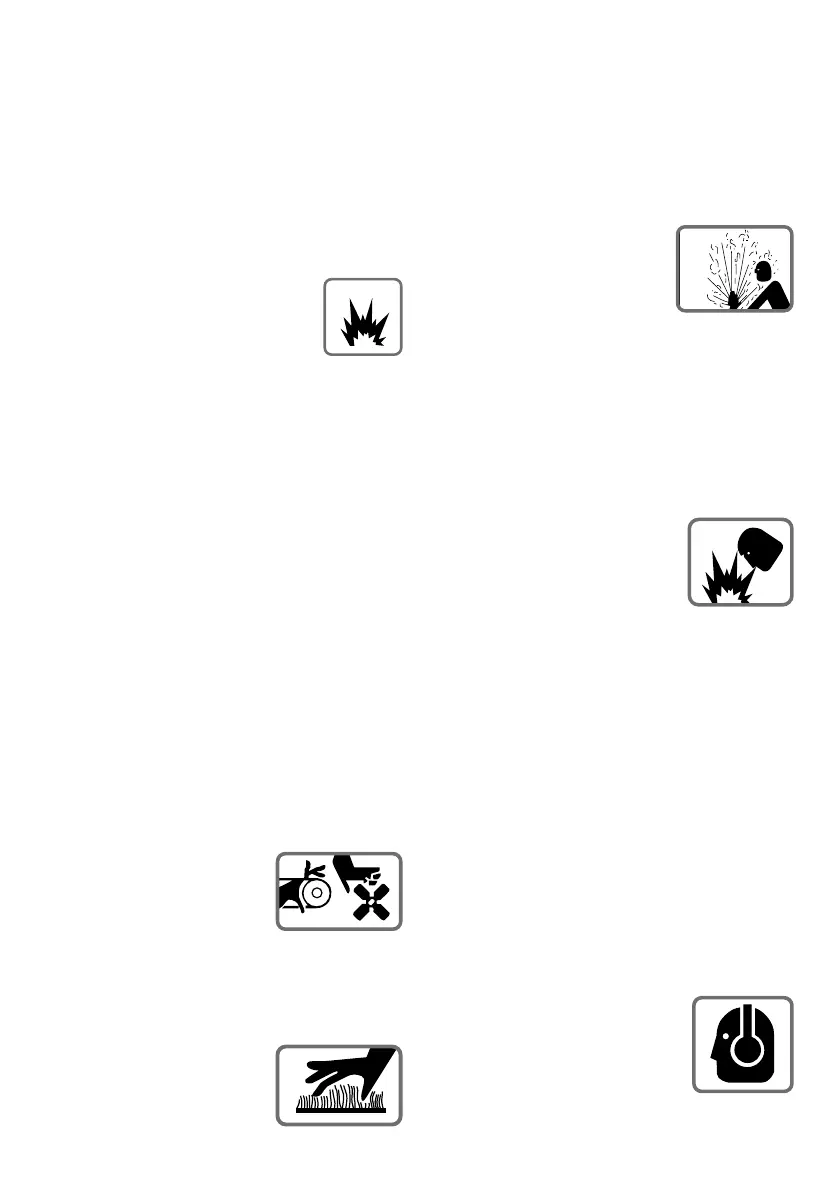
2.3. Fire and Explosion
Fuel and fumes associated with generator sets can
be flammable and potentially explosive. Proper care
in handling these materials can dramatically limit the
risk of fire or explosion. However, safety dictates that
fully charged BC and ABC fire extinguishers are kept
on hand. Personnel must know how to operate them.
Warning
• Ensure that the generator set room is
properly ventilated.
• Keep the room, the floor and the gen-
erator set clean. When spills of fuel, oil,
battery electrolyte or coolant occur, they should be
cleaned up immediately.
• Never store flammable liquids near the engine.
• Do not smoke or allow sparks, flames or other
sources of ignition around fuel or batteries. Fuel vapors
are explosive. Hydrogen gas generated by charging
batteries is also explosive.
• Turn off or disconnect the power to the battery
charger before making or breaking connections with
the battery.
• To avoiding arcing keep grounded conductive ob-
jects (such as tools) away from exposed live electrical
parts (such as terminals). Sparks and arcing might ignite
fuel or vapors.
• Avoid refilling the fuel tank while the engine is run-
ning.
• Do not attempt to operate the generator set with
any known leaks in the fuel system.
2.4. Mechanical
The generating set is designed
with guards for protection from
moving parts. Care must still be
taken to protect personnel and
equipment from other mechanical hazards when
working around the generator set.
Warning
• Do not attempt to operate
the generator set with the safe-
ty guards removed. While the
generator set is running, do not
attempt to reach under or around the guards to do
maintenance or for any other reason.
• Keep hands, arms, long hair, loose clothing and jewels
away from pulleys, belts and other moving parts.
Attention: Some moving parts cannot be seen clearly
when the set is running.
• Avoid contact with hot oil, hot
coolant, hot exhaust gases, hot sur-
faces and sharp edges and corners.
• Wear protective clothing includ-
ing gloves and hat when working around the generat-
ing set.
• Do not remove the radiator filler cap until the cool-
ant has cooled. Then loosen the cap slowly to relieve
any excess pressure before removing the cap com-
pletely.
2.5. Chemical
Fuels, oils, coolants, lubricants and
battery electrolyte used in this gen-
erator set are typical of the industry.
However, they can be hazardous to
personnel if not treated properly.
Warning
• Do not swallow or allow skin contact with fuel, oil,
coolant, lubricants or battery electrolyte. If swallowed,
seek medical treatment immediately. Do not induce
vomiting if fuel is swallowed. For skin contact, wash
with soap and water.
• Do not wear clothing that has been contaminated
by fuel or lube oil.
• Wear an acid resistant apron and face shield or gog-
gles when servicing the battery. If electrolyte is spilled
on skin or clothing, flush immediately with large quanti-
ties of water.
2.6. Noise
Generator sets that are not equipped
with sound attenuating enclosures
can produce noise levels in excess of
105 dB(A). Prolonged exposure to
noise levels above 85 dB(A) is haz-
ardous to hearing.


 To Next Page