9
• Keep all personnel away from the generator set
when it is suspended.
• If the generating set is going to be lifted, it should be
lifted by the lifting points fitted on canopied sets and
most open sets.
5.2. Location
In order to start to consider the possible layouts for
a site, the following criteria must first be determined:
• Planning and establishing the possible projects
• The total area available and any restrictions within
that area (i.e. buried or overhead services).
Any noise constraints. (i.e. the location of offices or
residential property). The access to the site, initially for
delivery and installation purposes, but afterwards for
the deliveries of fuel and servicing vehicles, etc.
• Ground condition, is it level or sloping?
• A forced ventilation system is required for the equip-
ment, which draws sufficient cooling and aspiration air
into the room at the back of the alternator and dis-
charges the air from in front of the engine. Dependent
upon the layout of the building, it may be necessary to
install additional ductwork to achieve the airflow re-
quired. • Protection from the elements such as rain,
snow, sleet, wind driven precipitation, flood water, di-
rect sunlight, freezing temperatures or excessive heat.
• Protection from exposure to airborne contaminants
such as abrasive or conductive dust, lint, smoke, oil
mist, vapors, engine exhaust fumes or other contami-
nants. • Protection from impact from falling objects
such as trees or poles, or from motor vehicles or lift
trucks.
• Clearance around the generator set for cooling and
access for service: at least 1 meter around the set and
at least 2 meters headroom above the set.
• Access to move the entire generator set into the
room. Air inlet and outlet vents can often be made
removable to provide an access point.
• Limited access to unauthorized personnel.
• If it is necessary to locate the generator set outside of
the building, the generator set should be enclosed in a
canopy. A canopy is also useful for temporary installa-
tions insider or outside the building.
• Check the internal grounding situation, ground bus
should be installed as close as possible to the GenSet.
• Place the unit in a location that is flat and has provi-
sions for water drainage, and strong enough to carry
the all Genset weight.
• DO NOT install generator where exhaust gas could
accumulate and enter inside or be drawn into a poten-
tially occupied building.
• Install the unit where air inlet and outlet openings will
not become obstructed.
• Install the Genset in well ventilated and clean areas
that protected from bad-weather conditions
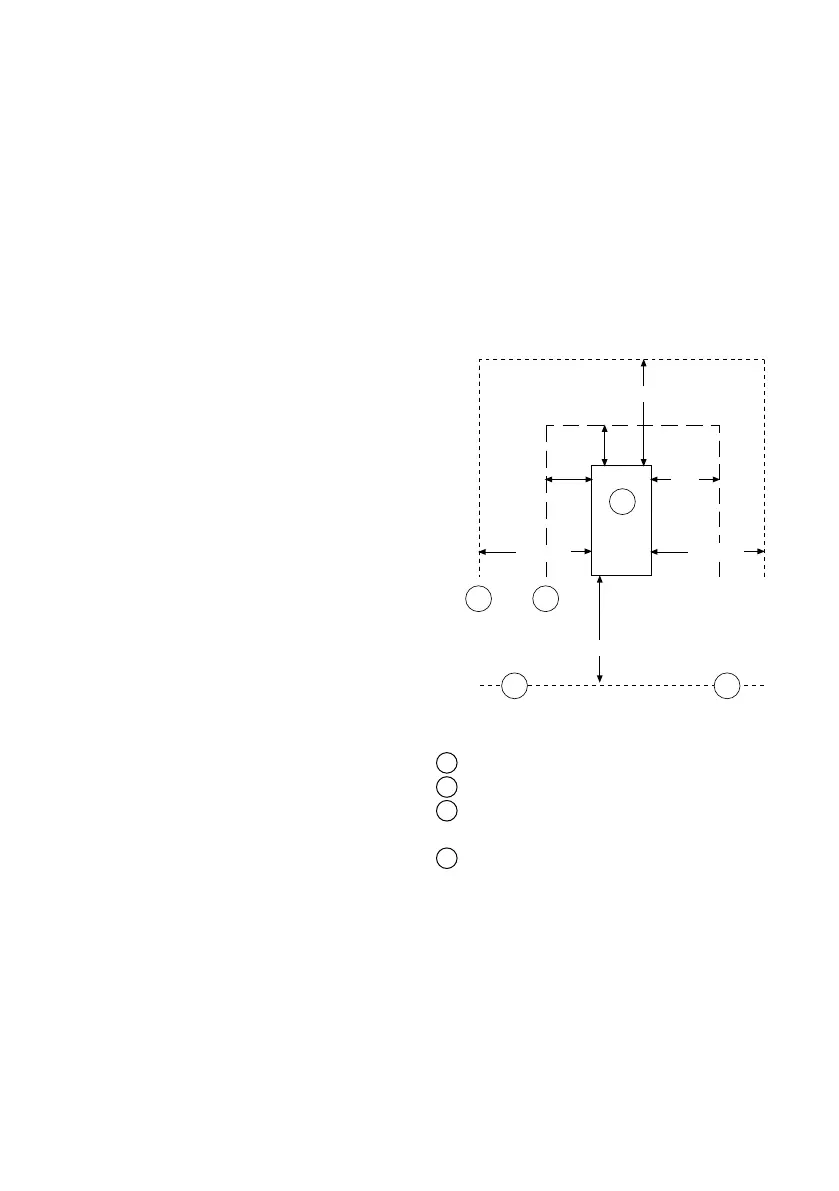
• Leave space between Genset and objects at least
1,5m
Non-Combustible material with Fire Resistant
A Rating of 1 hour or greater
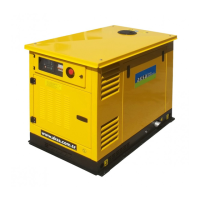
B Standby Generator
D Combustible Material or Structure with a Fire
Resistance Rating of less than 1 hour.
E Any structure or material. DO NOT connect
(A) and/or (D) to (E).
Figure 5.2. Location
5.3. Room Design Guidance Notes
Room size allowance
Ideally you should allow a minimum distance of 1 me-
ter from any wall, tank or panel within the room for
easy maintenance, and accessibility.
Inlet and outlet attenuators with weather louvers;
The inlet and outlet attenuators should be installed
B
1,5m1 ,5m
1 m
62 cm
1,5m
AD
1,5m
E E


 To Next Page