WTEC II ELECTRONIC CONTROLS TROUBLESHOOTING MANUAL
4–4 Copyright © 1998 General Motors Corp.
WIRE CHECK PROCEDURES
4. If the transmission being tested is an MD 3000, B 300, or B 400 after S/N 6510015259 or is an
HD 4000 or B 500, and if the connectors are clean and connected correctly, determine which wires in
the harness to test. Use the diagnostic code system schematic to locate the wire terminals. For this ex-
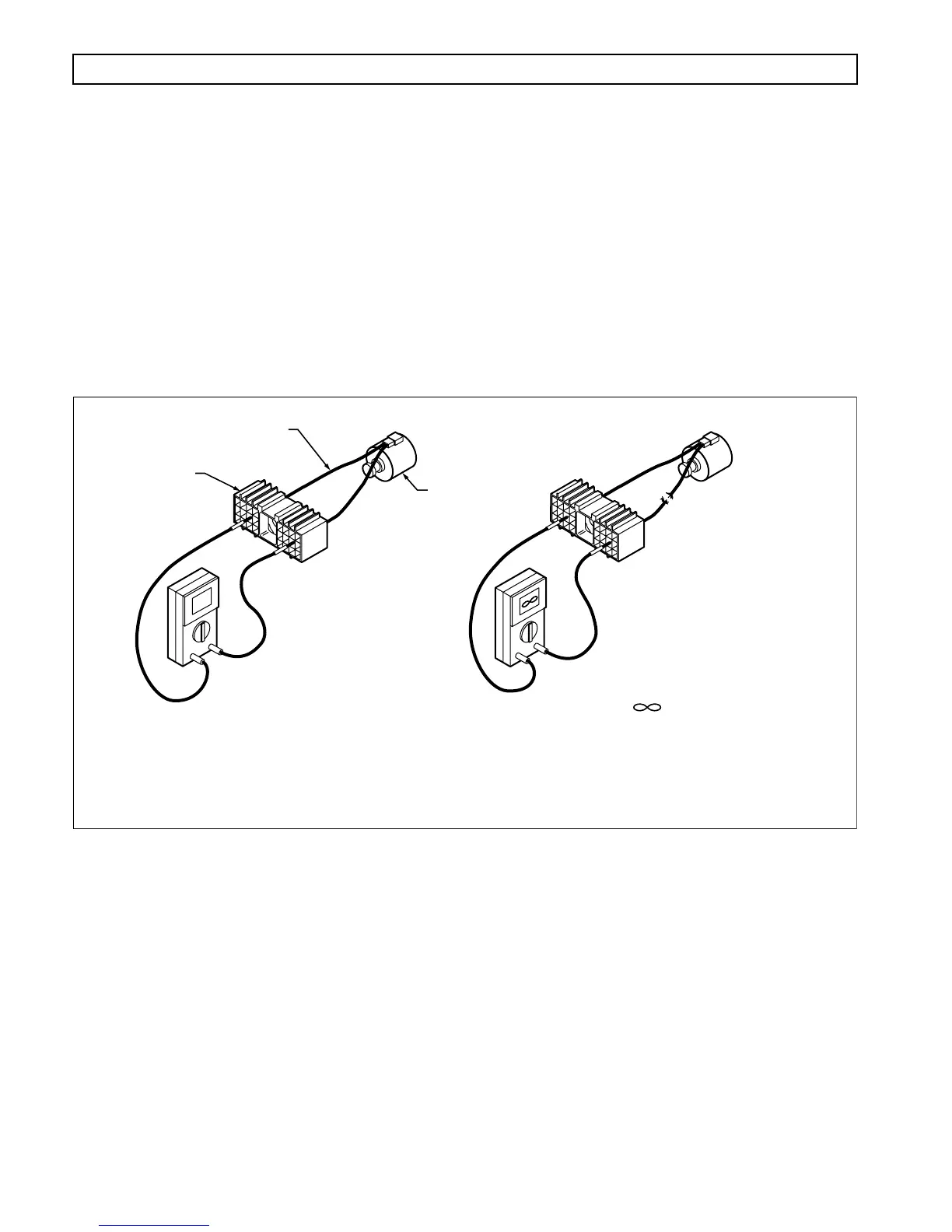
ample, Code 41 12, indicates an open or short-to-ground in solenoid “A” circuit — wires 102 and 120
(refer to Figure 4–4).
a. At the transmission connector, check the resistance of the A solenoid circuit. Resistance of a
solenoid circuit should be 2.4–5.0 Ohms — covering a temperature range of –18°C to 149°C
(0°F to 300°F). Refer to Solenoid Resistance vs. Temperature chart in Appendix K. No continuity
in the circuit (infinite resistance) indicates an open in the internal harness, the feedthrough connec-
tor, or the solenoid coil. Locate and repair the open in the internal harness or replace the internal
harness, replace the feedthrough connector, or replace the solenoid.
Figure 4–4. Checking Continuity
b. If the resistance check is good, check the harness for shorts between wires and to ground by per-
forming the following (refer to Figure 4–5):
(1) At the transmission connector, touch one probe of the VOM to one wire of the circuit being
tested and touch the other probe to each terminal in the connector and to chassis ground and to
the transmission main housing. Do this for both wires in the circuit being tested.
(2) If the VOM shows zero to low resistance, or the continuity beeper sounds, there is a short
between the two points being probed, wire-to-wire or wire-to-ground. An indication of a short
may be caused by a splice to the wire being checked. Check the wiring diagram in Appendix J
for splice locations. If the short is not a splice, then isolate and repair the short.
VOLT-
OHMMETER
SOLENOID
CONNECTOR
WIRING HARNESS
Circuit does not have continuity due to a
broken wire (open circuit). VOM reading is
very high (infinite Ohms or OL–Overlimit).
This could also be due to an open solenoid
coil or bad connection.
* Refer to Appendix K
INFINITE ( ) OHMS
+
–
3
.5
+
–
2–5 OHMS
AT NORMAL OPERATING
TEMPERATURE*
Circuit has continuity.
V00579.02



 To Next Page