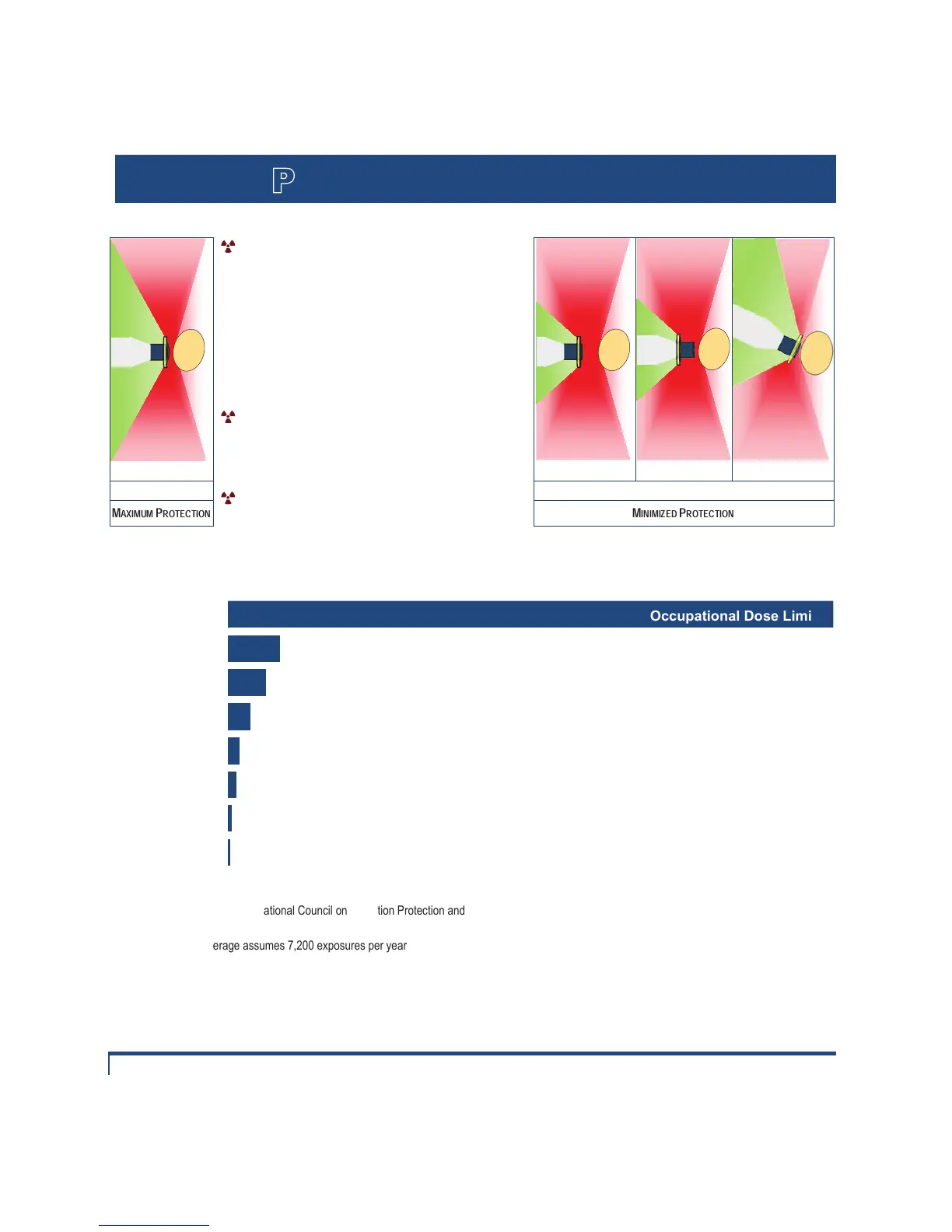
As shown in graphic representations,
protection (green area) from
backscatter radiation (red area) exists
when the NOMAD Pro is positioned
near the patient, is perpendicular to the
operator (with the patient’s head tilted if
needed), and the backscatter shield is
fully extended toward the pat
parallel to the operator.
Operation outside the protection zone
(or with a diminished protective zone)
requires proper precautions such as the
Do not operate if the backscatter
shield or collimator cone are broken!
MAXIMUM PROTECTION MINIMIZED PROTECTION
Occupational Dose Limit Requiring Dosimetry
1
Average Natural Background Radiation
2
Average Occupational Radiation Exposure for Flight Crews
3
Comparative Data for Whole Body Exposure (Annual)
General Public Dose Limit
1
Average Exposure Using NOMAD with D-Speed Film
4
Average Exposure Using NOMAD with F-Speed Film or Digital Sensor
4
1) Standards for Protection Against Radiation, 10 CFR 20 (US Federal Standards), 1994 (see also
NCRP Report No. 116
)
2)
NCRP Report No. 145
(National Council on Radiation Protection and Measurements), p7-9
3) "Estimated Cosmic Radiation Doses for Flight
Personnel", Feng YJ et al,
Space Medicine and Medical Engineering
, 15(4) 2002, p265-9
Normalized average assumes 7,200 exposures per year, and the average length of exposure for D-speed = 0.50 seconds, F-speed = 0.25
seconds, digital sensor = 0.20
Range of Exposure for Dental Personnel Using Conventional X-rays
2


 To Next Page