20
When using 88.2kHz and 96kHz as a sample
rate, you only have access to 8 channels of
digital input and 8 channels of digital output
(due to the ADAT protocol).
More information on how the iD mixer is used
to route to the optical outputs can be found
under The Routing Matrix section of this
manual.
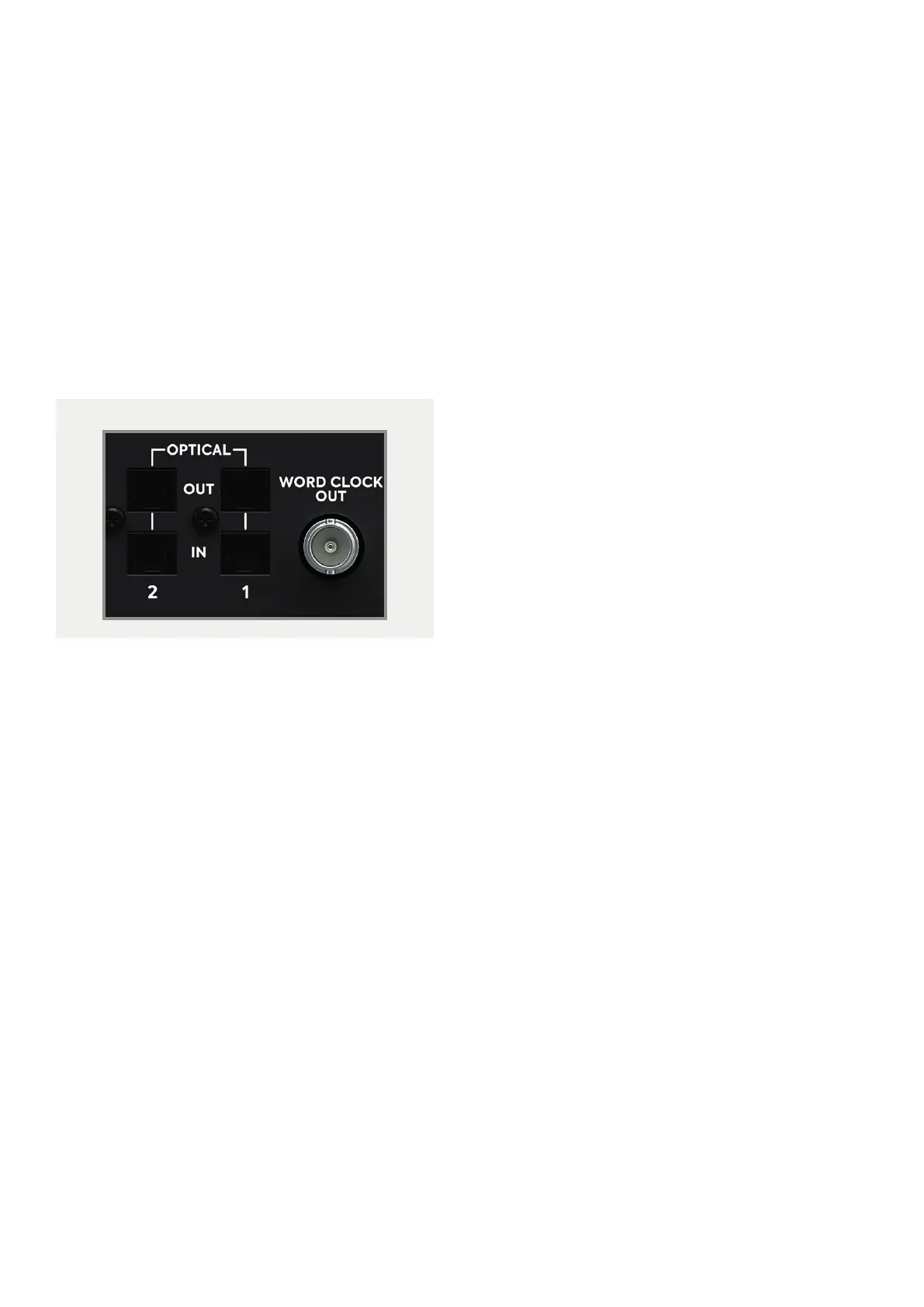
Word Clock Output
The iD44 also includes a BNC Word Clock
output which allows you to clock multiple
digital devices to the iD44’s master clock and
keep everything in sync.
The Word Clock output will send a clock signal
at the same sample rate (44.1, 48, 88.2 or
96kHz) that the iD44 is operating at. This will
occur regardless of whether the iD44 is being
clocked internally or externally.
Digital Inputs and Outputs
iD44 features two optical inputs and two
optical outputs. These can be set to operate
using optical stereo S/PDIF or 8-channel
ADAT using the iD mixer application. All i/o will
operate at up to 96kHz, with ADAT dropping
to 4 channels at sample rates of 88.2kHz or
higher.
Running in S/PDIF mode, the optical i/o
provides the option to integrate external
digital outboard, allowing up to 4 channels of
audio in and out of the iD44 at sample rates
up to 96KHz.
Running in ADAT mode, the optical i/o
provides a great way to expand to 20 inputs
for recording via external mic preamps such
as the Audient ASP800.
The ADAT outputs could also be connected
to headphone distribution systems such as a
HearbackTM System or to an 8-channel DAC
for summing purposes



 To Next Page