INSTALLATION and POWER
page 1 – 7
R-55e / July 2004
Audio and Control Wiring
All audio and control I/O connections to the R-55e console are made
through multipin DB-25 connectors located on the top of each module. The
output module also has a DB-9 connector. The factory supplied hand
crimping tool is used for all I/O wiring connections to and from the console
(see instruction on page 1-8).
Connection Procedures
As supplied from the factory, the console requires no logic connections
to function. Therefore an orderly installation begins with the audio wiring.
Note this manual is organized by module type (inputs, outputs, monitor
modules, etc.); each chapter contains detailed wiring instructions for its
module type. Proceed through the manual, chapter by chapter, until all
modules have been wired to suit your particular installation requirements.
Once proper audio operation is verified, go back to each individual chapter
and proceed with control wiring.
Unbalanced Connections (analog audio)
ANALOG INPUTS — Wire to the console with typical shielded two
conductor cable (like Belden 9451), just as if you were connecting a balanced
source. At the unbalanced source machine’s output, connect the black wire
(LOW) to the shield. If the machine has a -10 dBu output, don’t hesitate to
turn module input gain as high as is needed.
ANALOG OUTPUTS — R-55e consoles use an electronically balanced
output circuit. Care must be exercised when connecting them to an unbal-
anced system. While temporarily shorting the low side of the output signal
to ground will not cause any problems, continued operation will result in
increased distortion, decreased reliability, and possible oscillation prob-
lems. If you must connect the output to an unbalanced system, be sure to
leave the low side unterminated, and connect the unbalanced system to the
high side output and shield connections.
Modules Layout
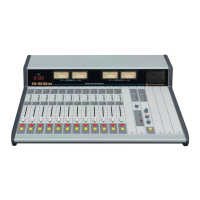
The R-55e console’s mainframe comes supplied with up to 20 (for 26 pos.
frame), 12 (for 18 pos. frame), or 8 (for 12 pos. frame) line level input
modules along with an output module, and a control room/studio module.
Each module type has its assigned slot (see drawings on pages 1-11, 11-12,
and 1-13). To handle mic level inputs, a quad mic preamp is included. Also
there can be optional modules: a superphone, a line select, a second studio,
and a tape remote module. Optional modules (except second studio) can be
placed in any input slot. The optional second studio module has a dedicated
slot (see layout drawings).
R-55e / Nov 2005


 To Next Page