45
About Time Weightings
The instrument uses three standard-defined time weightings: F, S and I. Time weightings define the exponential aver-
aging in the root-mean-square (RMS) measurement to average the fluctuations in sound levels and create useful read-
ings.
Time weightings use time constants. Time constants define the time it takes for the instrument to respond to a change in
sound levels.
l
F = 125 ms time constant, decay of 34.7 dB/s
The fast rise and decay of this time weighting means it will show a lot of the variations in the acoustic signal. You
can use this weighting to measure sounds that fade rapidly, such as a dog bark.
✐ Note: F time weighting can be used for most measurements.
l
S = 1 s time constant, decay of 4.3 dB/s
The relatively slow rise and decay of this time weighting means it will smooth the variations in the acoustic signal.
You can use this weighting to measure sounds that fade slowly, such as a bell toll.
l
I = 35 ms time constant, decay of 2.9 dB/s
When choosing a time weighting to use, ask yourself if you want to track or smooth the variations in sound levels over
time.
About Frequency Weightings
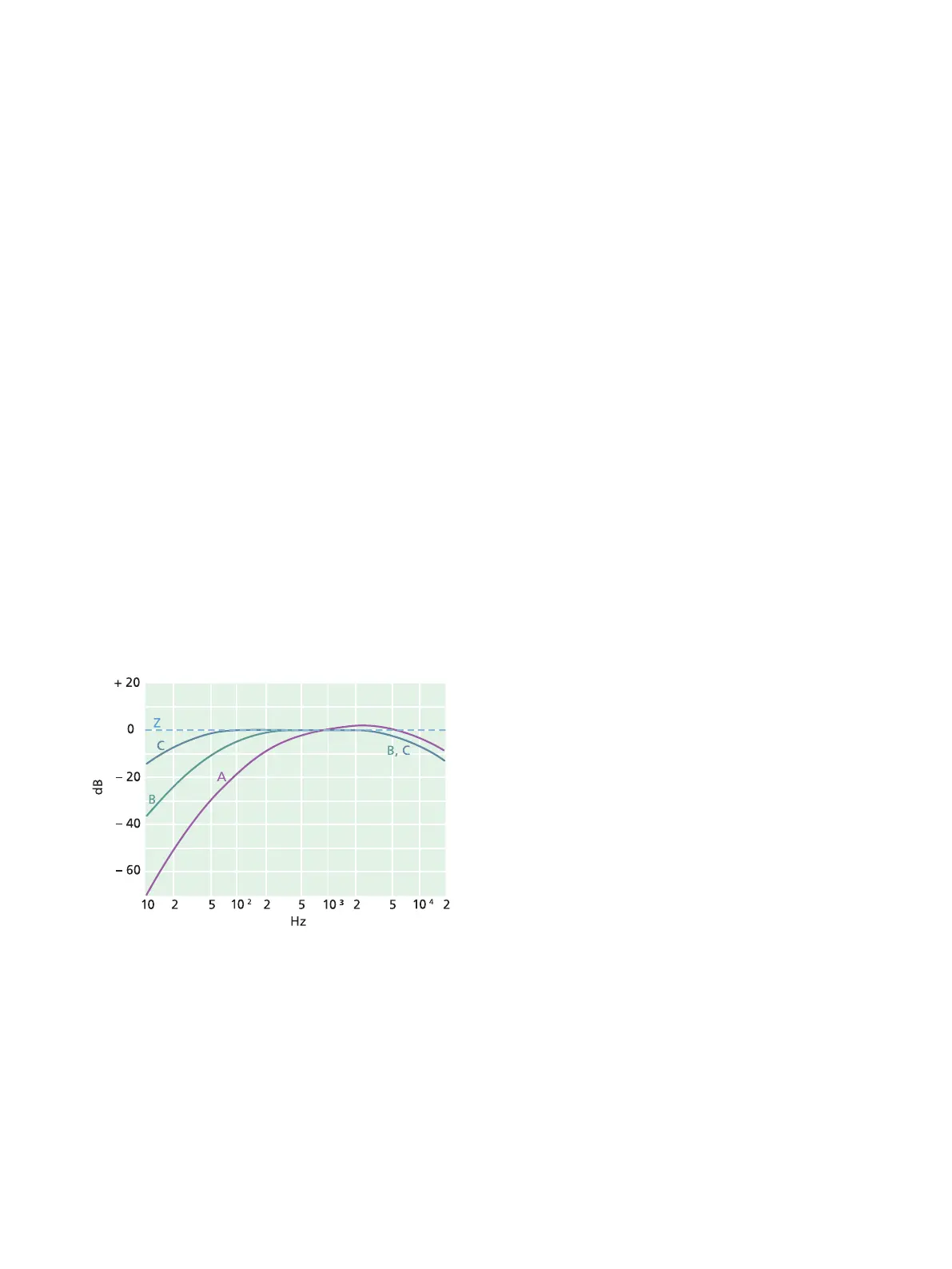
Frequency weightings mimic how humans hear sound.
A-weighting
l Represents the human ear’s response at low to medium sound levels
l Corresponding equal loudness curve: 40dB
l The most commonly applied frequency weighting
l Can be used for all sound levels
Set up the Instrument: Measurement Parameters



 To Next Page