49
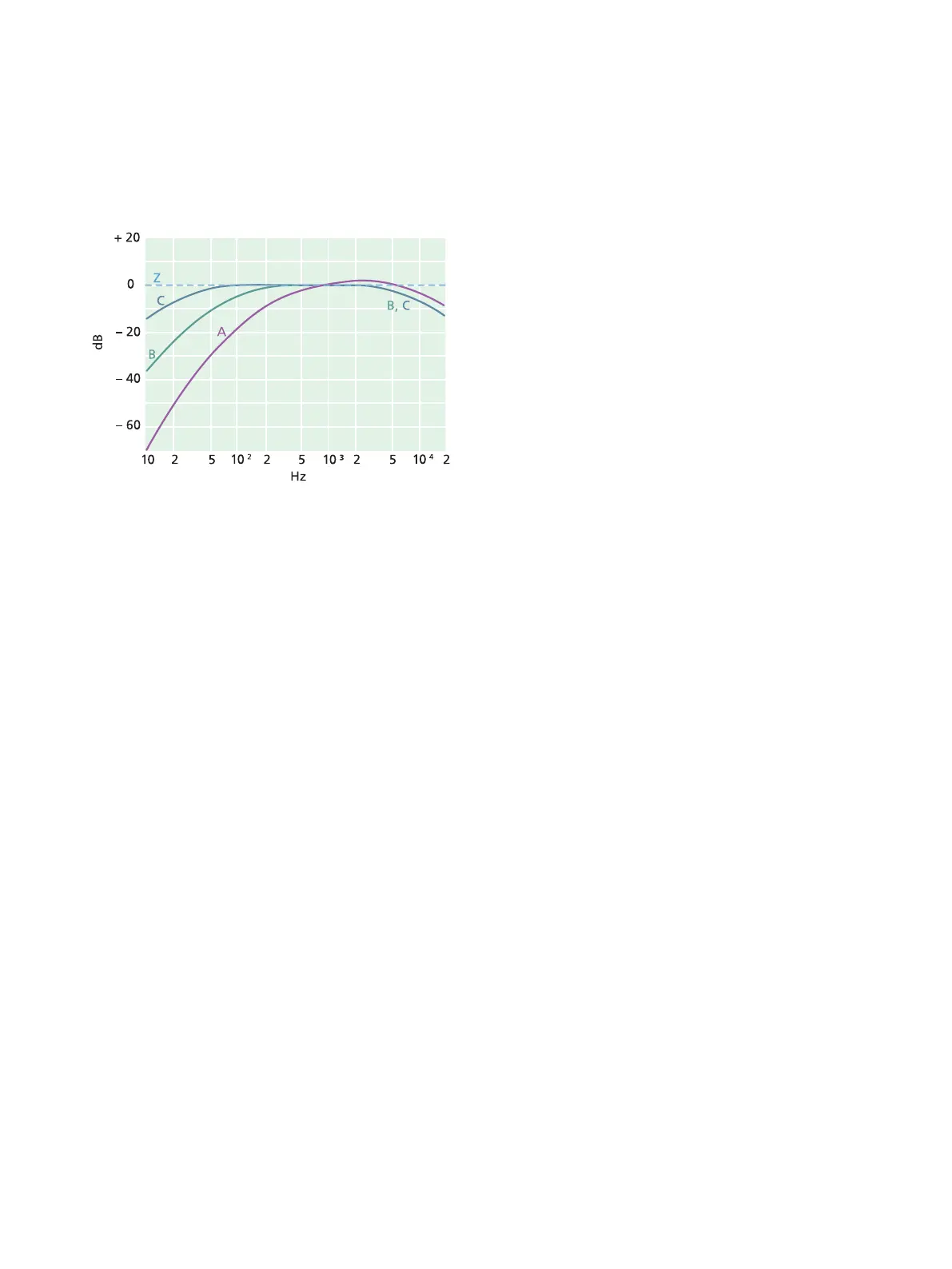
About Frequency Weightings
Frequency weightings mimic how humans hear sound.
A-weighting
l Represents the human ear’s response at low to medium sound levels
l Corresponding equal loudness curve: 40dB
l The most commonly applied frequency weighting
l Can be used for all sound levels
B-weighting
l Represents the human ear’s response at medium sound levels
l Corresponding equal loudness curve: 70dB
C-weighting
l Represents the human ear’s response at fairly high sound levels
l Corresponding equal loudness curve: 100dB
l Mainly used when assessing peak values of high sound pressure levels (LCpeak)
Z-weighting
l Without any frequency weighting
✐ Note: An equal loudness curve is a frequency response curve. Equal loudness curves are the experimental results
of presenting pure tones and levels at different frequencies to young people with no hearing impairment. Along a con-
tour line the young, average, normal listener will judge tones presented with different combinations of frequency and
dB to be equally loud.
Set up the Instrument: Measurement Parameters



 To Next Page