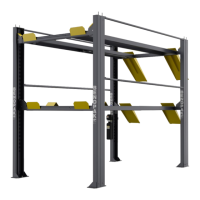
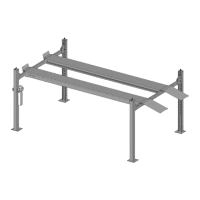
HD-973P Series Multi-Level Parking Lift 45 P/N 5900076 — Rev. B3 — January 2024
IMPORTANT! PLEASE READ NOW
Hydraulic Fluid Contamination
Hydraulic Fluid Contamination poses a serious issue for your Lift; contaminants such as water, dirt,
or other debris can make their way into the Hydraulic Hoses and Fittings on your Lift, making your new
Lift inoperable.
Your Lift is shipped with clean components; however, BendPak strongly recommends that you take a
secondary precaution to clean all Hydraulic Hoses and Fittings prior to making connections. It is better
and less costly to take these extra steps now so that you do not need to take your Lift out of service
later fixing issues that could have been prevented at the time of installation.
There are several ways to clean Hydraulic Hoses and Fittings:
• Compressed air. Use an air compressor to blow out contaminants from each Hydraulic Hose
and Fitting prior to installation. Clean, dry air is preferred. Wear eye protection (safety glasses,
goggles, or face shield) when using compressed air for cleaning. Never point an air hose nozzle at
any part of your body or any other person.
• Fluid flushing. If the Hydraulic Fluid is clean and compatible with the system fluid, you can flush
Hoses and Fittings to create turbulent flow to remove particulates. Always ensure that the fluid
itself is contaminant-free.
Some additional steps that will help keep the Hydraulic Fluid clean:
• Remove old thread seal tape. Some ports on the Hydraulic Cylinders are shipped with
temporary plugs secured with thread seal tape. Make sure to thoroughly remove any leftover
thread seal tape that may inadvertently enter the Hydraulic System.
• Use a liquid thread sealant only. Teflon paste-type thread sealant or Loctite™
5452 thread sealant is recommended for all NPT Fittings. Do not over tighten
NPT Fittings or they may crack. Do not use thread seal tape on flare-end JIC 37-
degree Fittings or ORB O-Ring Fittings.
• Always use clean equipment. If you use a dirty bucket or funnel to transfer the Hydraulic Fluid
into the Hydraulic Fluid Reservoir, the contaminants will be introduced into the Fluid. When using
cleaning rags, use a lint-free rag.
• Proper storage. Keep the Hydraulic Fluid sealed in its container until ready for use. Store the
Fluid in a clean, dry, and cool area.
• Cover the Hoses and Fittings. Before installation, do not leave the ends of the Fittings
exposed; the same applies to Hydraulic Hoses. Generally, keep the Hydraulic Hoses and Fittings
capped and in a clean area until ready for use.
• Filter the new Hydraulic Fluid. Just because it is new does not necessarily mean it is clean.
Use an offline filtration cart or kidney loop system to make sure the Hydraulic Fluid is clean before
being transferred into the Reservoir (even using a heavy-duty nylon mesh screen is better than
trusting what is left at the bottom of the barrel).
• Avoid mixing different types of Hydraulic Fluid. If Hydraulic Fluid needs to be replaced,
make sure to flush the Hydraulic System of the old Hydraulic Fluid before you add the replacement
fluid; do not mix the two together.


 To Next Page