49
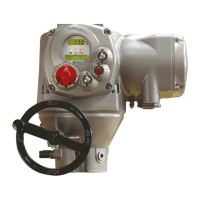
BIFFI FAIL SAFE ELECTRIC ACTUATORS, MODEL EFS2000V4
InstructIon and operatIng Manual
• Opening time: this information is only
available in the general data log. It is updated
at the end of every full valve stroke of the
valve in opening direction. The data of the
previous stroke are lost. It gives the time
necessary to the valve to move from the close
position to the open position, expressed in
hours, minutes and seconds.
• Closing time: this information is only available
in the general data log. It is updated at the
end of every full valve stroke of the valve in
closing direction. The data of the previous
stroke are lost. It gives the time required to
move the valve from the open position to the
close position, expressed in hours, minutes
and seconds.
• Contactor cycles: this number represents
the amount of cycles of contactors K1 and
K2. The value indicated in the general data
log is also used to generate the ‘maximum
contactor cycles’ warning when the maximum
allowable number of cycles of the contactor
is reached (see paragraph 12.11 of document
BIFRM-0003-EN). If the main power is DC or
single phase and in modulating actuators, the
counters (general and recent) are hold to 0.
• Motor run time: this parameter counts the
hours with motor energized.
• No power time: this parameter counts the
hours without electrical power.
• Utilization rate: this value is incremented
every 200 full strokes of the actuator. It
reaches 100% after 20.000 full strokes.
• Temperature min.: this is the lowest
temperature value (in °C) measured inside
the electronics compartment.
• Temperature max.: this is the highest
temperature value (in °C) measured inside
the electronics compartment.
• Term. temp. min.: this is the lowest
temperature value (in °C) measured inside
the terminal board enclosure.
• Term. temp. max.: this is the highest
temperature value (in °C) measured inside
the terminal board enclosure.
• Motor temp. max.: this is the highest
temperature value (in °C) measured in the
electrical motor.
• Thermostat alarms: this counter represents
the number of alarms due to the high
temperature of the electrical motor and to the
tripping of the motor thermostat.
• Torque alarms: this counter represents
the number of alarms due to high torque in
opening and closing.
14.4.5 Maintenance date
The routine allows viewing the following dates:
• Last date
• Next date
• Start-up date
• Recent log date
• Last date: this is the date of the last
maintenance operation. The date should
be updated by the user after each
maintenance operation (see ‘Set-up routines’,
maintenance, chapter ‘Set maintenance
date’).
• Next date: this is the date of the next
scheduled actuator maintenance. When
the date is reached, the EFS2000 generates
a maintenance request warning. The date
should be updated by the user after all
maintenance operations (see Set-up menu,
maintenance, chapter I).
• Start-up date: this is the date of actuator
start-up. During commissioning, the user
should enter the start-up date (see Set-up
menu, maintenance, chapter I).
• Recent log date: This is updated after
entering command ‘Clear recent data log’
(see Set-up menu, maintenance, chapterI).
This command clears the ‘recent data log’
counters. The content of ‘recent log’ is
updated starting from ‘recent log date’.
View procedure
• Move the local selector to OFF and then
simultaneously press OPEN and STOP within
20 sec (see chapter ‘Local controls, entering
view and set-up mode). Select the language
according to the instructions (see ‘Entering
the view mode’). When the message displayed
is ‘VIEW MODE OK?’ press YES. Press NO to
scroll through the list of available menus and
press YES to select the Maintenance menu.
• Press NO to scroll through the list of
available routines and press YES to select
operation log.
• Press YES to select general data or press NO
to skip to recent data.
• Press YES to scroll through the list of values.
• Press YES to view the recent data log or press
NO to exit.
• Press YES to scroll through the list of values.



 To Next Page