Model 621 User’s Manual INTRODUCTION
Bristol Instruments, Inc. 5
General Safety Considerations
This product has been designed and tested in accordance with IEC 61010-1 and has
been supplied in a safe condition. The instruction documentation contains information
and warnings that must be followed by the user to ensure safe operation and to maintain
the product in a safe condition.
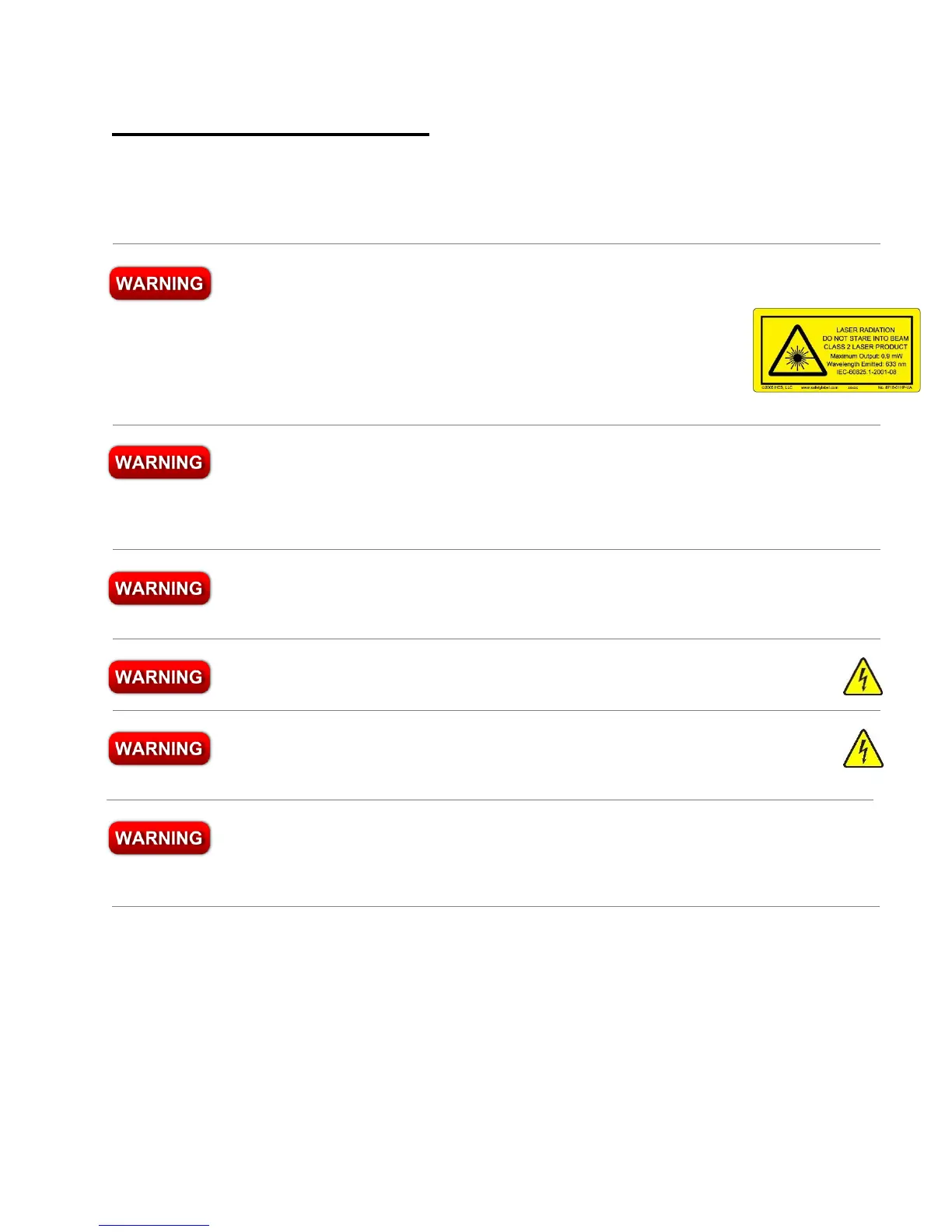
This instrument is a Class 2 Laser Product. It contains a laser that emits radiation
that can seriously damage your eyesight. Less than 15 W of this laser light is
emitted from the fiber-optic connector of the VIS and NIR versions,
and less than 50 W of this laser light is emitted from the aperture of
the IR and MIR versions. Do not stare into this beam or view it
directly with an optical instrument. The Class 2 warning label, shown
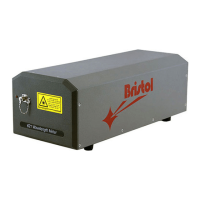
here, is located next to the fiber-optic input coupler (VIS and NIR) or
the input aperture (IR and MIR) on the front panel of the model 621.
If this instrument is not used as specified, the protection provided by the
equipment could be impaired. This instrument must be used in the specified mode
without deviation from the written instructions. Use of this product in any manner
other than described herein may cause permanent damage to eyesight and
therefore is strictly prohibited.
Never inspect or clean a fiber-optic cable without first disconnecting the entire
cable assembly from the optical source. Failure to take this precaution can
permanently damage your eyesight.
No user serviceable parts are inside. Refer servicing to Bristol Instruments or its
representatives only. To prevent electrical shock, do not remove covers.
To prevent electrical shock, disconnect this instrument from mains before
cleaning. Use a dry cloth or one slightly dampened with water to clean the
external case parts. Do not attempt to clean internally.
This is a Safety Class 1 product (provided with protective ground). The mains plug
shall only be inserted in a socket outlet provided with a protective ground contact.
Any interruption of the protective conductor inside or outside of the product is
likely to make the product dangerous. Intentional interruption is prohibited.


 To Next Page