2-9
CONTROL FUNCTIONS
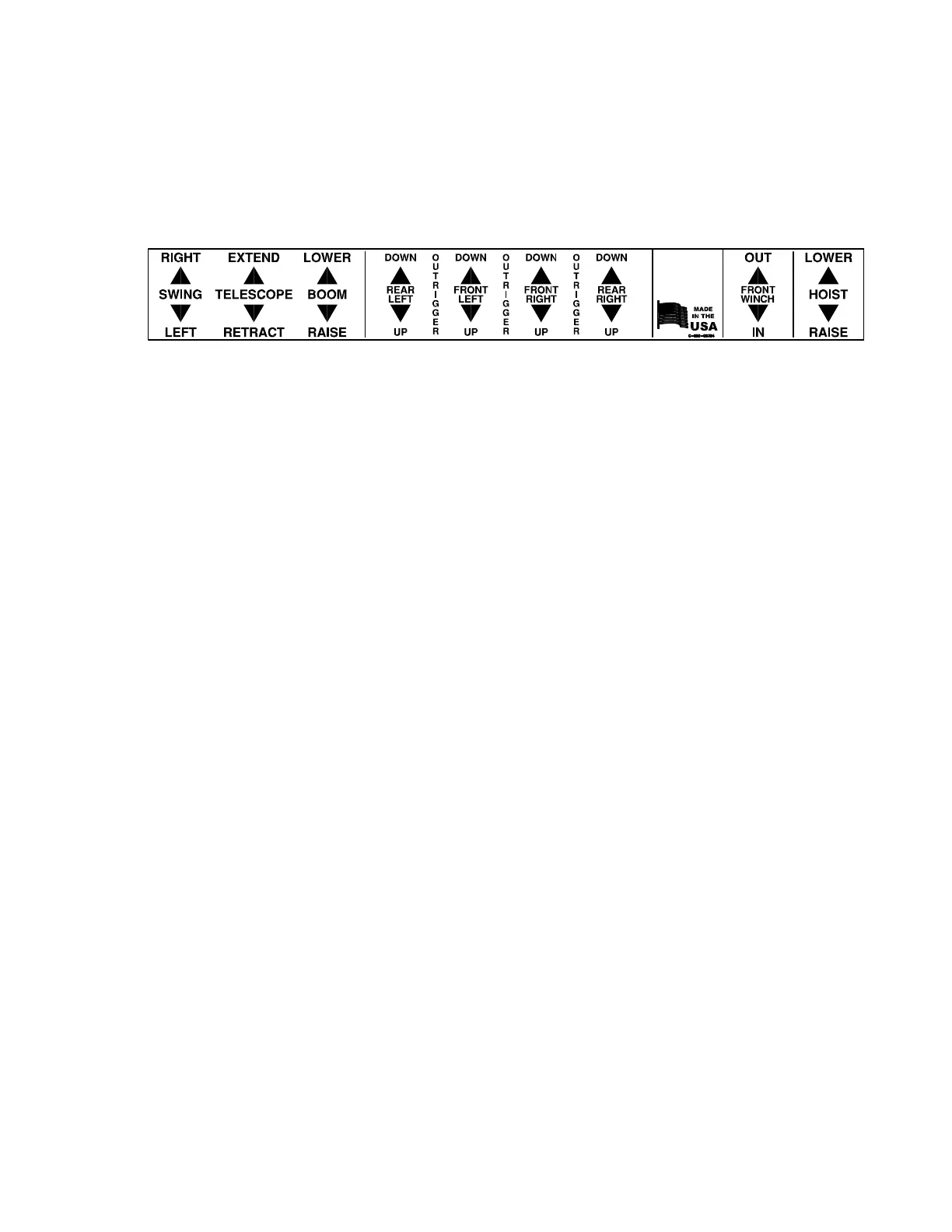
The controls for operating the outriggers, boom swing, boom elevation, boom telescope, and
hoist are located on the control panel. The handles are directly connected to the four-way
hydraulic control valves. The placards adjacent to these handles identify the function
controlled and the movement resulting from each handle actuation.
Swing: Pulling back on the lever will rotate the boom to the operator's left. Pushing forward
will rotate it to the operator's right.
Boom: Pulling back will raise the boom. Pushing forward will lower it.
Telescope: Pulling back on the lever will retract the boom. Pushing forward will extend the
boom.
Hoist: Pulling back on the lever will raise the hook. Pushing forward will lower the hook.
Outriggers: The four outriggers may be operated simultaneously or individually. Special
attention must be given to avoid hitting personnel or obstacles.
The boom and hoist controls may be used for simultaneous operation to achieve combinations
of movements. Some controls must be used together. For instance, the boom telescope and
the hoist controls must be used together to maintain clearance between boom and load line
hook.
Avoid holding a control lever in the open position after the function has reached the end of its
travel. This will impose unnecessary stresses on the components and heat the hydraulic
system.
THREE-MODE STEERING FUNCTIONS
The IC-40-2D is equipped with three-mode steering: four-wheel round steering can be used
for making tight turns, two-wheel rear steering should be used for traveling long distances, and
crab steering can be used for maneuvering in tight places. A switch on the dashboard sets the
mode. Electronic sensors and controls automatically align the wheels when a new mode is
selected, as the wheels are steered past the centered position.



 To Next Page