2-14
CRANE CAPACITY CHART DEFINITIONS AND RULES:
The load radius is the horizontal distance from the centerline of boom rotation (the center of
the turntable when it is level), to the vertical load line, with the load suspended. Because of
deflections of the boom and carrier, the load radius increases when a load is hoisted from its
resting place. The load radius may be measured with a measuring tape. If the desired load
radius falls between two load radii on the chart, it is recommended to use the load radius with
the lower capacity, and not try to interpolate between the numbers.
Load capacity ratings on this equipment are given on the basis that operations are to be
conducted on firm & level terrain, and in a safe environment. These capacity ratings are
reduced in proportion to the deviation from the prescribed conditions. Any unfavorable
environmental condition, such as soft, sloping or uneven terrain, high wind, or hazardous
surroundings, constitutes a deviation.
The main boom capacities are given in direct relation to the radius at which the load is
being handled. Boom extension capacities depend on the boom angle, as well as the
load radius. The capacities shown on the capacity chart are the maximum allowable at
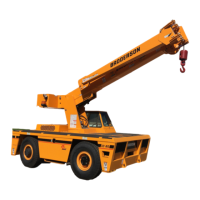
the indicated radius. The greatest load that may be handled by the BMC IC-40 is 9000
pounds (4080 kg), but only at a 4-foot (1.2 m) radius, and on outriggers. All variances
of loads and radii of handling are shown on the crane capacity chart. A metal chart is
attached near the operator's seat, and a laminated chart is included in the literature
compartment for the express purpose of informing the operator when a load can or
cannot be safely handled. The capacities shown in the 360° ROTATION columns of the
capacity chart apply to the entire 360º rotation of the boom and are maximum allowable at the
indicated radius. The capacities OVER FRONT are limited as follows:
On Outriggers: Boom rotation is limited to an arc of 15° either side of the crane
centerline.
On Rubber: Boom rotation is limited to the boom centered over front. Pick and Carry
operations are limited to the boom centered over front.
Note that the 360º ROTATION capacities at some load radii are much less than the OVER
FRONT capacities. The least stable position of the boom is over the side of the crane.
Use great care when swinging a load from the front or rear of the crane, toward the side of the
crane. The load must be known in order to assure that the crane will not tip.
N O T I C E
Under certain load conditions, torsion induced in the chassis can cause it to twist. This
may result in an opposite-side outrigger or tire lifting free from the supporting surface.
This is most likely to occur when the boom is positioned over one corner of the
machine. The condition does not indicate a loss of stability when working within the
limits of the capacity chart. Provided the crane capacity has not been exceeded,
operation may continue without restriction.
C A U T I O N
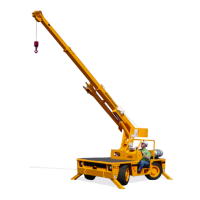
A capacity load may be carried on the boom, or a capacity load may be carried on the
deck. DO NOT carry capacity deck loads and capacity boom loads at the same time.



 To Next Page