2-15
C A U T I O N
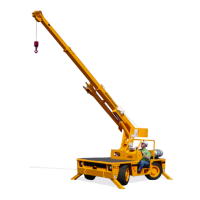
The capacities of this crane are based on all outriggers being FULLY EXTENDED to a
firm, level surface. The crane may tip at less than capacity loads if operated in the
following manner:
A. Outriggers only partially extended and resting on curbing, shoring, etc. If the outriggers
are not all the way DOWN, they are not all the way OUT.
B. Outriggers extended to a surface that appears to be firm, but is unable to support the
outrigger pad at full rated loads. Examples of this type surface are:
1. Thin or cracked blacktop or concrete.
2. Dirt that appears dry and firm on top, but is moist or unpacked beneath the
surface.
3. Dirt with a frozen but thin crust.
C. Crane operated on a hill or sloping surface. Crane will tip at less than rated capacity
when load is lifted on downhill side.
CAPACITY EXAMPLE
Refer to the IC-40-2D Capacity Chart on the following page. A load weighing 4600 pounds
(2090 kg) is to be lifted onto the deck of the crane for transport to a new location. The closest
we can get to the load is at a 6-foot (1.83 m) load radius over the side. We see on the chart
that 4500 pounds (2040 kg) is the maximum load on a one-part line, so the sheave block is
required. The charts show the weight of the standard sheave block to be 60 pounds (27 kg).
The rigger says that two slings are required, weighing a total of 40 pounds (18 kg). The total
load is 4600+60+40=4700 (2135 kg).
Looking at the 360° ROTATION, ON RUBBER column we see that the load is too heavy for
this condition. The OVER THE FRONT, ON RUBBER column shows that we can lift 5100
pounds (2250 kg) at a 6-foot (2.0 m) load radius. However, we cannot get that close to the
load, so the load cannot be lifted this way. This leaves the ON OUTRIGGERS columns. The
outriggers should always be used whenever possible anyway. We see that we can lift up to
5850 pounds (2400 kg) at a 6-foot (2.0 m) load radius, either over the front or over the side.
Checking the chart again, we see that the load is within the deck load limit of 6000 pounds
(2720 kg). Note: The travel speed with the load must be limited to 2 mph (3 km/h), or less if
conditions dictate.
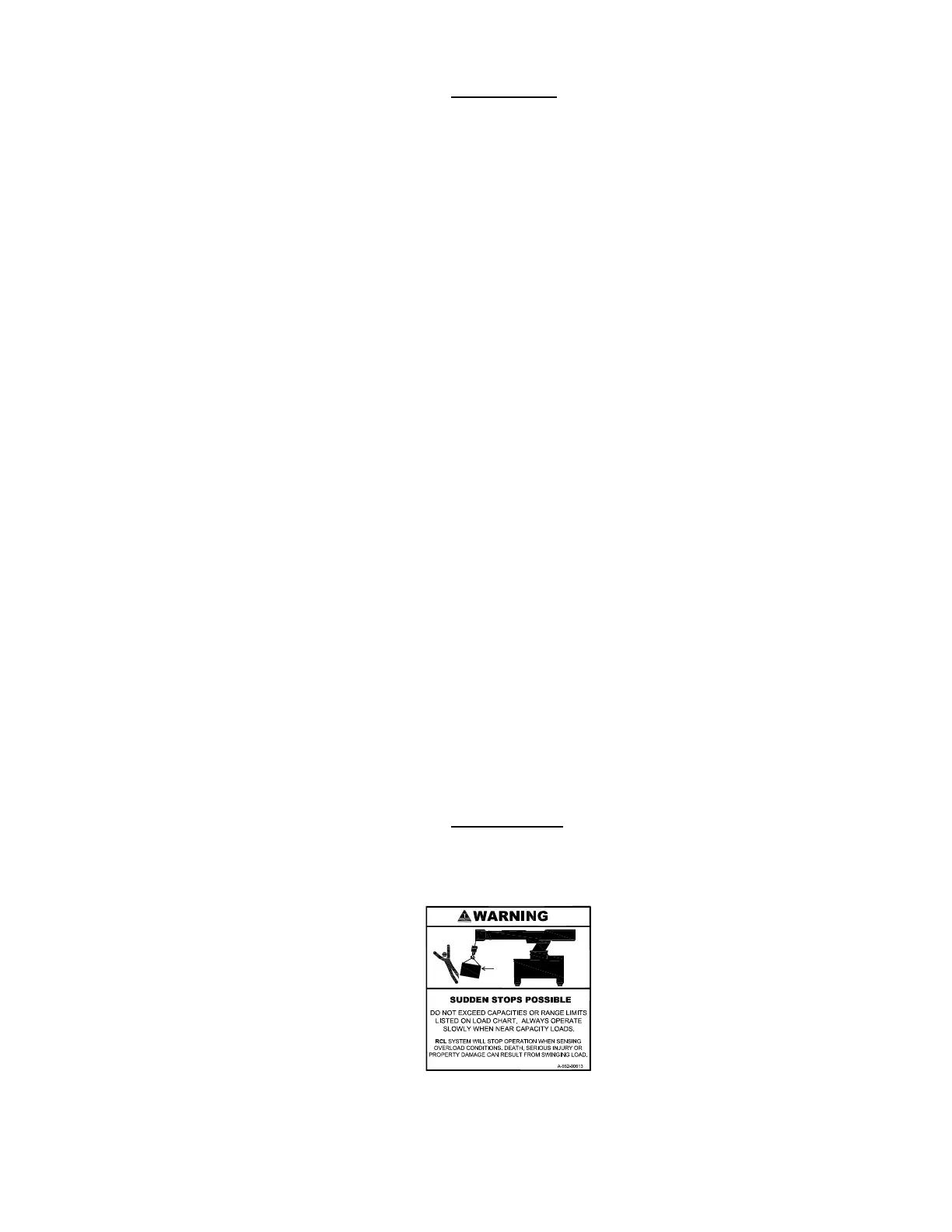
W A R N I N G
The Rated Capacity Limiter can suddenly stop the BOOM LOWER and SWING functions,
causing the load to bounce or swing. Use great care when handling a load near capacity
limits or near a two-blocking condition.



 To Next Page