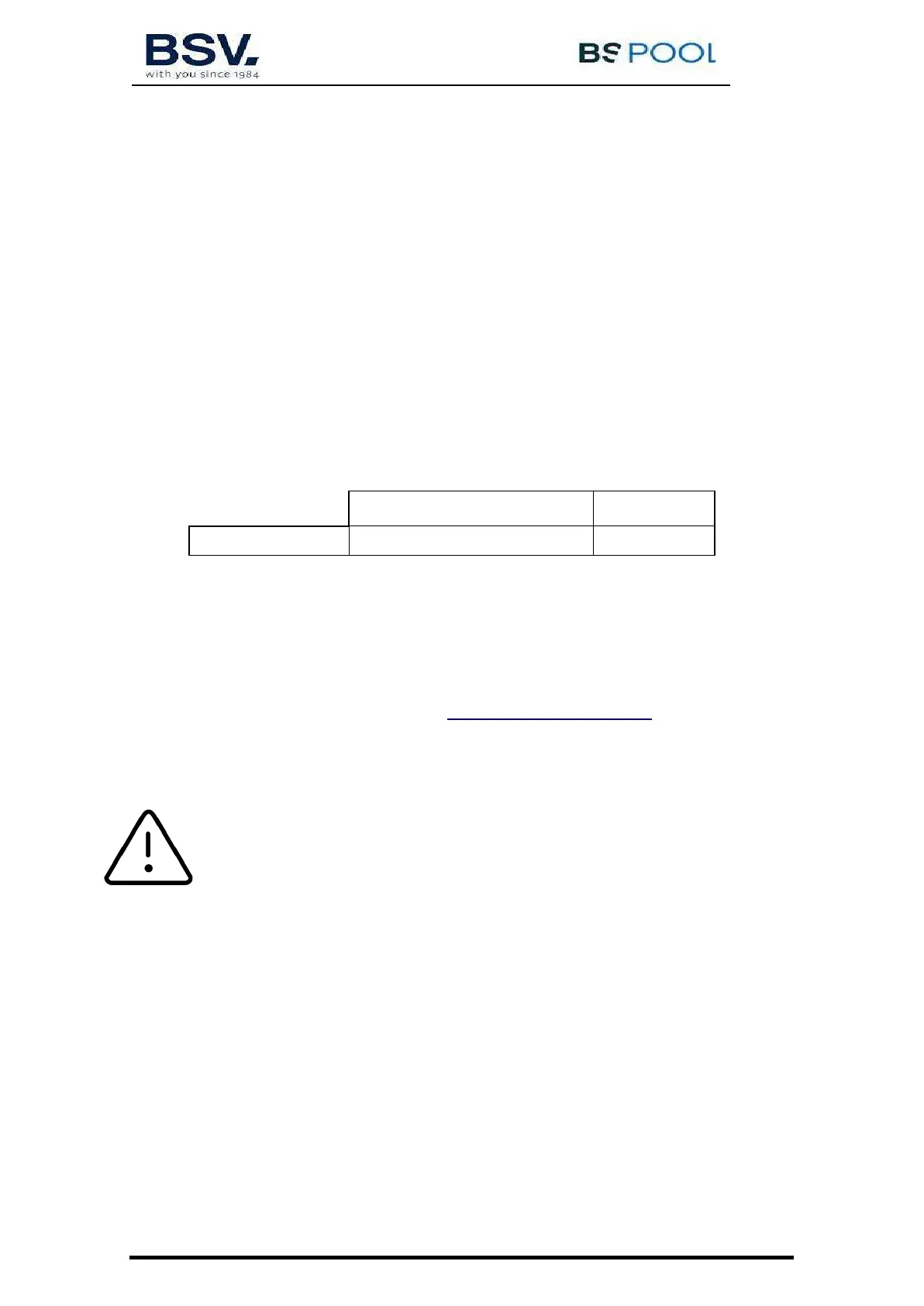
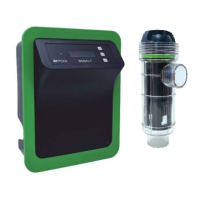
Ensure that the heatsink wings (in the rear part of the equipment) are not blocked and that air can easily
circulate through them.
All the BSV equipment incorporate protection systems against short circuits in the cell, absence of water
detector and other safety systems that give an acoustic and visual alarm in the event of any anomaly.
However, for optimum results, you should ensure the correct hydraulic operation of your swimming pool.
Equipment housing has IP65 protection. However, it is highly recommended not to install the equipment
directly exposed to sunlight.
Corrosive environments may reduce the lifespan of the equipment. Do not leave open containers with
acids near the equipment.
2- PREPARING THE SWIMMING POOL
2.1- Adding salt to the water
To ensure that the chlorinator works correctly, a small amount of salt should be added and the pH level
should be suitable.
The recommended salt and pH levels are the following:
Although the equipment will start to operate with lower amounts of salt, the optimum production of salt
will be reached with concentrations of over 4kg/m3. We recommend a concentration of 5Kg/m3 to offset
small losses of salt occurring when cleaning the filter, the effect of rainfall, etc.
To calculate the salt to be added, multiply the total m3 of your swimming pool x 5.
Example : A swimming pool measuring 9m in length x 4.5m in width x 1.6m in depth, using a PRO unit.
9 x 4.5 x 1.6= 64.8 cubic metres. 64.8 x 5 = 324 Kg of salt to be added.
We recommend using salt that is especially prepared for use in salt water chlorination installations, as it
is especially prepared for rapid dissolution and to achieve optimum results. You can find it at retailers
specializing in swimming pool products.
ATTENTION
When adding salt to the swimming pool, first disconnect the chlorinator (position OFF), and
start-up the filter for 3 or 4 hours, in order for the salt dissolving and not to overload the
equipment. Once dissolved, switch on the chlorinator.


 To Next Page