4.3- Operation times
It may be useful to see the operation times for regular maintenance operations. From the main screen,
press both buttons at the same time.
4.4- Electrolysis cell life
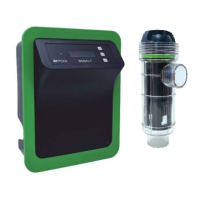
The electrolysis cells from our units are designed to reach a lifespan of 10.000 hours (10K
models) and 5.000 hours (5k models). However, this lifespan is directly related with the quality of the
water and specially with the correct use of the equipment. Please, read the following suggestions in
order to guarantee that your cell reaches the specified lifespan.
Salt concentration: It is very important that the water of your swimming pool has a sufficient salt
concentration, otherwise the cell will degrade prematurely if you keep it working permanently in low salt
conditions. It is important to add salt when the unit shows the “lack of salt” indication.
Low temperature operation: Don’t keep the system work in low water temperature conditions
(under 15ºC). As an alternative, there are some hibernation products that keeps the water in good
conditions in winter time. If you still want to use it in low water conditions, please consider to reduce the
maximum production value, for example, set it at 50% instead of 100%.
Automatic cleaning cycles: The time between automatic cleanings can be adjusted in PRO units, so it
can be adapted to the water hardness of your swimming pool. The chlorinator is configured by default to
4 hours. If your swimming pool water is very hard, you can decrease this value, so the automatic
cleanings will perform more frequently, but the lifespan of the cell will be reduced. On the other hand, if
the water is soft, you can increase the cleaning time cycle, and the cell’s lifespan will be increased.
Deficient cleaning: If you observe calcium deposits between the cell electrodes, clean it as shown in
the 5.1 section. Don’t allow to keep the cell working in these conditions for a long time.
5- MAINTENANCE
Carefully follow the recommendations and safety warnings detailed in section
1.4 of this manual.
The chlorinator has a self-cleaning system of the chlorination cell, which reduces maintenance
considerably. In any event, it is advisable to clean the cell and check the chlorine (Redox), free chlorine
or pH probe if available.
Bear in mind that both the electrolysis cell and the REDOX probe wear out through use. If after cleaning,
the equipment does not work normally, the probe or cell should be replaced. Your dealer will be able to
advise you on the need to change these elements.
5.1- Cleaning the electrolysis cell
The electrolysis cell should be cleaned in the following circumstances:
If the low level of salt indicator comes on and the concentration is correct.
If the overload indicator comes on and the level of salt is correct.
If lime scale is observed on the surfaces of the electrodes. In this case, the equipment can also be
adjusted so that the frequency between each automatic cleaning operation is less. This frequency will
depend on the hardness of water in your area.
Submerge the cell in a hydrochloric acid solution, or use a commercial product to clean electrolysis cells
(CELLCLEAN). Do not use sharp objects that could damage the titanium coating of the electrodes.


 To Next Page