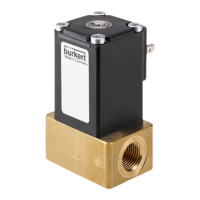
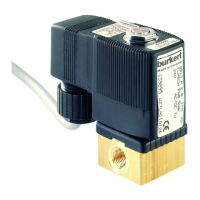
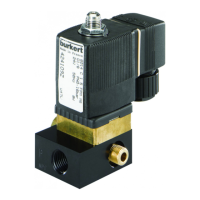
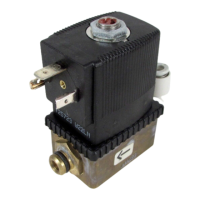
Type 2000
Product description
11
5 PRODUCT DESCRIPTION
The device is specially optimised for decentralised process automation and meets all the relevant require-
ments, even under difficult usage conditions.
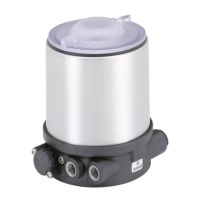
Its design enables the easy integration of automation modules in all extension stages, whether they are
electrical/optical position feedback, pneumatic control units, or even an integrated fieldbus interface. Long
service life and high tightness are achieved by the tried and tested self-adjusting packing gland. The sys-
tem, consisting of valve and automation module is distinguished by a compact and sleek design, integrated
pilot air ducts, a high chemical resistance, the degrees of protection IP65 or IP67 as well as the NEMA pro-
tection class 4X.
The device uses neutral gases or air to control the flow rate of liquid or gaseous media, such as water, alco-
hol, oil, fuel, saline solution, hydraulic fluid, lye, organic solvent or vapour.
5.1 Features
▪ Actuator can be rotated steplessly by 360°
▪ Valve body made of stainless steel with threaded connection, clamp connection or welded connection
▪ Easy integration of automation modules
▪ High chemical resistance
▪ High tightness and long service life due to self-adjusting packing gland
▪ High flow values through flow rate-optimised valve body made of stainless steel
▪ High seat tightness by swivel plate
▪ Maintenance-free under normal conditions
5.2 Structure and function
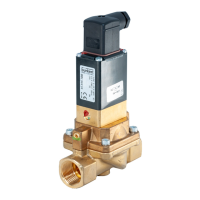
The angle seat valve consists of a pneumatically actuated piston actuator and a 2-way valve body. The ac-
tuator is made of PA or PPS. The proven, self-adjusting packing gland guarantees a high degree of tight-
ness. Valve bodies made of stainless steel or red bronze
1
.
Depending on the variant, the valve seat is connected in the direction of or against the medium flow. Spring
force (SFA) or pneumatic pilot pressure (SFB and SFI) generate the closing force on the swivel plate. A
spindle connected to the actuator piston transmits the force.
1
not for seat size 80



 To Next Page