PRELIMINARY
Document type: Title: Revision date: Revision:
User's Manual (MUT) Mod. V1729 4 Channel 12 Bit Sampling ADC 22/06/2005 3
NPO: Filename: Number of pages: Page:
00109/04:V1729.MUTx/03 V1729_REV3.DOC 38 5
1. General description
1.1 Overview
The CAEN Mod. V1729 board is suited for acquisition of fast analog signals based on the
MATACQ (analog matrix) chip developed by collaboration of the CEA/DAPNIA and the
l’IN2P3/LAL [1].
The V1729 board, in the mechanical format VME double Europe, is compatible with
several standards of acquisition (VME A32/D32, A24/D16, and GPIB).
This board performs the coding of 4 analog channels of bandwidth up to 300MHz over 12
bits at a sampling frequency (Fe) reaching up to 2GHz and over a depth of 2520 usable
points.
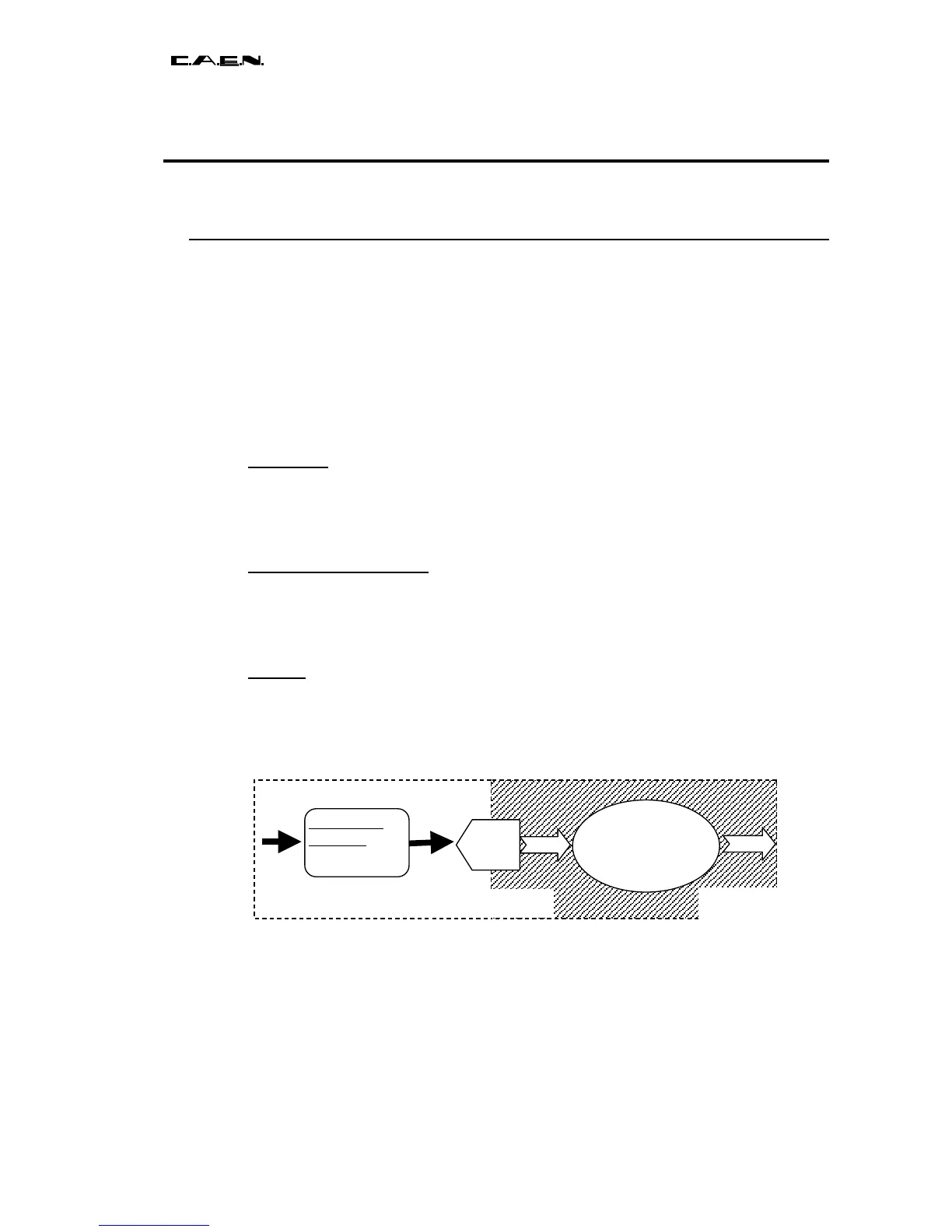
This operation is realized in three phases (see Fig 1.1):
Acquisition
:
the analog signal is continuously sampled at the frequency Fe in a circular analog
memory. The arrival of a trigger signal initiates the stopping phase of the sampling (2.1.1.
At the end of this phase, the state of the memory is set : it then contains the last 2560
points sampled (of which 2520 are valid).
Numerization and storage
:
after a stopping order of the acquisition, the samples stored under analog form in the
MATACQ chips are rapidly (650µs) re-read and coded into digital data over 12 bits, then
stored in a digital memory buffer. The acquisition is informed of the end of the coding
phase either by scrutation of an internal register, or by an interruption.
Reading
:
the memory buffer can then be re-read by the acquisition system. For an acquisition
system of VME A24-D16 standard, the latter operation lasts a few ms for the full readout
of a 4-channel board, which permits attaining an acquisition frequency of a few hundred
Hz for the acquisition of 2500 points per channel. With a high performance A32-D32
system, one should reach 1 kHz.
Fig. 1.1: data flow in the board



 To Next Page