Using Sentinel
CX3001 v7.0 © Calnex Solutions 30
Applies in
UDP/IPv6
Multicast
mode only. Values are:
Interface – Local
,
Link –
local
,
Realm – local
,
Admin – local
,
Site – local
,
Organisation – local
or
Global
.
IP header DSCP setting, range 0 to 63; default 46
Determines whether negotiation is enabled or disabled in Unicast mode
IP address of PTP master. The Ping button allows user to ping the master
address
PTP domain which PTP Master is configured to work in.
Number of Announce messages to be sent per second
Requested number of Sync messages to be sent per second (by the PTP Master)
Number of Delay Request messages to be sent per second
Requested PTP contract duration
Allows the correction field to be included in the PDV measurement; default
enabled
When
On -
PDV samples are normalized relative to first delay sample so that
first PDV sample has zero value. In this mode delay variations are displayed on
PDV graphs.
When
Off -
no PDV normalization is done, so PDV graphs display absolute
delays (including propagation delay, time offset between Master and Sentinel,
and other time inaccuracies in the system). PTP 2 Way TE will be calculated
when Normalize delays is
Off
User defined 2way Time Error mask value
When in Pseudo-slave mode, the Packet module acts as a PTP slave, however the internal 1 PPS is kept constant
for the measurement and is not adjusted according to the PTP master. This allows measurement of PDV on
Master to Pseudo-slave network path.
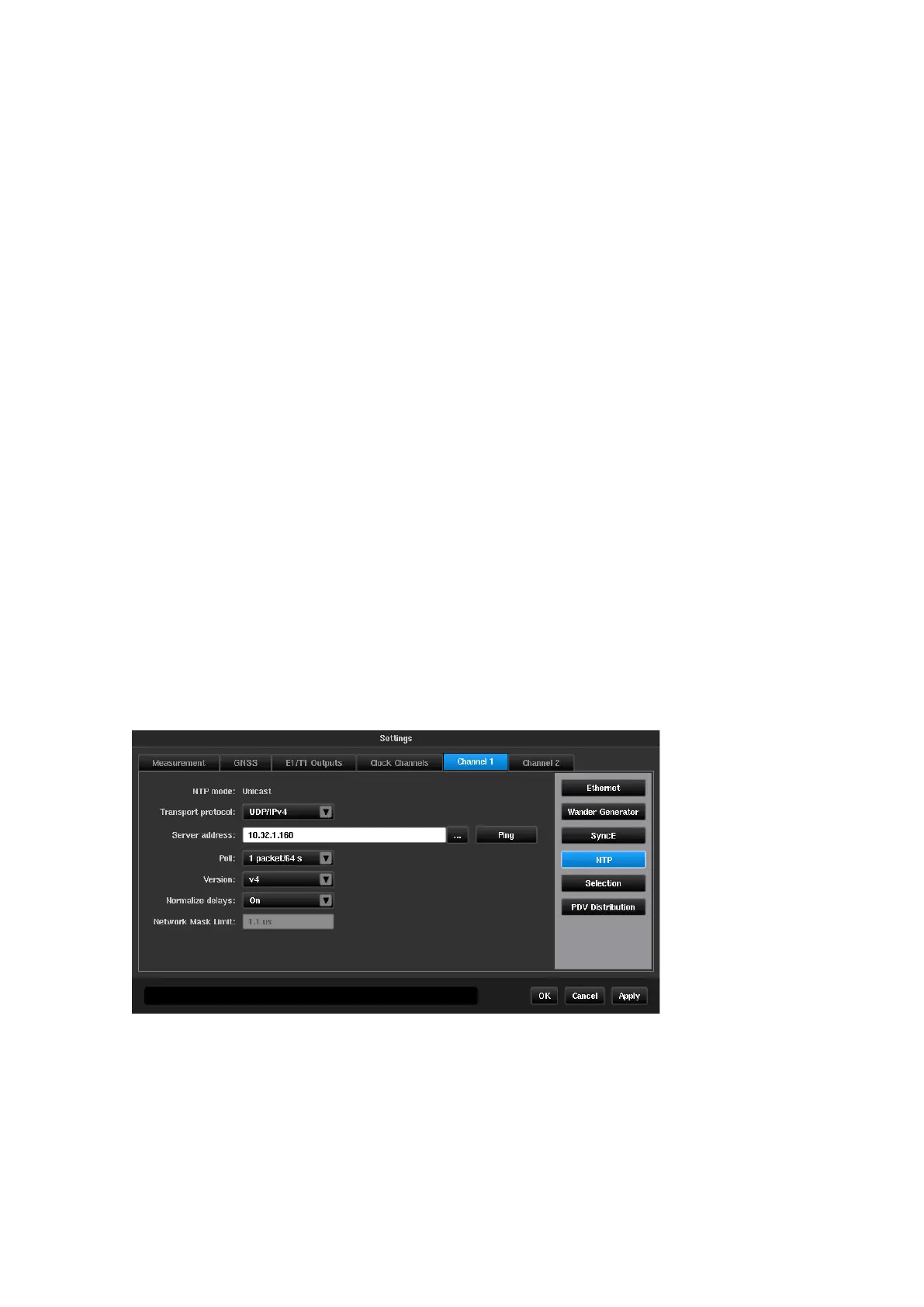
NTP
This page will only be available if the PDV Option is enabled on the Sentinel and NTP Client has been selected
in the Mode page. This window contains all parameters related to NTP stack behaviour in pseudo-client mode.
Protocol level for NTP measurement:
UDP/IPv4
,
UDP/IPv6.
Note: On Sentinels with serial numbers below 400000 NTP client only supports
UDP/IPv4. Selecting UDP/IPv6 will result in no measurement data being
recorded.
IP address of NTP server. The Ping button allows user to ping the server
address


 To Next Page