EasyManua.ls Logo

CAME PS ONE SERIES - User Manual

CAME PS ONE SERIES
28 pages
Print Icon
To Next Page IconTo Next Page
Loading...
3DUNLQJOLQH
SERIES PS ONE
INSTALLATION MANUAL
PS ONE
CONTROL SYSTEMS FOR
PARKING FACILITIES
E
ng
li
s
h
EN
Question and Answer IconNeed help?

Do you have a question about the CAME PS ONE SERIES and is the answer not in the manual?

Summary

Parking system scheme and technical notes

Description of units making up the PS One system

Technical data

001 PSAC110 server

Technical specifications for the server unit.

001 PSA101101 automatic cash register

Technical specifications for the automatic cash register.

001 PSI121 entry unit - 001 PS0131 exit unit

Technical specifications for entry and exit units.

001 PSM101 Manned cash register

Technical specifications for the manned cash register.

001 PSM104 Roboticket tabletop reader;printer unit

Technical specifications for the roboticket reader/printer.

Connection diagram

Overall dimensions and anchoring bases

Entry and Exit Unit Dimensions

Dimensional data for entry and exit units.

Automatic Cash Register Dimensions

Dimensional data for automatic cash registers.

Anchoring Base Guidelines

Guidelines for anchoring bases of various units.

Sample installation scheme

Entry unit; exit unit board - description

Board Components and Connections

Description of terminals and components on the entry/exit unit board.

Cash-register board - description

Cash Register Board Description

Description of terminals and components on the cash register board.

Automatic cash register - installation

Setting up the cash-register base

Procedure for preparing and installing the cash register base.

Mounting the automatic cash register

Steps for mounting the automatic cash register unit.

ETHERNET power supply and connection

Instructions for ETHERNET power and data connections.

Installing a back up generator (optional)

Guide for installing an optional backup generator.

Switching on the automatic cash register

Procedure for powering on the automatic cash register.

Entry unit - exit unit - installing

Setting up the entry unit and exit unit bases

Procedure for preparing and installing entry/exit unit bases.

Entry unit - exit unit - electrical connections

Connecting coils

Instructions for connecting metal mass detector sensors (coils).

Connecting barriers

Procedure for connecting the barrier systems.

Traffic light connections

Instructions for connecting traffic light displays.

Power supply connections

Steps for making power supply connections.

ETHERNET connection

Instructions for connecting the ETHERNET cable.

Switching on entry;exit units

Procedure for powering on the entry and exit units.

Status signal LED indicators

Explanation of colour-coded status LEDs.

LED input index on entry - exit unit board

Index of LED inputs and component statuses.

Manned manual cash register - installation

Roboticket Connections

Instructions for connecting the roboticket reader/printer.

Overview

The CAME PS ONE is a comprehensive parking control system designed for managing parking facilities efficiently. It leverages a "native" ETHERNET interface, allowing for a flexible and scalable configuration of an unlimited number of peripherals. This system is ideal for various parking environments, from small lots to large multi-level garages, and is designed to streamline vehicle access, payment, and monitoring.

Function Description:

The PS ONE system integrates several key components to provide a complete parking management solution:

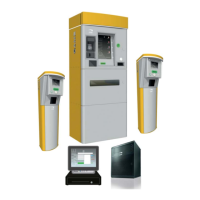
  • Central Server (001PSAC110): This is the brain of the system, managing all entry and exit devices, logging events, and monitoring passages (even remotely). It also incorporates VoIP control unit functions for an integrated intercom system.
  • Automatic Cash Register (001PSA101101): This unit handles automated payments. It features an integrated plastic card reader, ticket printer and reader, writer and reader (ISO format for proximity and TFT high luminosity), and a touch screen microchip/display. It dispenses receipts, coins, and banknotes, and accepts payments in different currencies, ATM cards, and credit cards.
  • Entry Unit (001PSI121) / Exit Unit (001PS0131): These units manage vehicle entry and exit. Each unit includes an integrated plastic card reader, ticket printer and reader, writer and reader (ISO format for proximity and IMAGER microchip/reader for 1D and 2D barcodes, even on mobile tickets), and a high-luminosity 5.7" TFT display to visualize function status.
  • Manned Cash Register (001PSM101): For assisted payment, this unit comprises an industrial PC with a 15-inch touch screen, a manual ticket barcode reader, an integrated device for reading/printing and writing ISO format plastic cards (for proximity microchip), a receipt printer, a user-side additional display, an RFID card reader/writer, and a cash drawer.
  • Roboticket Tabletop Reader/Printer Unit (001PSM104): This component is used with the manned cash register for ticket processing. It features barcode and RFID reading capabilities, thermal printing, and robust construction for reliable operation.
  • PSINS (Free - Full two-sides light box): A complete light box indicating parking availability.
  • PSSRV (Red-green traffic light Ø 200 mm): A standard traffic light for directing vehicle flow.
  • Free parking space display: A screen-printed panel with a multi-character display to show available parking spaces.
  • SMA2 (Bi-channel magnetic sensor for metal-mass detection): Used for vehicle detection at entry and exit points.
  • Intercom station: Fitted within the manned cash register, providing voice phone and video communication.
  • VAN detector sensor: Allows for specific entry settings for vans, campers, and buses.
  • OCR module: Reads, recognizes, and digitalizes vehicle license plates for monitoring at entry and exit.
  • EYE SYSTEM module: Associates high-definition images of all four sides of vehicles with each entry and exit passage.

Important Technical Specifications:

001PSAC110 Central Server:

  • Power supply: 230 V
  • Container: Micro tower
  • Microprocessor: Dual Core 1.5 GHz AMD Turion II
  • RAM: PC3-10600E DDR 3.8 GB (2 x 4 GB)
  • HDD: 8 TB (4 x 2 TB 3.5" SATA drives)
  • Network control: Embedded NC107i PCI Express Gigabit Ethernet Server Adaptor
  • Dimensions: 267 x 260 x 210 mm
  • Weight: 3 kg
  • Operating temperature: 0° / + 40°C
  • Depositing temperature: 0° / +70°C

001PSA101101 Automatic Cash Register:

  • Power supply: 230 V AC 50/60 Hz
  • Consumption (working): 400 VA
  • Consumption (idle): 320 VA
  • Peak draw: 730 VA
  • Protection rating: IP 40
  • Weight: 200 Kg
  • Operating temperature: -25° / +55°C
  • Depositing temperature: 0° / +70°C
  • Coin container: Up to three 1000-coin containers
  • Banknote reader: Recognizes up to six banknote denominations in all four directions; container for 1000 paid-in banknotes and 60 change banknotes.
  • Barcode reader: 2D barcode
  • Receipt printer: Thermal
  • EFT/POS: Enabled for credit and debit card circuit

001PSI121 Entry Unit / 001PS0131 Exit Unit:

  • Power supply: 230 V AC 50/60 Hz
  • Consumption (working): 500 VA
  • Consumption (idle): 390 VA
  • Peak draw: 620 VA
  • Protection rating: IP 40
  • Weight: 30 Kg
  • Operating temperature: -25° / +55°C
  • Depositing temperature: 0° / +70°C
  • Barcode reader: 2D barcode
  • Ticket printer: Thermal

001PSM101 Manned Cash Register:

  • Power supply: Outdoors 12V/24V
  • Container: Integrated system with ABS adjustable, plastic monitor
  • Display: TFT LCD 15", 1024x768 panel with resistive touch screen
  • Microprocessor: Intel E5300 Pentium Dual Core, 2.60 GHz
  • RAM: DDR2 512 MB
  • HDD: 500 GB
  • Barcode reader: Omni-directional
  • Dimensions: 382 x 356 x 388 mm
  • Weight: 5 kg
  • Operating temperature: 0° / + 40°C
  • Depositing temperature: 0° / +70°C

001PSM104 Roboticket Tabletop Reader/Printer Unit:

  • Power supply: 240 Vca
  • CPU: Risc 32 bit Fujitsu CPU (up to 512 KB Flash Memory, 8k x 8 bytes serial Eeprom)
  • Ports: 1 asynchronous RS232 optoisolated serial port (up to 115200 bps host), 1 virtual com USB communication port (up to 1125200 bps host).
  • Ticket format and size: ISO 54 x 85.6 mm
  • Structure: Stainless steel with moulded plastic details.
  • Reader: IMAGER for 1D and 2D barcodes, Transversal Barcode Reader, Mifare, RFID 125Khz reading.
  • Printer: 203 dpi thermal printer (option for 300 dpi), 48 mm wide thermal ticket (180-220g/m2), prints Code 128 and Code 39 barcodes (other 2D codes possible via image processing).
  • Printing speed: 100 mm/s (print duty cycle > 30%)
  • Memory: Non-volatile for at least two graphic images.
  • Management: Ticket in FanFolded Pack (excludes ticket roll feeding), moulded tickets with optical fork-type sensor.
  • Sensors: For ticket position (inside and on feeder tray).
  • Drives: ISO-card format 54 x 85.6 mm Paper-Ticket print out/validation drive (0.18-0.22 mm thick), ISO Plastic-Card (no print out) drive.
  • Features: Ticket withholding and retrieval detection from exit tray, RS232 communication, EMTS module protocol with remote diagnostics, power supply outputs for LED illumination, self-lubricating guillotine cutter. Highly reliable in adverse climate conditions.

Usage Features:

  • Scalability: The ETHERNET interface allows for an unlimited number of peripherals, making the system highly adaptable to different parking facility sizes and needs.
  • User-friendly interfaces: Touch screens on automatic cash registers and manned cash registers, along with TFT displays on entry/exit units, provide clear status visualization and intuitive interaction.
  • Diverse payment options: Automatic cash registers accept coins, banknotes, ATM cards, and credit cards in multiple currencies, offering convenience to users.
  • Advanced vehicle identification: Barcode readers (1D and 2D), plastic card readers (proximity and microchip), OCR for license plates, and the EYE SYSTEM for vehicle imaging ensure robust and accurate identification.
  • Traffic management: Integrated traffic lights (PSSRV) and parking space displays enhance traffic flow and user experience.
  • Intercom system: VoIP control unit functions enable seamless communication between users and operators.
  • Special vehicle handling: VAN detector sensors allow for specific entry configurations for larger vehicles.
  • Status indication: LED lights on entry/exit units provide color-coded status (e.g., blue for standby/active, white for maintenance, red for error).

Maintenance Features:

  • Modular design: Components like the automatic cash register are supplied in three disassembled parts (base, central element, closing element) for easier installation and potential maintenance.
  • Accessible components: The entry/exit units have removable covers to access electrical boards and sensors. The manned cash register has a removable back cover for cable access.
  • Backup generator support: The automatic cash register is designed to accommodate a backup generator in case of power outages, ensuring continuous operation.
  • Robust construction: Units are built with durable materials like stainless steel and molded plastic, designed for outdoor use and resistance to mechanical wear and abrasion.
  • Self-lubricating guillotine cutter: In the Roboticket unit, this feature contributes to high reliability and low stoppage risk.
  • Remote diagnostics: The Roboticket unit's EMTS module protocol includes remote diagnostics commands, facilitating troubleshooting.
  • Clear wiring diagrams: The manual provides detailed connection diagrams for coils, barriers, traffic lights, power supply, and Ethernet, aiding in installation and maintenance.
  • LED input index: The entry/exit unit board features an LED input index to quickly identify the status of components like coils and barriers, simplifying diagnostics.

CAME PS ONE SERIES Specifications

General IconGeneral
BrandCAME
ModelPS ONE SERIES
CategoryControl Systems
LanguageEnglish

Related product manuals