6.7 Opening modes of the locking devices
6.7.1 About the different opening modes of the locking devices
Block
mode
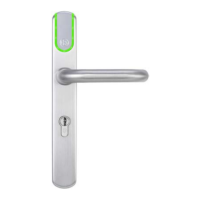
A locking device in block mode remains constantly uncoupled, i.e. the door cannot be opened.
Access is no longer possible, even with authorised locking media.
Release
mode
A locking device in release mode remains constantly coupled, i.e. the door can be opened at
any time without having to use a locking medium.
Emergency
mode
Emergency mode is similar to release mode: the locking device remains constantly coupled so
that the door can be opened at any time without having to use a locking medium.
Unlike release mode, however, emergency mode cannot be cancelled again by the Release-
Master but only by the Emergency-Key and has the highest priority of all the opening modes,
see "Hierarchy of opening modes" below.
Normal
mode
A locking device in normal mode can be opened with an authorised locking media.
Unauthorised locking media are rejected.
6.7.2 Hierarchy of opening modes
1 = highest priority, 7 = lowest priority
1 Emergency mode (activated by Emergency-Key)
2 Block mode (activated by Block-Master)
3 Block time (activated by time profile in OMEGA Client)
4 Release mode (activated by Release-Master)
5 Enable time (activated by time profile in OMEGA Client)
7 Normal mode (opening enabled by locking medium)
Page 38 of 83 Wide shield replacement handle set ILS-I
6.7 Opening modes of the locking devices
Overview: Use of master media
Help & troubleshooting Technical data
Maintenance & disposal
Operation
Administration
Assembly Basic information


 To Next Page
 Loading...