16
P/N 192047138 Rev AA November 2017
TROUBLESHOOTING CHART
Always disconnect unit from the power supply system before removing hoist covers or the back cover of control station.
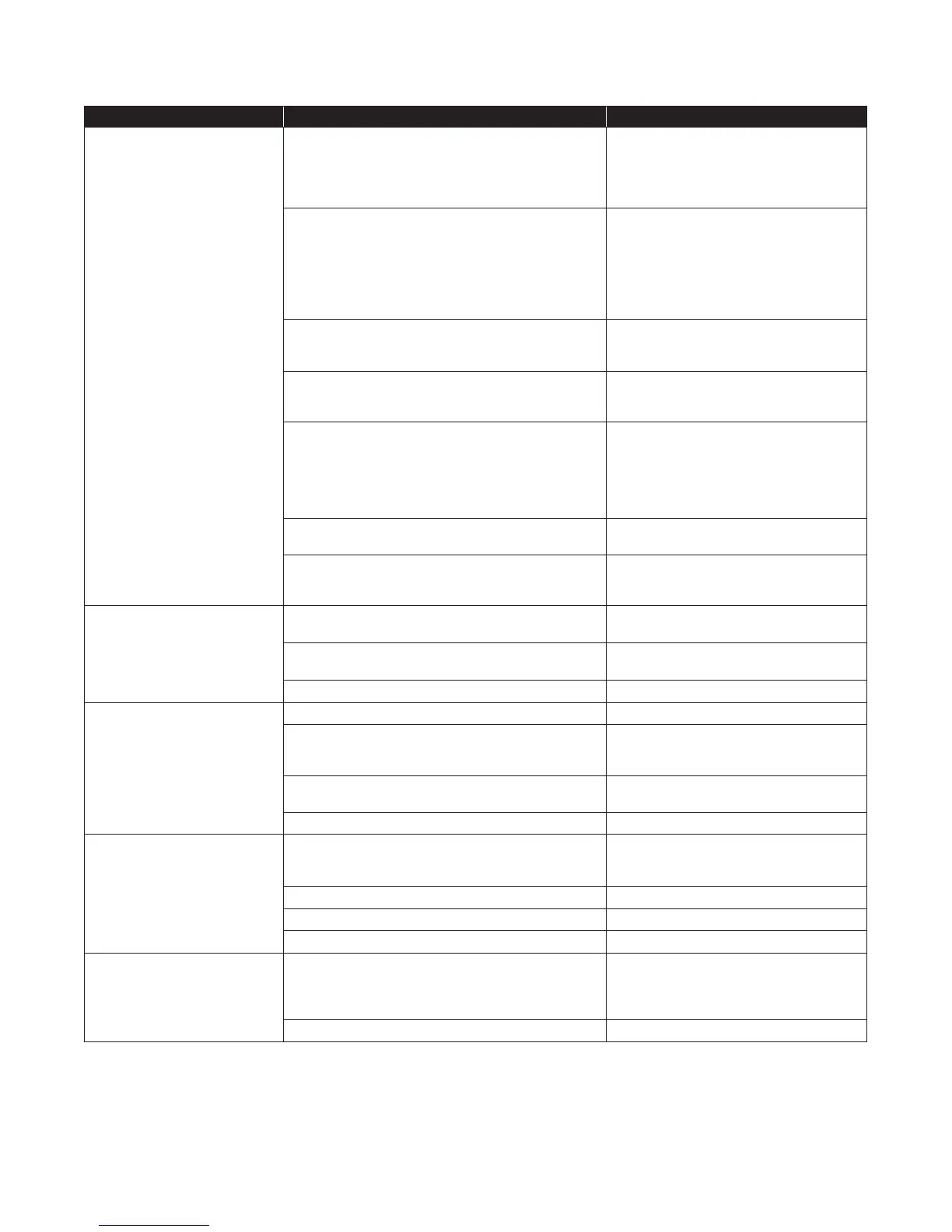
Symptom Possible Cause(s) Corrective Action
1. Hook does not respond to the control
station
A.) No voltage at hoist-main line or branch circuit switch open;
branch line fuse blown or circuit breaker tripped.
A.) Check for blown fuse or tripped circuit breaker
or open disconnect switch in main line or branch
circuit. Replace fuse, reset circuit breaker or
close switch.
B.) Open control circuit due to loose connections or broken wires in
circuit; motor thermal protector open; control station contacts
not closing; open or Shorted winding in transformer; transformer
thermal cut-out open; mechanical binding in contactor; open
or shorted winding in contactor coil or blown Printed Circuit
Board fuse.
B.) Check electrical continuity thru motor thermal
protector. If it is open, allow motor to cool. If this
does not correct the trouble, use wiring diagram to
check electrical continuity of wiring, transformer,
contactor and control station contacts. Repair
wiring or replace defective part. Check Printed
Circuit Board fuse & replace if needed.
C.) Wrong voltage or frequency. C.) Make sure that the power supply to hoist is the
same as that shown on identification plate on
button of hoist.
D.) Low Voltage. D.) Check power supply system to make sure it
complies with the requirements listed under
“power supply system” starting on page 3.
E.) Brake not releasing due to open or shorted coil, defective diodes
or brake disc binding.
E.) Check coil continuity, diodes and connections.
Make sure brake disc slides freely on brake driver
and brake spring is not broken. Replace coil (brake
field), repair connections, remove burrs from
brake driver so that brake disc slides freely and/or
replace brake spring.
F.) Excessive load. F.) Reduce load to capacity limit as indicated on
identification and capacity labels on hoist.
G.) Phase failure (single phasing-three phase units only) - open circuit,
grounded or faulty connection in one line of power supply system,
hoist wiring, contactor, motor leads or windings.
G.) Check for electrical continuity and repair or
replace defective part.
2.) Hook moves in the wrong direction. A.) Wiring connections reversed in control station or hoist. A.)Use wiring diagram and check wiring connections.
B.) Failure of cut-out device (single phase units only) to effect
dynamic braking at time of reversal.
B.) Check connections to cut-out device. Replace
damaged device or faulty capacitor
C.) Phase reversal (three phase unit only). C.) See “Three Phase Hoists.”
3.) Hook lowers but will not raise. A.) Excessive load. A.) See item 1F.
B.) Hoisting circuit is OPEN due to loose connections or broken
wire in circuit; control station contacts are not making; open or
shorted winding in contactor coil.
B.) Use wiring diagram to check electrical continuity
of wiring and control station contacts. Repair wiring
or replace defective part.
C.) Motor cut-out device not operating. (single phase units only). C.) Check cut-out device and connections to same.
Repair connections and/or replace cut-out device.
D.) Phase failure (three phase units only). D.) See item 1G.
4.) Hook raises but will not lower. A.) Lowering circuit is OPEN due to loose connections or broken
wire; control station contacts not closing; open or shorted
winding in contactor coil.
A.) See item 1B.
B.) Motor reversing switch not operating (single phase unit only). B.) See item 3C
C.) Phase reversal (three phase units only). C.) See item 2C
D.) Phase failure (three phase units only). D.) See item 1G.
5.) Hook does not stop promptly. A.) Brake slipping. A.) Check electric brake, especially the brake disc for
wear or glazing and make sure brake spring is not
broken. Replace worn or glazed brake disc or replace
brake spring.
B.) Excessive load. B.) See item 1F.


 To Next Page