MAN.234 Rev.6 ENG - Use and maintenance manual S19HD page 46 of 126
4.4.5.2 Slowdown of the aerial part maneu-
vers
Slowdowns can be set by software for start and end
of each aerial part maneuver (lifting/lowering of
arms, extension/retraction of arms, clockwise/ anti-
clockwise rotation of the turret, opening/closing jib),
valid in the following conditions:
o boom angle;
o boom extension;
o opening jib;
o pre-alarm condition (90% of the block);
o approaching of turret’s corner to a curve
change area.
4.4.5.3 Anti-crash system
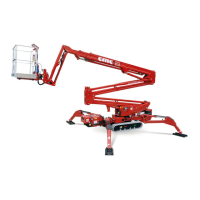
When the machine is stabilized in the predefined
areas, both with tracks resting on the ground and
raised, the outriggers with their curved structure can
reach a height greater than that of the machine
frame.
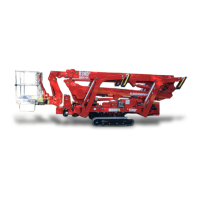
Furthermore, the engine pack with the fuel tank has
a considerable bulk, which comes out from the rear
shape of the chassis.
The anti-crash system, supplied as standard device,
does not allow the aerial part (pantograph, boom,
jib) to have accidental impacts with these bulky
parts mounted on the frame and the outriggers,
blocking the movements operated by means of logic
parameters set via software.
When activated, it is signalled by the warning light 6
(Figure 9) on the electronic panel of the radio con-
trol or wired remote control.
When the warning light 6 will be flashing
and will be associated with an audible alert,
the machine will be in "anti-crash block”
(collision danger). In order to unlock the ma-
chine, it is necessary to press the parking
button P on the radio control together with
the desired manoeuvre.
If, during the descent of the pantograph or
booms, the machine gets blocked (anti-crash
warning light on), it will be necessary to continue
the closing operations by pressing and holding
the parking button P simultaneously to the de-
sired operation. The sudden or intentional re-
lease of that button will immediately disable the
operation carried out.



 To Next Page