EasyManua.ls Logo

Commodore MPS-801 - Page 12

Commodore MPS-801
34 pages
Print Icon
To Next Page IconTo Next Page
To Previous Page IconTo Previous Page
Loading...
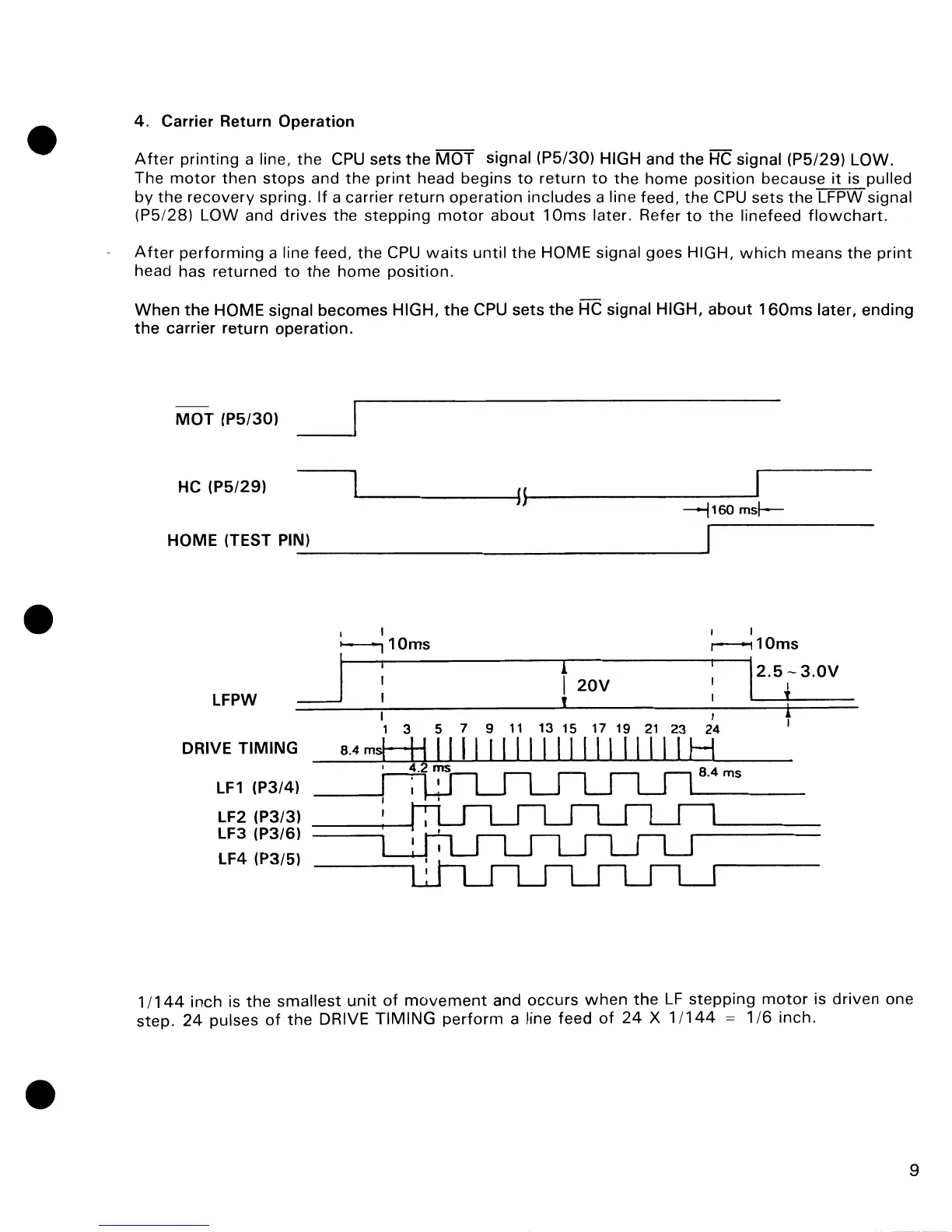
4.
Carrier
Return
Operation
After
printing
a line,
the
CPU
sets
the
MOT
signal (P5/30) HIGH and
the
HC signal (P5/29)
LOW.
The
motor
then
stops
and
the
print
head
begins
to
return
to
the
home
position
because
it
is pulled
by
the
recovery
spring.
If
a carrier
return
operation
includes
a line feed,
the
CPU
sets
the
LFPW signal
(P5/28)
LOW
and
drives
the
stepping
motor
about
10ms
later. Refer
to
the
linefeed
flowchart.
After
performing
a line feed,
the
CPU
waits
until
the
HOME
signal
goes
HIGH,
which
means
the
print
head has
returned
to
the
home
position.
When
the
HOME
signal
becomes
HIGH,
the
CPU
sets
the
HC signal HIGH,
about
160ms
later,
ending
the
carrier
return
operation.
MOT
(P5/30)
HC
(P5/29)
HOME
(TEST PIN)
LFPW
DRIVE
TIMING
LF1
(P3/4)
LF2 (P3/3)
LF3
(P3/6)
LF4
(P3/5)
~----------~!i~-------------~---1-w-m~s~
I I
r----110ms
I
I
20V
t
I I
1 3 5 7 9
11
13 15 17 19
21
23 24
8.4
msl:-:H
II I I I I I I I I I I I I I I I I I H
1
2
.
5
y-3.0V
i
I
1/144
inch
is
the
smallest
unit
of
movement
and
occurs
when
the
LF
stepping
motor
is
driven
one
step.
24
pulses
of
the
DRIVE
TIMING
perform
a line
feed
of
24
X
1/144
=
116
inch.
9

Other manuals for Commodore MPS-801

Related product manuals