Need help?
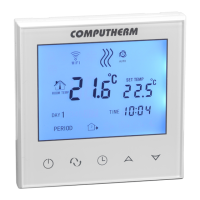
Do you have a question about the Computherm E300 and is the answer not in the manual?
Connect devices to the terminal block for one-zone or multi-zone heating systems.
Connect the floor sensor to the thermostat's 'Sensing' terminals for temperature measurement.
Connect the thermostat to the 230 V AC network using a two-core cable.
Separate front and rear plates, mount rear in wall box, then attach front plate.
Download and install the free COMPUTHERM E Series application from app stores.
Connect the thermostat to your Wi-Fi network via the COMPUTHERM E Series application.
Register the thermostat to your user account through the application's search function.
Add additional users to control the thermostat via the application after initial setup.
Rename the thermostat within the application for easier identification.
Prevent new users from connecting to the thermostat via the application.
Remove a thermostat from the application if it is no longer needed.
Set the current day and time either via the phone application or directly on the thermostat.
Lock the thermostat's physical buttons to prevent accidental changes.
Choose between internal, floor, or both sensors for temperature measurement and control.
Configure the maximum floor temperature and the sensitivity for its control.
Adjust the displayed temperature to match the actual measured temperature.
Enable automatic heating activation below a critical low temperature to prevent freezing.
Select how the thermostat operates after a power outage: turn off or resume previous state.
Reset all thermostat settings to their original factory values.
Maintain a preset temperature manually until the next intervention or program change.
Operate the thermostat automatically based on pre-set daily temperature schedules.
Temporarily override the programmed temperature until the next scheduled switch.
 General
| Voltage | 230V AC |
|---|---|
| Temperature measuring accuracy | ±0.5°C |
| Temperature setting accuracy | ±0.5°C |
| Accuracy | ±0.5°C |
| Switching voltage | 230V AC |
| Sensor type | NTC sensor |
| Display | LCD |
| Protection Class | IP20 |
| Temperature setting range | 5°C to 35°C |
| Switching current | 8A (resistive load) |
| Mounting | Wall-mounted |

 To Next Page