15
3.6 Theory of Operation
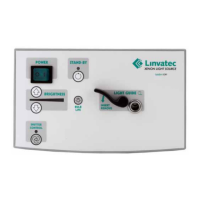
The xenon light source uses a replaceable short
arc xenon lamp with an integral elliptical
reflector. The lamp is designed to produce a very
small high brilliance electric arc in a sealed
xenon envelope to simulate the spectral content
of sunlight for the best video camera
performance. The arc also produces IR (heat)
that is filtered by two hot mirrors positioned
between the lamp and the light guide.
To operate an arc lamp, a special power supply
is needed since the start-up process is not a
simple matter of applying power. In the off
condition the arc has very high impedance.
Therefore, a high voltage (23KV min. balanced)
must be applied to develop a conduction path
from the anode to the cathode. Following the
very high voltage, an intermediate voltage is
applied as the impedance of the arc path drops
and the arc becomes larger. In the third phase of
the start-up sequence the voltage falls between
11.5 - 15 VDC as current regulation takes over
to sustain the now fully developed arc. The unit
continues to operate in this current regulated
mode until the power is removed by the front
panel “POWER” button.
The temperature on the surface of the lamp can
be very high, therefore, cooling is very
important during operation. The lamp must be
allowed to cool in accordance with the included
instructions before any handling is attempted.
The lamp is very fragile and can easily break
explosively since the lamp is under high
pressure.
The power supply is a switch mode type with a
built-in, high voltage lamp ignitor and current
regulator. The fans are powered from an
auxiliary 12VDC power output of the main
supply. An interlock switch in the lamp access
door removes power from the fans and lamp
supply outputs including all DC and AC voltage
and current. When the door is open, power
remains connected to the fuses and the two EMI
filters inside the unit, as well as some internal
components in the power supply. See the
schematic diagram for details.
An EEPROM chip mounted on the lamp module
tracks lamp life for easy and accurate front panel
display. A microcontroller controls two
communication ports, all front panel controls
and indicators, shutter motor, and lamp life
operation. The microcontroller board is powered
by the auxiliary 12VDC from the lamp supply.




 To Next Page